Module 03

Stereotactic Planning → Physiological Confirmation

Slides 11–15 | From image space to therapeutic physiology

Original lecture slides 11–15 · Module 03 / 10

“TARGETING IS A PROCESS, NOT A SINGLE COORDINATE.”

DBS targeting is a chain of information

  1. 01MRI
  2. 02REFERENCE FRAME
  3. 03CT
  4. 04REGISTRATION / FUSION
  5. 05TARGET
  6. 06TRAJECTORY
  7. 07ANAESTHETIC STRATEGY
  8. 08PHYSIOLOGY
  9. 09MACROSTIMULATION
  10. 10FINAL LEAD DECISION

Anatomy, stereotactic reference, registration, trajectory, physiology when appropriate, clinical testing when available and final lead position form one continuous surgical decision.

Learning objectives

By the end of this module you should be able to

  1. 01Explain MRI–CT fusion in stereotactic DBS planning
  2. 02Recognize registration error as a potential targeting error
  3. 03Plan trajectories in three orthogonal planes
  4. 04Identify vascular, ventricular and eloquent-structure considerations
  5. 05Compare awake and asleep DBS workflows
  6. 06Explain what MER contributes to DBS surgery
  7. 07Recognize the limitations of MER
  8. 08Explain the concept of macrostimulation
  9. 09Define the therapeutic window
  10. 10Distinguish intraoperative testing from chronic programming

Original lecture slides

Slides 11–15

The slides below are reproduced exactly as delivered. Everything outside the slide panel is added study material.

Slide 11

Slide 11

Original lecture slide

100%
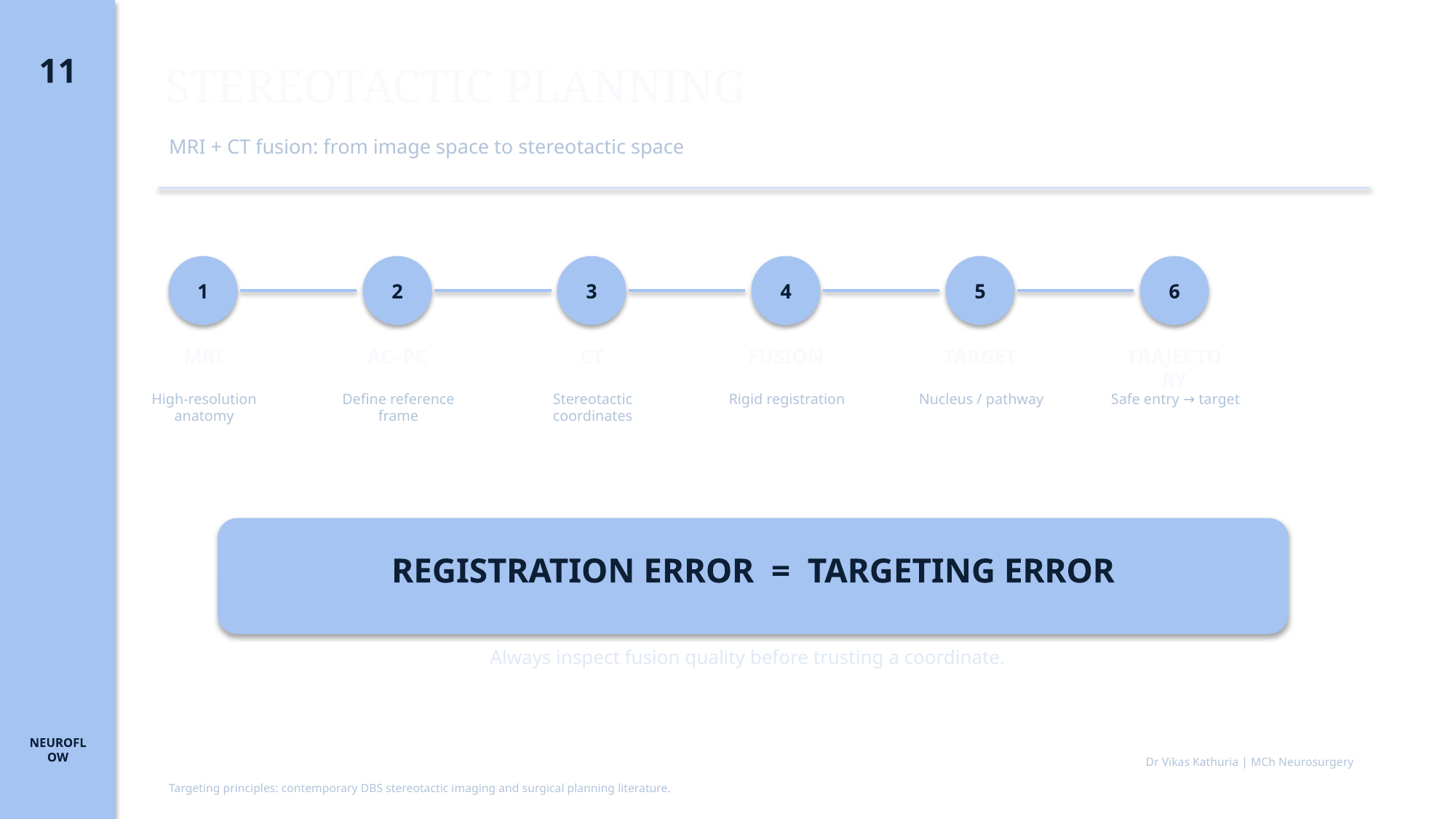
Original lecture slide 11 showing MRI and CT fusion from image space to stereotactic space

STEREOTACTIC PLANNING

  • MRI + CT fusion: from image space to stereotactic space
  • 1 MRI — High-resolution anatomy
  • 2 AC–PC — Define reference frame
  • 3 CT — Stereotactic coordinates
  • 4 FUSION — Rigid registration
  • 5 TARGET — Nucleus / pathway
  • 6 TRAJECTORY — Safe entry → target
  • REGISTRATION ERROR = TARGETING ERROR
  • Always inspect fusion quality before trusting a coordinate.
  • Targeting principles: contemporary DBS stereotactic imaging and surgical planning literature.
  • Dr Vikas Kathuria | MCh Neurosurgery
Slide 12

Slide 12

Original lecture slide

100%
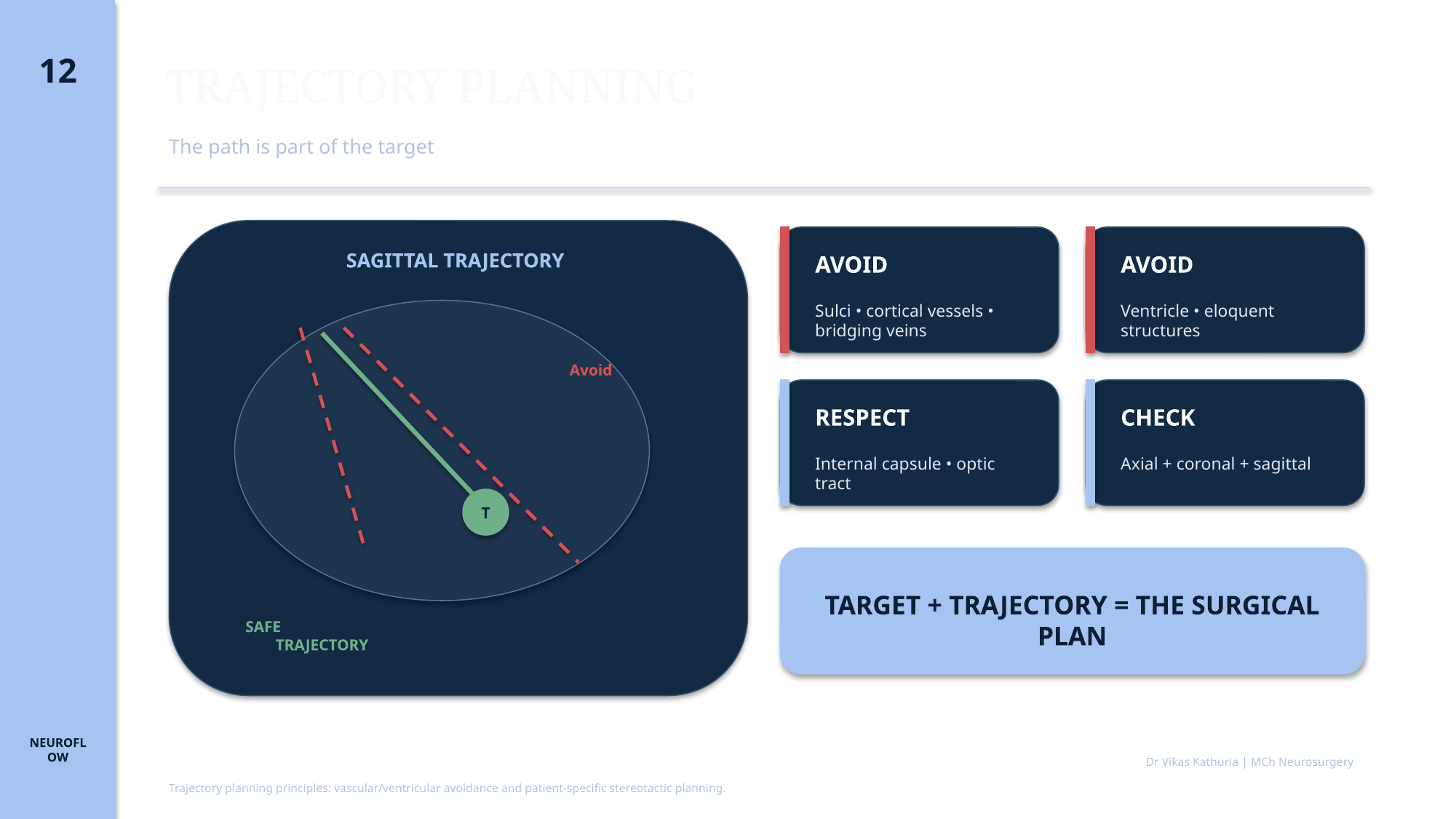
Original lecture slide 12 showing safe sagittal trajectory planning

TRAJECTORY PLANNING

  • The path is part of the target
  • SAGITTAL TRAJECTORY
  • SAFE TRAJECTORY
  • AVOID — Sulci • cortical vessels • bridging veins
  • AVOID — Ventricle • eloquent structures
  • RESPECT — Internal capsule • optic tract
  • CHECK — Axial + coronal + sagittal
  • TARGET + TRAJECTORY = THE SURGICAL PLAN
  • Trajectory planning principles: vascular/ventricular avoidance and patient-specific stereotactic planning.
  • Dr Vikas Kathuria | MCh Neurosurgery
Slide 13

Slide 13

Original lecture slide

100%
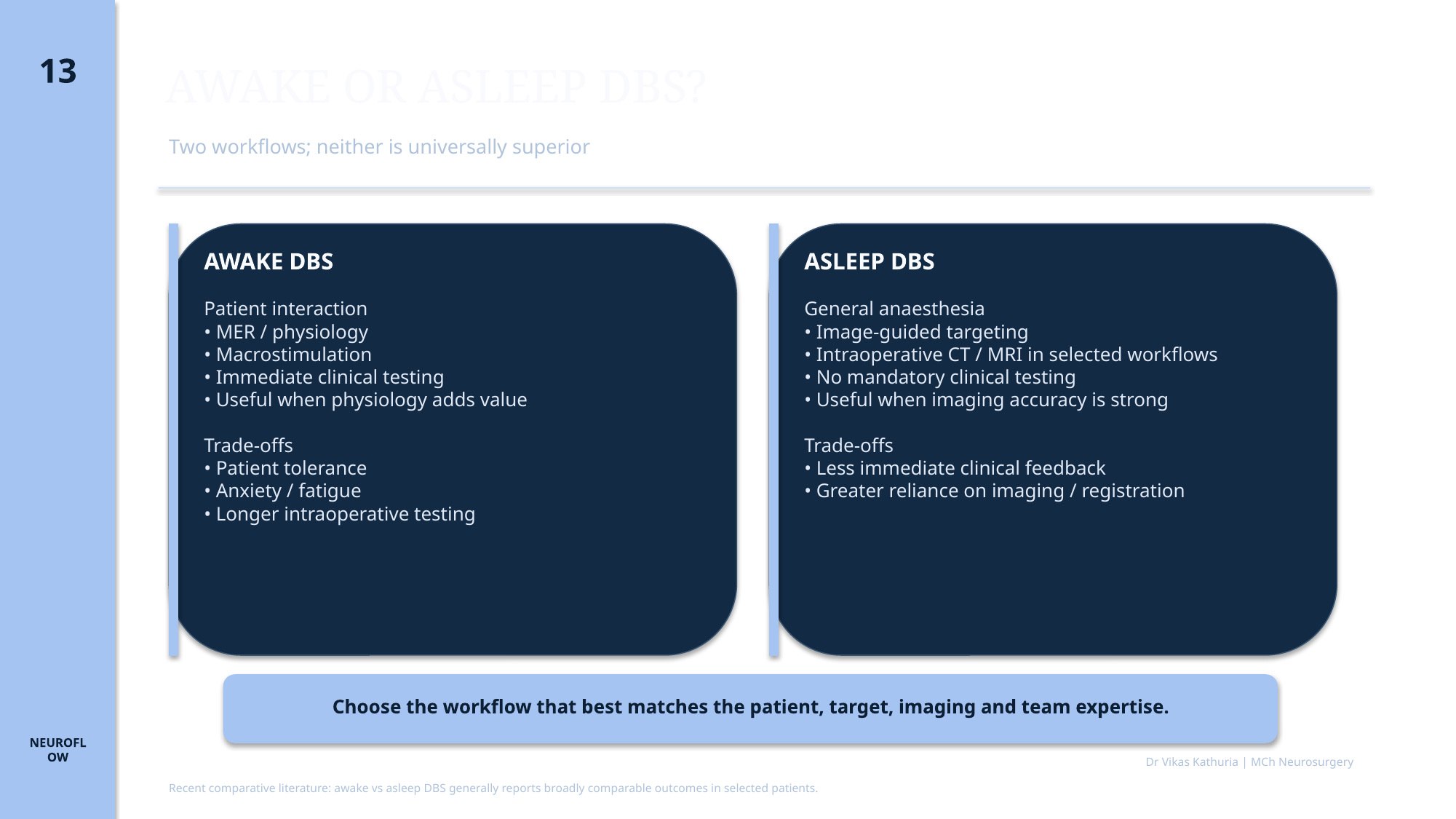
Original lecture slide 13 comparing awake and asleep DBS workflows

AWAKE OR ASLEEP DBS?

  • Two workflows; neither is universally superior
  • AWAKE DBS
  • Patient interaction
  • • MER / physiology
  • • Macrostimulation
  • • Immediate clinical testing
  • • Useful when physiology adds value
  • Trade-offs
  • • Patient tolerance
  • • Anxiety / fatigue
  • • Longer intraoperative testing
  • ASLEEP DBS
  • General anaesthesia
  • • Image-guided targeting
  • • Intraoperative CT / MRI in selected workflows
  • • No mandatory clinical testing
  • • Useful when imaging accuracy is strong
  • Trade-offs
  • • Less immediate clinical feedback
  • • Greater reliance on imaging / registration
  • Choose the workflow that best matches the patient, target, imaging and team expertise.
  • Recent comparative literature: awake vs asleep DBS generally reports broadly comparable outcomes in selected patients.
  • Dr Vikas Kathuria | MCh Neurosurgery

Slide 14

Slide 14

Original lecture slide

100%
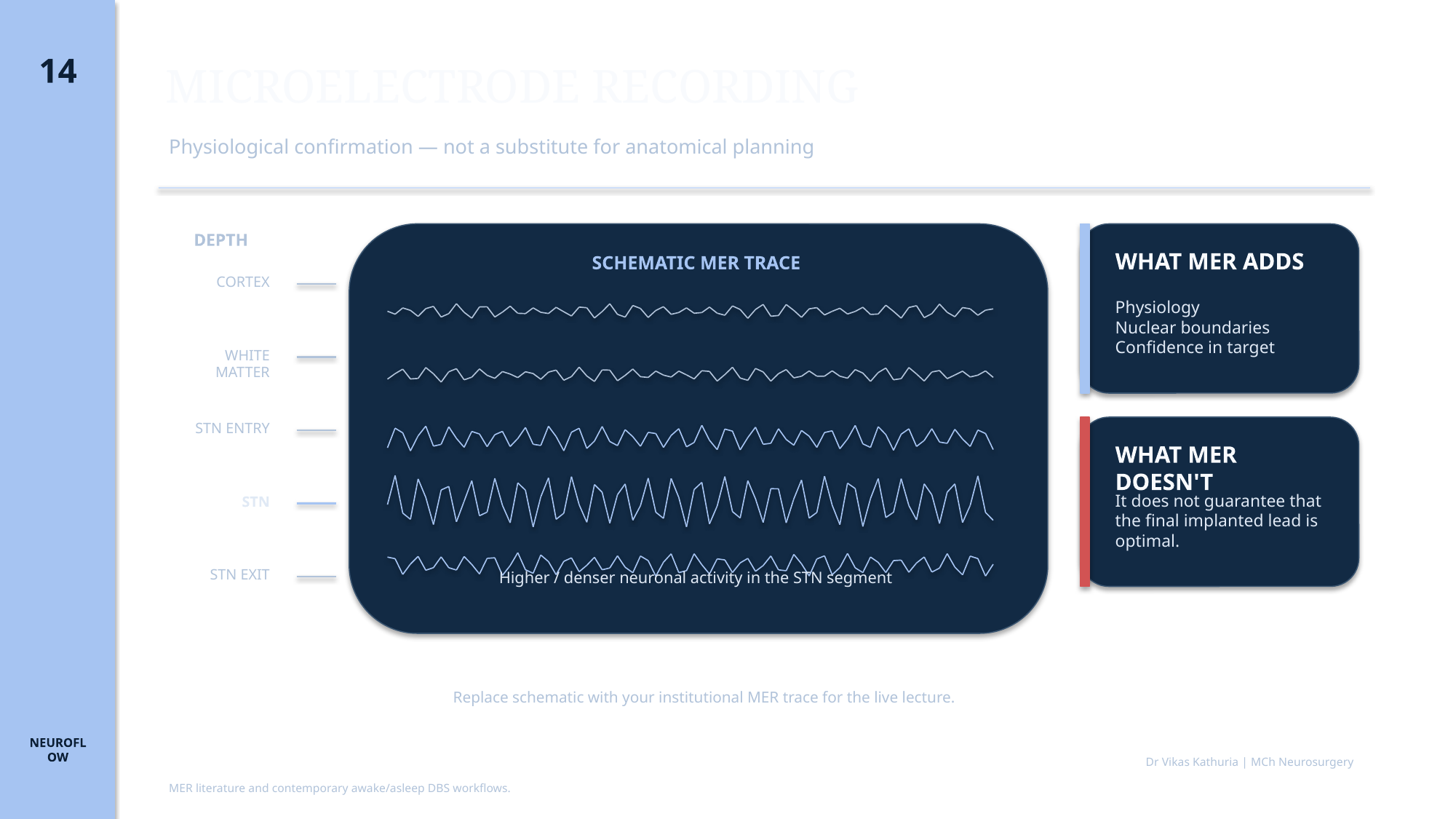
Original lecture slide 14 showing a schematic MER track through the STN

MICROELECTRODE RECORDING

  • Physiological confirmation — not a substitute for anatomical planning
  • DEPTH
  • CORTEX
  • WHITE MATTER
  • STN ENTRY
  • STN
  • STN EXIT
  • SCHEMATIC MER TRACE
  • Higher / denser neuronal activity in the STN segment
  • WHAT MER ADDS
  • Physiology
  • Nuclear boundaries
  • Confidence in target
  • WHAT MER DOESN'T
  • It does not guarantee that the final implanted lead is optimal.
  • Replace schematic with your institutional MER trace for the live lecture.
  • MER literature and contemporary awake/asleep DBS workflows.
  • Dr Vikas Kathuria | MCh Neurosurgery

Slide 15

Slide 15

Original lecture slide

100%
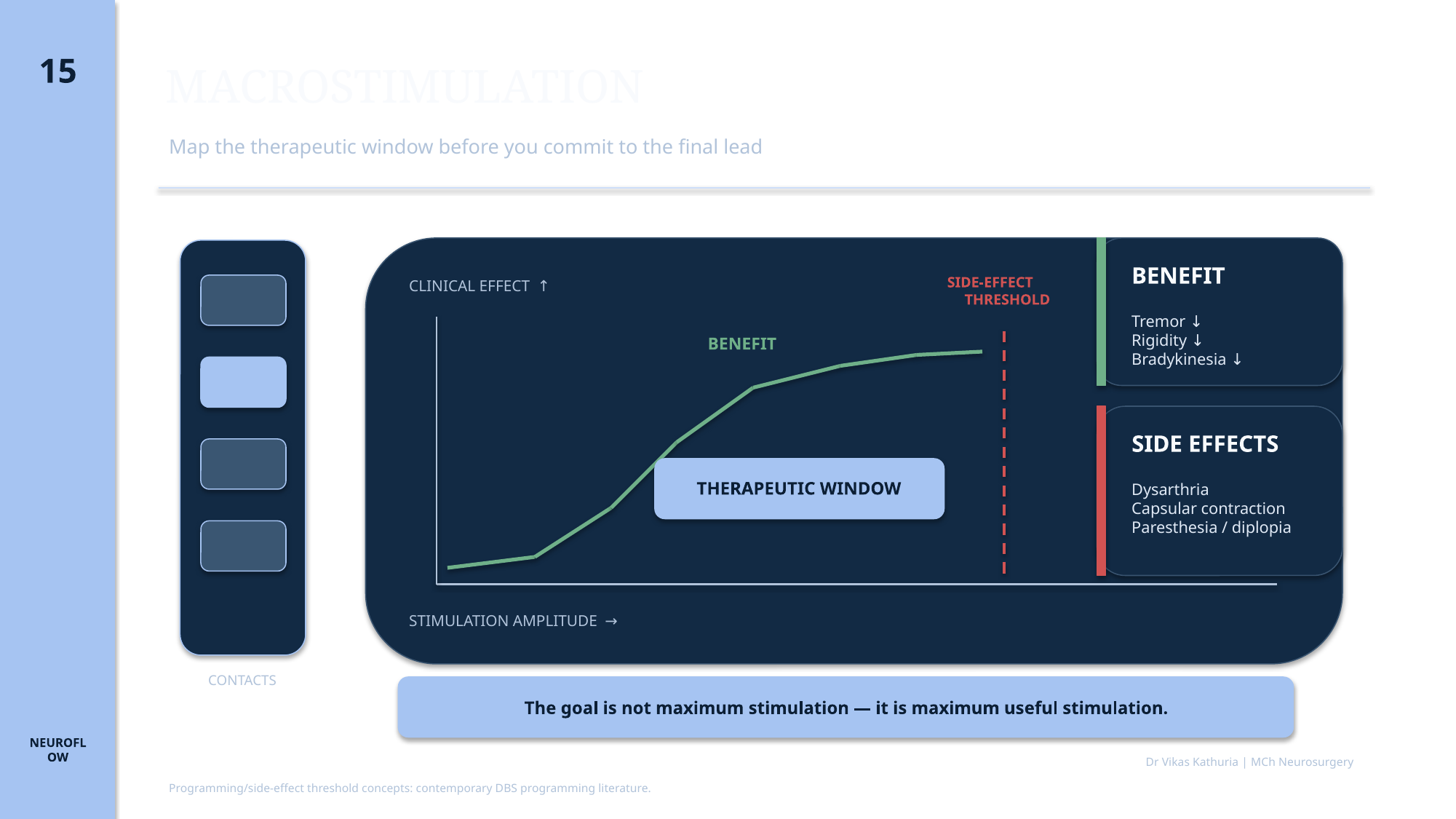
Original lecture slide 15 showing therapeutic window during macrostimulation

MACROSTIMULATION

  • Map the therapeutic window before you commit to the final lead
  • CONTACTS
  • STIMULATION AMPLITUDE →
  • CLINICAL EFFECT ↑
  • BENEFIT
  • SIDE-EFFECT THRESHOLD
  • THERAPEUTIC WINDOW
  • BENEFIT
  • Tremor ↓
  • Rigidity ↓
  • Bradykinesia ↓
  • SIDE EFFECTS
  • Dysarthria
  • Capsular contraction
  • Paresthesia / diplopia
  • The goal is not maximum stimulation — it is maximum useful stimulation.
  • Programming/side-effect threshold concepts: contemporary DBS programming literature.
  • Dr Vikas Kathuria | MCh Neurosurgery

Interactive simulation

Conceptual contact testing

Compare conceptual windows without fabricated patient data. This educational simulation is not a programming recommendation.

Educational simulation

Contact 1

Benefit threshold

Early

Side-effect threshold

Late

Conceptual window

Wide

Amplitude ↑ → benefit threshold → side-effect threshold → therapeutic window. Conceptual only; no patient values are shown.

Case-based learning

One continuous surgical decision

Commit to a surgical response before revealing the teaching decision.

Case 01

Registration before coordinates

MRI demonstrates a well-defined STN and CT is acquired correctly, but MRI–CT fusion appears slightly misregistered.

What should happen before accepting the stereotactic coordinates?

Case 02

Two routes to one target

Two trajectories reach the planned STN. Trajectory A passes near a cortical vessel and crosses the ventricle; trajectory B has a safer entry and avoids the ventricle.

Which is the better surgical plan?

Case 03

Physiology, benefit and early dysarthria

MER suggests STN activity. Macrostimulation produces benefit but also early dysarthria.

What should you conclude?

Deep study material

Expanded study material

A chain, not a single modality

ESTABLISHED

MRI alone, coordinates alone, MER alone and macrostimulation alone are each incomplete. Their value comes from disciplined integration across the surgical workflow.

Image-based reconstruction and field modelling

EMERGING

Increasingly sophisticated lead reconstruction, pathway-informed targeting and individualized stimulation-field models can add context, but remain method- and workflow-dependent.

Anatomy

Anatomy

Expanded study material for this section is written once the original slides for this module are supplied.

Surgical principles

Surgical principles

Frame application and frame-based coordinate calculation

Entry point selection and avoidance structures

Frameless and robotic alternatives

Physiology

Physiology

Expanded study material for this section is written once the original slides for this module are supplied.

Imaging

Imaging

Stereotactic MRI sequence selection

CT-MRI fusion and verification of fusion accuracy

Distortion and its effect on coordinates

Programming

Programming

Expanded study material for this section is written once the original slides for this module are supplied.

Image placeholders

Images required for this module

Each placeholder states the image type, what is required, why it teaches and where a legitimate source should come from. No clinical image is fabricated.

Image placeholder

AC-PC PLANE

Real clinical image required

Image typeAC-PC plane
DescriptionAnnotated MRI showing anterior commissure, posterior commissure and the AC-PC line with midcommissural point.
Clinical purposeDefines the reference frame on which every indirect coordinate depends.
Suggested sourceTo be supplied — publication, institution or own series
Copyright statusNot yet cleared
CaptionTo be written with the final image
AssociationModule 03

Image placeholder

PREOPERATIVE MRI

Real clinical image required

Image typeClinical MRI
DescriptionAxial and coronal MRI demonstrating the STN region with the red nucleus for reference.
Clinical purposeShows the direct-targeting appearance of the intended nucleus.
Suggested sourceTo be supplied — publication, institution or own series
Copyright statusNot yet cleared
CaptionTo be written with the final image
AssociationModule 03

Image placeholder

MRI-CT FUSION

Real clinical image required

Image typeMRI-CT fusion
DescriptionFused stereotactic CT and planning MRI with fiducials and fusion check points visible.
Clinical purposeIllustrates how frame space and anatomical space are brought into register.
Suggested sourceTo be supplied — publication, institution or own series
Copyright statusNot yet cleared
CaptionTo be written with the final image
AssociationModule 03

Image placeholder

MER TRACE

Real clinical image required

Image typeMER trace
DescriptionRepresentative microelectrode recording showing the transition into subthalamic nucleus physiology.
Clinical purposeLinks electrophysiological signature to anatomical depth along the trajectory.
Suggested sourceTo be supplied — publication, institution or own series
Copyright statusNot yet cleared
CaptionTo be written with the final image
AssociationModule 03

Image placeholder

STEREOTACTIC FRAME

Real clinical image required

Image typeStereotactic frame
DescriptionOperative photograph of a stereotactic frame mounted and set to target coordinates.
Clinical purposeGrounds the coordinate discussion in the physical apparatus.
Suggested sourceTo be supplied — publication, institution or own series
Copyright statusNot yet cleared
CaptionTo be written with the final image
AssociationModule 03

THE DBS TARGETING CHAIN

01

IMAGE SPACE

02

STEREOTACTIC SPACE

03

TARGET

04

TRAJECTORY

05

ANAESTHETIC WORKFLOW

06

PHYSIOLOGICAL CONFIRMATION

07

MACROSTIMULATION

08

FINAL LEAD

  1. LEAD
  2. ELECTRICAL FIELD
  3. FUNCTIONAL ANATOMY
  4. THERAPEUTIC EFFECT

DBS TARGETING IS A CHAIN OF INFORMATION.

Clinical pearls

  • Registration quality is part of targeting accuracy.
  • The path is part of the target.
  • Never approve a trajectory from one plane.
  • Awake versus asleep is a workflow decision, not a dogma.
  • MER confirms physiology; it does not guarantee final lead optimality.
  • The goal of macrostimulation is not maximum amplitude.
  • Optimize the therapeutic window rather than simply maximizing stimulation.

Take-home message

MRI alone is not enough.Coordinates alone are not enough.MER alone is not enough.Macrostimulation alone is not enough.

  1. ANATOMY
  2. REFERENCE
  3. REGISTRATION
  4. TRAJECTORY
  5. PHYSIOLOGY WHEN APPROPRIATE
  6. CLINICAL TESTING WHEN AVAILABLE
  7. FINAL LEAD

References

Evidence supporting this module

  1. Geevarghese R, O'Gorman Tuura R, Lumsden DE, et al. Registration accuracy of CT/MRI fusion for localisation of deep brain stimulation electrode position: an imaging study and systematic review. Stereotact Funct Neurosurg. 2016;94(3):159-163.
  2. Wang X, Li N, Li J, et al. Optimized deep brain stimulation surgery to avoid vascular damage: a single-center retrospective analysis of path planning for various deep targets by MRI image fusion. Brain Sci. 2022;12(8):967.
  3. Bériault S, Al Subaie F, Collins DL, Sadikot AF, Pike GB. A multi-modal approach to computer-assisted deep brain stimulation trajectory planning. Int J Comput Assist Radiol Surg. 2012;7(5):687-704.
  4. Wang X, Tian L. Asleep versus awake deep brain stimulation in the treatment of Parkinson disease: a systematic review and meta-analysis. J Neurol. 2025;272(8):525.
  5. Li L, Rae AI, Burchiel KJ. A meta-analysis of medication reduction and motor outcomes after awake versus asleep deep brain stimulation for Parkinson disease. Neurosurgery. 2025;96(3):481-493.
  6. Hines K, Sharan I, Schaefer J, et al. Microelectrode recording during deep brain stimulation does not consistently represent lead trajectory. Oper Neurosurg (Hagerstown). 2025;28(1):38-42.
  7. Blume J, Schlaier J, Rothenfußer E, et al. Intraoperative clinical testing overestimates the therapeutic window of the permanent DBS electrode in the subthalamic nucleus. Acta Neurochir (Wien). 2017;159(9):1721-1726.

“DBS targeting is a chain of information. The strongest workflow integrates anatomy, stereotactic reference, registration, trajectory, physiology when appropriate, clinical testing when available and final lead position.”

Next module · 04Lead Implantation → Verification → Stimulation Field