Module 01

DBS Foundations

From Stereotactic Coordinates to Precision Neuromodulation

Original lecture slides 1–5 · Module 01 / 10

“Before learning how to implant a DBS lead, understand what DBS is actually trying to modulate.”

Module pathway

  1. 01PATIENT
  2. 02PHENOTYPE
  3. 03PATHOLOGICAL CIRCUIT
  4. 04THERAPEUTIC TARGET
  5. 05STIMULATION FIELD
  6. 06CLINICAL EFFECT

Learning objectives

By the end of this module you should be able to

  1. 01Define deep brain stimulation as a form of therapeutic neuromodulation
  2. 02Explain why DBS should not be conceptualized simply as electrical inhibition
  3. 03Understand the complete DBS treatment journey
  4. 04Identify the essential characteristics of an appropriate DBS candidate
  5. 05Understand why phenotype and therapeutic objective should drive target selection
  6. 06Distinguish the major DBS targets introduced in this lecture: STN, GPi and VIM
  7. 07Understand the concept of a therapeutic territory rather than a single stereotactic coordinate

Original lecture slides

Slides 1–5

The slides below are reproduced exactly as delivered. Everything outside the slide panel is added study material.

Slide 1

Slide 1

Original lecture slide

100%
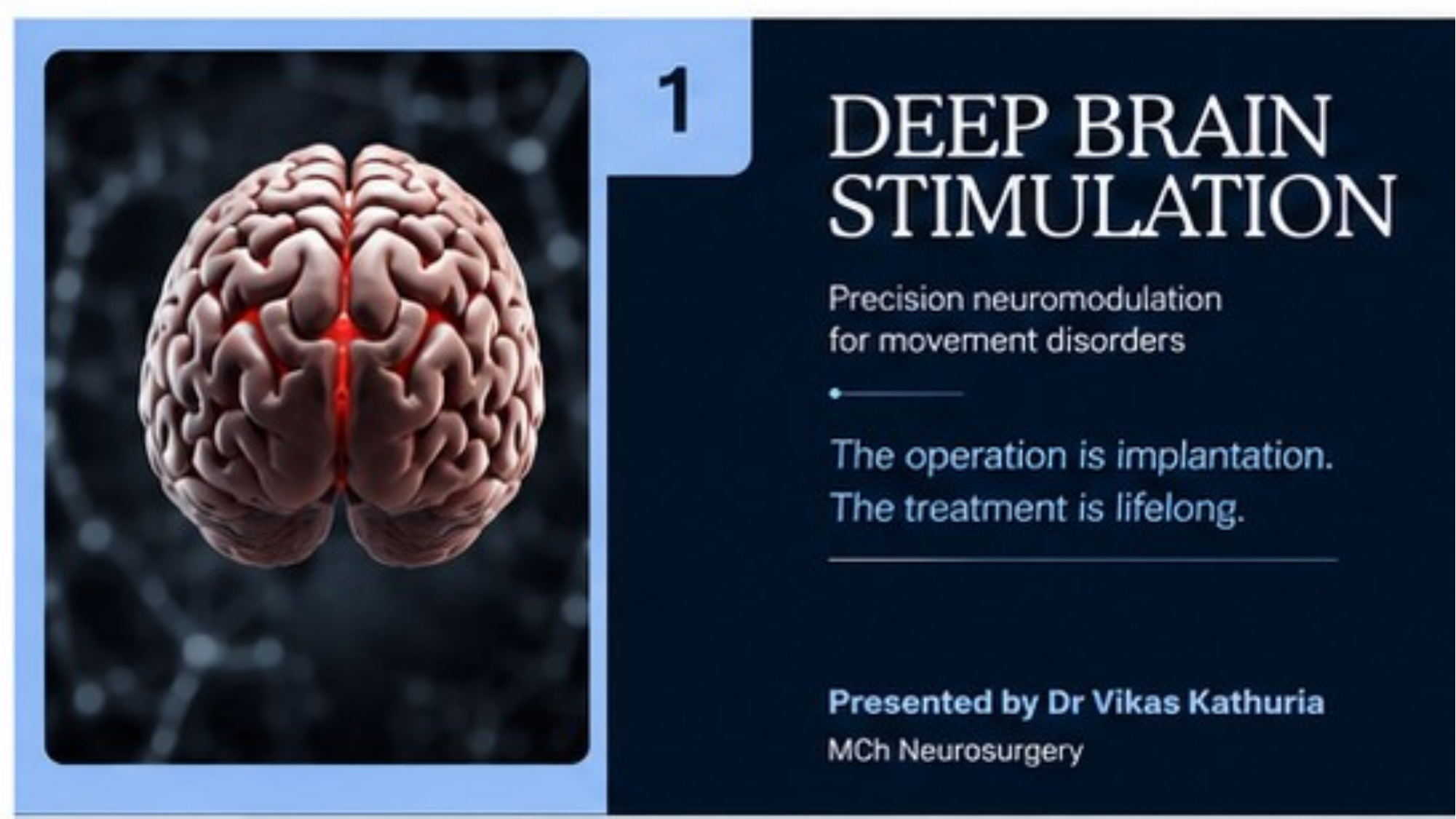
Original lecture slide 1 introducing Deep Brain Stimulation

DEEP BRAIN STIMULATION

  • Precision neuromodulation for movement disorders
  • The operation is implantation.
  • The treatment is lifelong.
  • Presented by Dr Vikas Kathuria
  • MCh Neurosurgery

Why this slide matters

This slide establishes the central thesis of the entire lecture. DBS is introduced not as an isolated neurosurgical procedure but as a longitudinal therapeutic system: the neurosurgeon performs the implantation, while the therapeutic outcome depends on patient selection, target selection, stereotactic planning, lead placement, programming, medication adjustment and long-term follow-up.

Core concepts

The operation is implantation. The treatment is longitudinal.

ESTABLISHED

The most important conceptual distinction of this module. Technical success in theatre is a prerequisite for, not equivalent to, therapeutic success.

Outcome is the sum of the whole pathway

  • Patient selection
  • Target selection
  • Stereotactic planning
  • Lead placement
  • Programming
  • Medication adjustment
  • Long-term follow-up

Surgical / clinical pearl

  • “Successful DBS is not defined by a successful lead implantation alone.” The true endpoint is sustained, clinically meaningful benefit with acceptable adverse effects over time.

Image placeholder

DBS SYSTEM OVERVIEW

Real clinical image required

Image typeSchematic / diagram
DescriptionHigh-quality clinical/anatomical illustration showing brain, DBS lead, extension and implantable pulse generator.
Clinical purposeIntroduce the complete implanted system before any surgical detail.
Suggested sourceClean medical illustration, or a properly sourced clinical photograph from a publication or institutional archive.
Copyright statusTo be confirmed before publication.
CaptionTo be written with the final image
AssociationModule 01 · Slide 01

Image placeholder

DBS PATIENT JOURNEY

Real clinical image required

Image typeSchematic / diagram
DescriptionHorizontal diagram: Selection → Planning → Surgery → Programming → Follow-up.
Clinical purposeFix the longitudinal structure of DBS care in the learner's mind at the outset.
Suggested sourceConceptual diagram — clearly conceptual, not a clinical image.
Copyright statusNot yet cleared
CaptionTo be written with the final image
AssociationModule 01 · Slide 01

Audience question

WHAT WOULD YOU SAY?ESTABLISHED

Is DBS a surgical procedure, a neurological treatment, or a chronic disease-management platform?

Deep dive

An adjustable interface, not a fixed lesion

ESTABLISHED

DBS is fundamentally different from a conventional lesioning procedure. A lesion is created once; DBS provides an adjustable interface with neural circuitry, and the stimulation parameters can be changed after implantation.

The therapeutic field can evolve with

  • Disease progression
  • Clinical response
  • Side effects
  • Medication changes
  • Hardware changes
  • New programming strategies

Diagram

The DBS treatment journey

  1. 01PATIENT
  2. 02SELECTION
  3. 03TARGET
  4. 04TRAJECTORY
  5. 05LEAD
  6. 06PROGRAMMING
  7. 07FOLLOW-UP
  8. 08OUTCOME

DBS is a treatment journey — not a single operation.

Speaker notes — 2 teaching points (hidden by default)
  • Open with the closing statement of the slide: the operation is implantation, the treatment is lifelong.
  • Ask the audience question before revealing the answer.

References

  1. Benabid AL, Pollak P, Gervason C, et al. Long-term suppression of tremor by chronic stimulation of the ventral intermediate thalamic nucleus. Lancet. 1991;337(8738):403-406.
  2. Limousin P, Krack P, Pollak P, et al. Electrical stimulation of the subthalamic nucleus in advanced Parkinson's disease. N Engl J Med. 1998;339(16):1105-1111.
  3. Okun MS. Deep-brain stimulation for Parkinson's disease. N Engl J Med. 2012;367(16):1529-1538.
  4. Bronstein JM, Tagliati M, Alterman RL, et al. Deep brain stimulation for Parkinson disease: an expert consensus and review of key issues. Arch Neurol. 2011;68(2):165-171.
Slide 2

Slide 2

Original lecture slide

100%
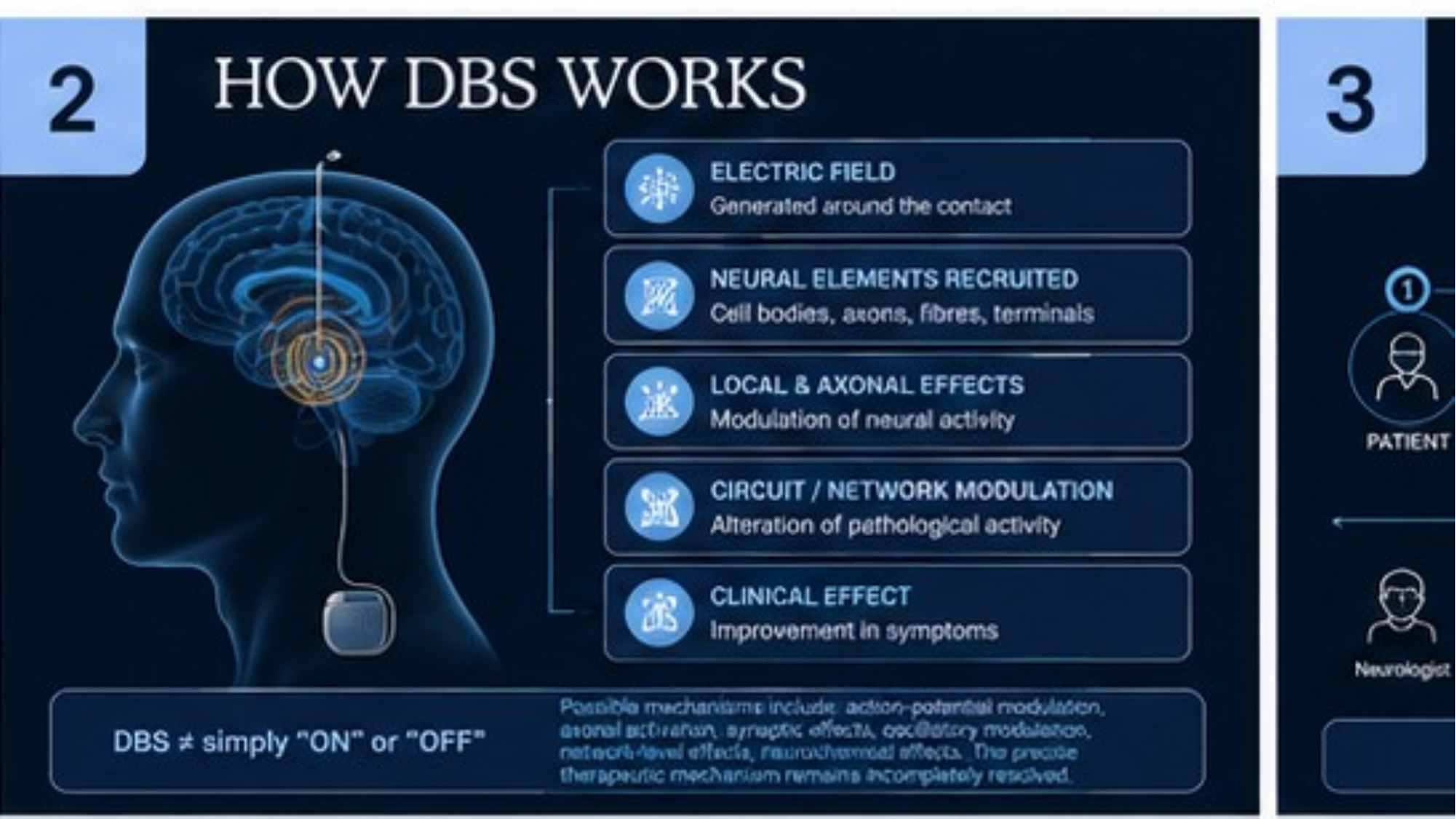
Original lecture slide 2 explaining how DBS works

HOW DBS WORKS

  • ELECTRIC FIELD — Generated around the contact
  • NEURAL ELEMENTS RECRUITED — Cell bodies, axons, fibres, terminals
  • LOCAL & AXONAL EFFECTS — Modulation of neural activity
  • CIRCUIT / NETWORK MODULATION — Alteration of pathological activity
  • CLINICAL EFFECT — Improvement in symptoms
  • DBS ≠ simply “ON” or “OFF”
  • Possible mechanisms include: action-potential modulation, axonal activation, synaptic effects, oscillatory modulation, network-level effects, neurochemical effects. The precise therapeutic mechanism remains incompletely resolved.

Why this slide matters

The central teaching question of this slide is: what does DBS actually do to the brain? Teaching “high-frequency stimulation = inhibition” is an oversimplification that misleads later reasoning about lead location, programming and side effects.

Core concepts

Beyond the simple model

SUPPORTED

Modern DBS physiology is better conceptualized as modulation of neural activity involving axons, cell bodies, dendrites, local circuits, passing fibres and network connections.

The clinical effect depends on

ESTABLISHED
  • Electrode position
  • Contact configuration
  • Amplitude
  • Pulse width
  • Frequency
  • Orientation of fibres
  • Distance from relevant structures
  • Individual anatomy

The lead does not simply “switch off” a nucleus

SUPPORTED
  • Modulate pathological activity
  • Alter firing patterns
  • Influence axonal conduction
  • Engage connected pathways
  • Change network activity
  • Produce clinically useful effects

Surgical / clinical pearl

  • “DBS is better understood as patterned neuromodulation of neural circuits than as simple electrical inhibition of a nucleus.”

Image placeholder

ELECTRIC FIELD

Real clinical image required

Image typeSchematic / diagram
DescriptionDBS lead with an expanding stimulation field, overlaid with the sequence CONTACT → ELECTRIC FIELD → NEURAL ELEMENTS → NETWORK → CLINICAL EFFECT.
Clinical purposeShow that the contact is the source, not the boundary, of the therapeutic effect.
Suggested sourceConceptual diagram, or a modelling figure from a peer-reviewed publication.
Copyright statusNot yet cleared
CaptionTo be written with the final image
AssociationModule 01 · Slide 02

Image placeholder

BASAL GANGLIA NETWORK

Real clinical image required

Image typeSchematic / diagram
DescriptionProperly sourced anatomical/network diagram showing cortex, striatum, GPe, GPi, STN, SNr and thalamus, clearly distinguishing motor circuitry from the entire basal-ganglia system.
Clinical purposeProvide the circuit substrate for every later discussion of target choice and stimulation effect.
Suggested sourceAtlas or peer-reviewed publication figure; licence to be confirmed.
Copyright statusTo be confirmed before publication.
CaptionTo be written with the final image
AssociationModule 01 · Slide 02

Audience question

WHY?SUPPORTED

If the DBS lead is physically located in the STN, why can stimulation produce effects mediated by structures outside the STN?

Deep dive

Advanced neurosurgical concept

SUPPORTED

The structures activated by DBS may not be identical to the anatomical structure containing the electrode contact. Lead location must therefore be interpreted together with the electric field and network connectivity.

Diagram

From field to clinical effect

  1. 01ELECTRICAL FIELD
  2. 02NEURAL ELEMENTS
  3. 03LOCAL CIRCUIT
  4. 04NETWORK MODULATION
  5. 05CLINICAL EFFECT

This sequence is deliberately not labelled “stimulation = inhibition”.

References

  1. McIntyre CC, Savasta M, Kerkerian-Le Goff L, Vitek JL. Uncovering the mechanism(s) of action of deep brain stimulation: activation, inhibition, or both. Clin Neurophysiol. 2004;115(6):1239-1248.
  2. Herrington TM, Cheng JJ, Eskandar EN. Mechanisms of deep brain stimulation. J Neurophysiol. 2016;115(1):19-38.
  3. Chiken S, Nambu A. Mechanism of deep brain stimulation: inhibition, excitation, or disruption? Neuroscientist. 2016;22(3):313-322.

Slide 3

Slide 3

Original lecture slide

100%
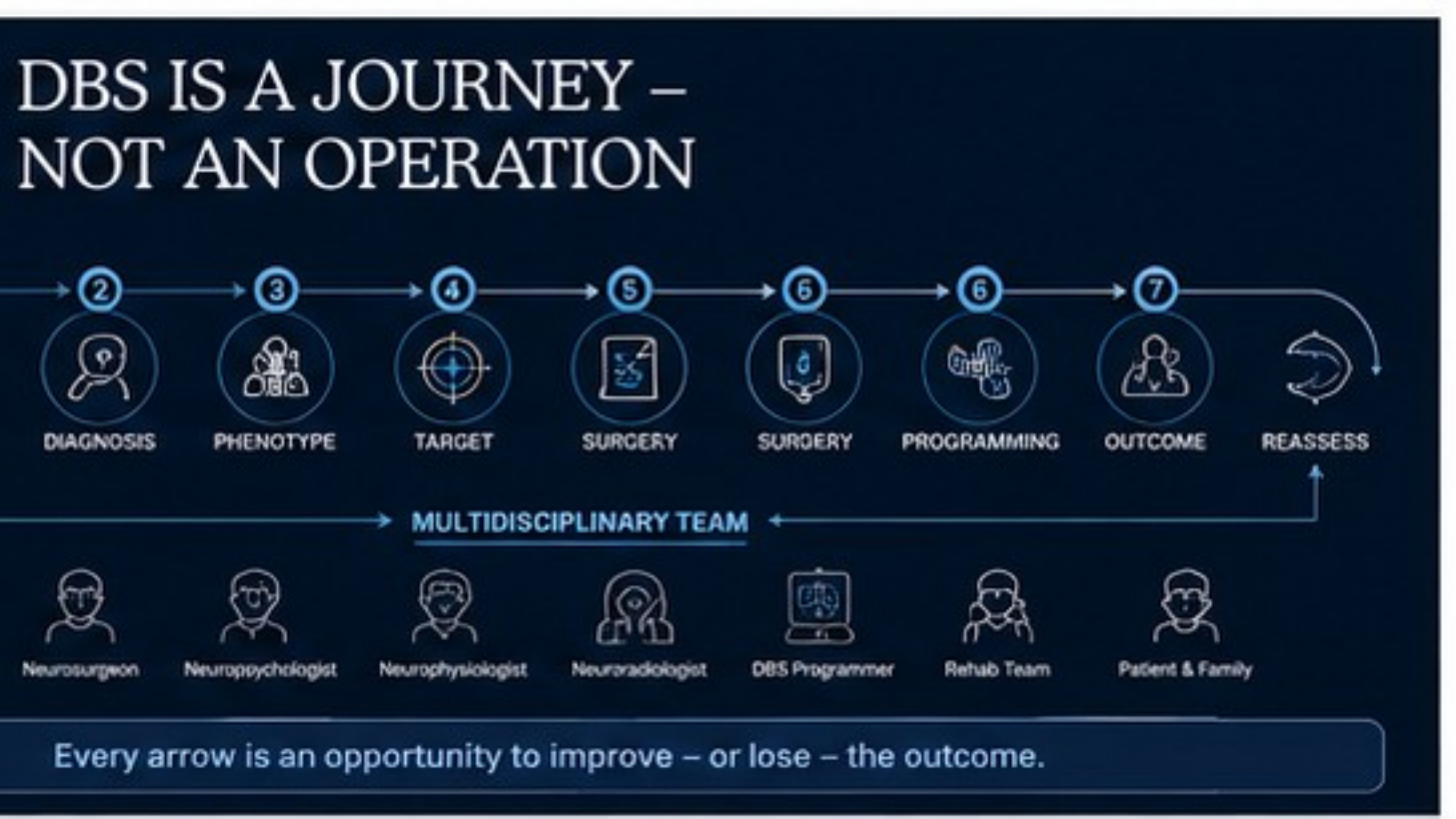
Original lecture slide 3 showing DBS as a multidisciplinary journey

DBS IS A JOURNEY – NOT AN OPERATION

  • DIAGNOSIS → PHENOTYPE → TARGET → SURGERY → SURGERY → PROGRAMMING → OUTCOME → REASSESS
  • MULTIDISCIPLINARY TEAM
  • Neurosurgeon
  • Neuropsychologist
  • Neurophysiologist
  • Neuroradiologist
  • DBS Programmer
  • Rehab Team
  • Patient & Family
  • Every arrow is an opportunity to improve – or lose – the outcome.

Why this slide matters

This is one of the key framework slides of the entire platform: the whole curriculum is organised along this pathway, and every subsequent module expands one of its steps.

Core concepts

Step 01 — Patient

Who is the patient?

  • Age
  • Comorbidity
  • Functional disability
  • Expectations
  • Support system
  • Ability to participate in long-term follow-up

Step 02 — Diagnosis

Is the diagnosis correct? Examples: Parkinson disease, essential tremor, dystonia. Do not assume that every tremor, parkinsonian syndrome or dystonia is DBS-responsive.

Step 03 — Phenotype

What is actually disabling the patient?

  • Tremor
  • Rigidity
  • Bradykinesia
  • Motor fluctuations
  • Dyskinesia
  • Dystonia

Step 04 — Indication

Does the expected therapeutic benefit justify DBS?

  • Severity
  • Medication response
  • Medication-refractory symptoms
  • Quality of life
  • Functional impairment
  • Patient goals

Step 05 — Target

Select the target according to phenotype + therapeutic objective + anatomy.

Step 06 — Trajectory

Plan the safest trajectory that reaches the intended therapeutic territory while avoiding critical structures.

Step 07 — Physiology

Where appropriate, MER + intraoperative stimulation + clinical response can provide physiological information.

Step 08 — Lead

The final implanted lead must be assessed relative to the intended target, neighbouring anatomy and the therapeutic field.

Step 09 — Programming

Programming converts hardware into therapy.

  • Contact
  • Configuration
  • Amplitude
  • Pulse width
  • Frequency

Step 10 — Follow-up

DBS requires continuing clinical assessment, programming, medication adjustment and hardware surveillance.

Step 11 — Outcome

Outcome should be measured by meaningful patient benefit rather than technical success alone.

Surgical / clinical pearl

  • “Every arrow is a decision.” A DBS program can fail even when the operation itself is technically uncomplicated.

Audience question

WHERE CAN IT FAIL?ESTABLISHED

Where in this pathway can a DBS program fail despite a technically perfect operation?

Diagram

Master pathway — every arrow is a decision

  1. 01PATIENTPotential failure point
  2. 02DIAGNOSISPotential failure point
  3. 03PHENOTYPEPotential failure point
  4. 04INDICATIONPotential failure point
  5. 05TARGETPotential failure point
  6. 06TRAJECTORYPotential failure point
  7. 07PHYSIOLOGYPotential failure point
  8. 08LEADPotential failure point
  9. 09PROGRAMMINGPotential failure point
  10. 10FOLLOW-UPPotential failure point
  11. 11OUTCOME
Speaker notes — 1 teaching points (hidden by default)
  • Take audience responses across the pathway before revealing the answer.

References

  1. Okun MS. Deep-brain stimulation for Parkinson's disease. N Engl J Med. 2012;367(16):1529-1538.
  2. Bronstein JM, Tagliati M, Alterman RL, et al. Deep brain stimulation for Parkinson disease: an expert consensus and review of key issues. Arch Neurol. 2011;68(2):165-171.
  3. Lang AE, Houeto JL, Krack P, et al. Deep brain stimulation: preoperative issues. Mov Disord. 2006;21(Suppl 14):S171-S196.

Slide 4

Slide 4

Original lecture slide

100%
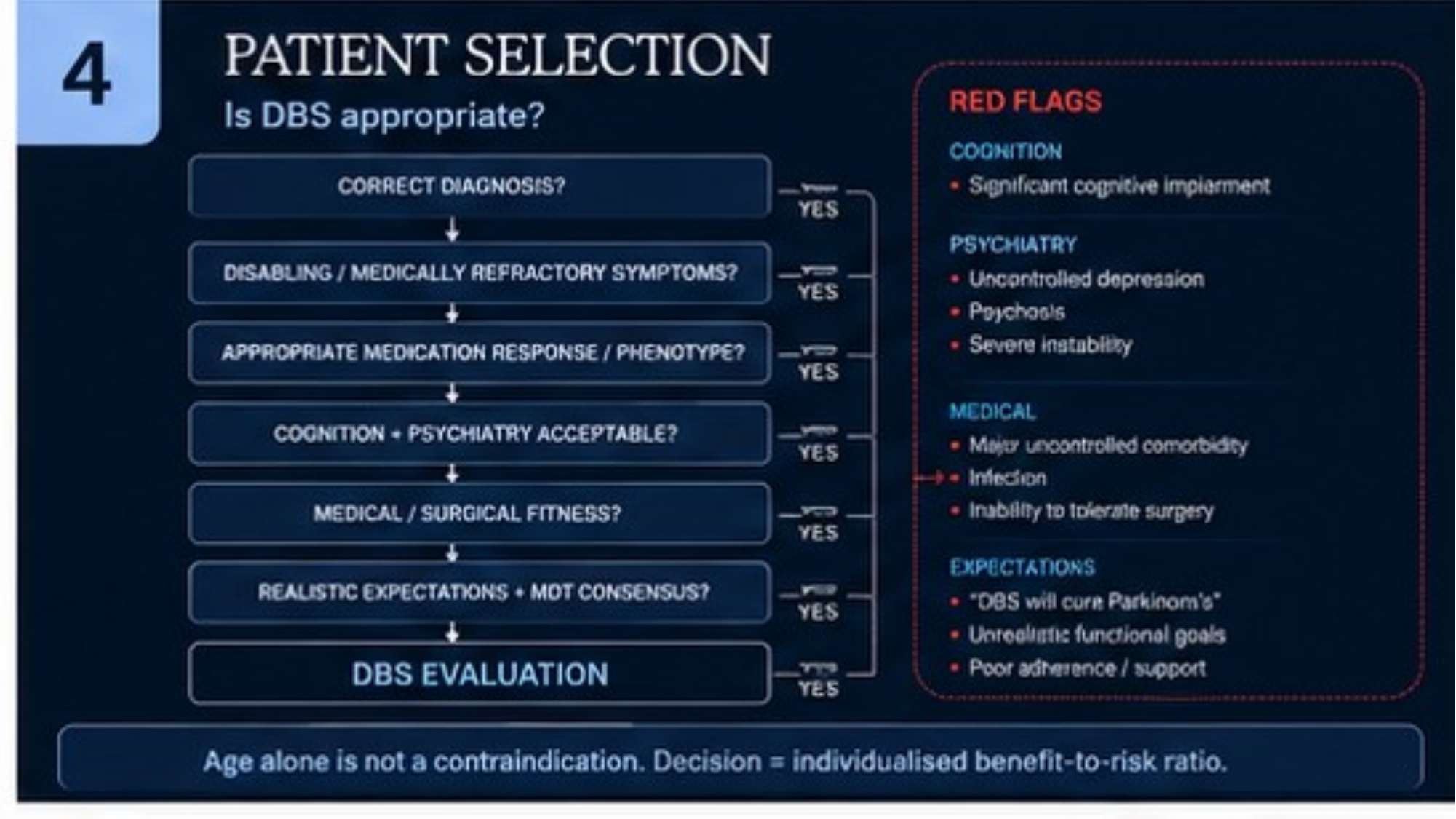
Original lecture slide 4 showing the DBS patient-selection pathway and red flags

PATIENT SELECTION

  • Is DBS appropriate?
  • CORRECT DIAGNOSIS? YES
  • DISABLING / MEDICALLY REFRACTORY SYMPTOMS? YES
  • APPROPRIATE MEDICATION RESPONSE / PHENOTYPE? YES
  • COGNITION + PSYCHIATRY ACCEPTABLE? YES
  • MEDICAL / SURGICAL FITNESS? YES
  • REALISTIC EXPECTATIONS + MDT CONSENSUS? YES
  • DBS EVALUATION YES
  • RED FLAGS
  • COGNITION — Significant cognitive impairment
  • PSYCHIATRY — Uncontrolled depression; Psychosis; Severe instability
  • MEDICAL — Major uncontrolled comorbidity; Infection; Inability to tolerate surgery
  • EXPECTATIONS — “DBS will cure Parkinson's”; Unrealistic functional goals; Poor adherence / support
  • Age alone is not a contraindication. Decision = individualised benefit-to-risk ratio.

Why this slide matters

Patient selection is taught here as the first and perhaps most important surgical decision: no degree of stereotactic accuracy rescues an inappropriate candidate.

Core concepts

Concept 01 — Correct diagnosis

ESTABLISHED

Before discussing surgery, confirm the diagnosis and confirm that the symptoms are likely to respond to the chosen intervention. The surgeon should be suspicious of:

  • Atypical parkinsonism
  • Poor levodopa responsiveness
  • Non-physiological symptom patterns
  • Uncertain tremor diagnosis
  • Uncertain dystonia phenotype

Concept 02 — DBS-responsive disability

ESTABLISHED

The question is not “does the patient have Parkinson disease?” but “does the patient's disabling phenotype have a reasonable probability of meaningful improvement with DBS?”

Concept 03 — Medical optimization

ESTABLISHED

DBS should generally be considered after appropriate medical treatment has been assessed. For Parkinson disease, document:

  • Levodopa responsiveness
  • Motor fluctuations
  • OFF periods
  • Dyskinesia
  • Medication burden
  • Functional disability

Concept 04 — Cognition and psychiatry

ESTABLISHED
  • Cognitive function
  • Mood
  • Depression
  • Anxiety
  • Impulse-control issues
  • Psychosis where relevant
  • Patient expectations
  • Caregiver / support environment

Concept 05 — Expectations

ESTABLISHED

The patient must understand what DBS is expected to improve and what it is unlikely to improve. Avoid unrealistic expectations such as “DBS will cure Parkinson disease.” DBS provides symptomatic neuromodulation; disease progression continues.

Surgical / clinical pearl

  • “Patient selection is the first operation.”

Image placeholder

MULTIDISCIPLINARY DBS CLINIC

Real clinical image required

Image typeCase image
DescriptionProfessional clinical photograph or conceptual illustration of a multidisciplinary DBS team evaluation.
Clinical purposeReinforce that candidacy is a team decision, not a single clinician's judgement.
Suggested sourceInstitutional photograph with consent, or a specialist-team image from a publication. Avoid generic hospital stock photography where a more relevant specialist-team image is available.
Copyright statusTo be confirmed before publication.
CaptionTo be written with the final image
AssociationModule 01 · Slide 04

Audience question

WHAT WOULD YOU DO?ESTABLISHED

A patient has Parkinsonism but poor levodopa response. Would you proceed to DBS simply because the patient is severely disabled?

Multidisciplinary evaluation

Movement disorder neurologist
Neurosurgeon
Neuropsychologist
Psychiatrist
Neurophysiologist
Rehabilitation team
DBS programming team
Patient + caregiver

Patient selection checklist

Teaching checklist — ticks are local to this session and are not stored.

References

  1. Defer GL, Widner H, Marié RM, Rémy P, Levivier M. Core Assessment Program for Surgical Interventional Therapies in Parkinson's Disease (CAPSIT-PD). Mov Disord. 1999;14(4):572-584.
  2. Lang AE, Houeto JL, Krack P, et al. Deep brain stimulation: preoperative issues. Mov Disord. 2006;21(Suppl 14):S171-S196.
  3. Bronstein JM, Tagliati M, Alterman RL, et al. Deep brain stimulation for Parkinson disease: an expert consensus and review of key issues. Arch Neurol. 2011;68(2):165-171.
  4. Okun MS. Deep-brain stimulation for Parkinson's disease. N Engl J Med. 2012;367(16):1529-1538.

Slide 5

Slide 5

Original lecture slide

100%
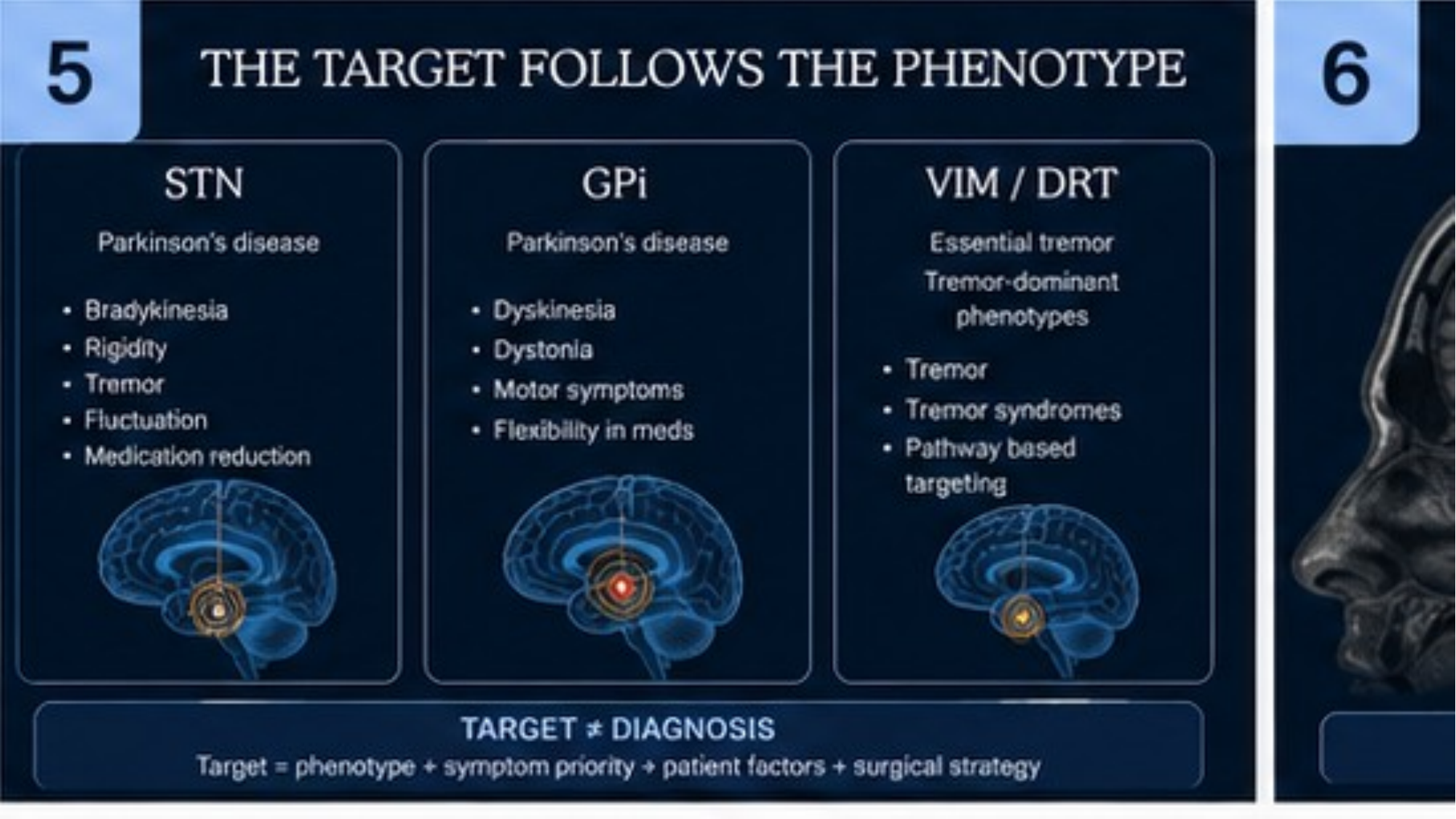
Original lecture slide 5 comparing STN, GPi and VIM/DRT targets

THE TARGET FOLLOWS THE PHENOTYPE

  • STN
  • Parkinson's disease
  • Bradykinesia
  • Rigidity
  • Tremor
  • Fluctuation
  • Medication reduction
  • GPi
  • Parkinson's disease
  • Dyskinesia
  • Dystonia
  • Motor symptoms
  • Flexibility in meds
  • VIM / DRT
  • Essential tremor
  • Tremor-dominant phenotypes
  • Tremor
  • Tremor syndromes
  • Pathway based targeting
  • TARGET ≠ DIAGNOSIS
  • Target = phenotype + symptom priority + patient factors + surgical strategy

Why this slide matters

This is the bridge from clinical neurology to functional neurosurgery. The key principle: do not choose the target first. First define what symptom is being treated, then which therapeutic circuit or territory should be modulated.

Core concepts

STN

ESTABLISHED

Common DBS target in Parkinson disease. Potential therapeutic goals include:

  • Motor symptom improvement
  • Motor fluctuation reduction
  • Reduction in dopaminergic medication requirement in appropriate patients

GPi

ESTABLISHED

Important target in Parkinson disease, dyskinesia and dystonia. Target selection should depend on phenotype and therapeutic objective rather than assuming GPi or STN is universally superior.

VIM

ESTABLISHED

Classical tremor target, particularly relevant to essential tremor and tremor-dominant syndromes. The modern discussion also introduces PSA/DRTT pathway targeting later in the course.

Surgical / clinical pearl

  • “The target is not a coordinate. The target is a therapeutic territory within a circuit.”

Image placeholder

THREE-TARGET ANATOMICAL INFOGRAPHIC

Real clinical image required

Image typeSchematic / diagram
DescriptionSimplified brain cross-section showing STN, GPi and VIM with subtle pale-blue target highlights; neighbouring structures labelled only where anatomically accurate.
Clinical purposeGive the three targets an anatomical location before stereotactic planning is introduced.
Suggested sourceConceptual anatomical diagram in the NEUROFLOW palette — clearly conceptual.
Copyright statusNot yet cleared
CaptionTo be written with the final image
AssociationModule 01 · Slide 05

Image placeholder

CORONAL BASAL GANGLIA ANATOMY

Real clinical image required

Image typeClinical MRI
DescriptionHigh-resolution anatomical MRI or atlas section showing STN, GPi, thalamus, internal capsule and substantia nigra.
Clinical purposeAnchor target discussion in real sectional anatomy rather than schematic approximation.
Suggested sourceProperly licensed stereotactic atlas or peer-reviewed publication.
Copyright statusTo be confirmed before publication.
CaptionTo be written with the final image
AssociationModule 01 · Slide 05

Image placeholder

VIM / THALAMIC ANATOMY

Real clinical image required

Image typeVIM anatomy
DescriptionAtlas section showing VIM relative to VPL, VPM, internal capsule and the subthalamic region.
Clinical purposeClarify why VIM stimulation side effects follow neighbouring thalamic and capsular anatomy.
Suggested sourceAuthoritative stereotactic atlas or appropriately sourced anatomical image.
Copyright statusTo be confirmed before publication.
CaptionTo be written with the final image
AssociationModule 01 · Slide 05

Audience question

WHICH TARGET?SUPPORTED

A patient with Parkinson disease has severe dyskinesia, good levodopa responsiveness, minimal medication burden and significant concern regarding cognition. Would you automatically choose STN?

Deep dive

Important nuance

SUPPORTED

Teach target selection as an equation, not a lookup table: PHENOTYPE + THERAPEUTIC GOAL + PATIENT FACTORS + ANATOMY = TARGET SELECTION.

Diagram

Target selection equation

  1. 01PHENOTYPE
  2. 02THERAPEUTIC GOAL
  3. 03PATIENT FACTORS
  4. 04ANATOMY
  5. 05TARGET SELECTION

Target selection matrix

TargetTypical therapeutic domainKey consideration
STNParkinson motor symptoms / fluctuationsMedication-reduction strategy and patient-specific cognitive/psychiatric considerations.
GPiDyskinesia / dystonia / Parkinson motor symptomsParticularly useful when dyskinesia control is central to the therapeutic objective.
VIMTremorClassical tremor target; later connect with DRTT/PSA concepts.

Do not present STN = Parkinson disease, GPi = dyskinesia, VIM = tremor as absolute rules.

Speaker notes — 1 teaching points (hidden by default)
  • Do not reveal the answer immediately — allow discussion first.

References

  1. Follett KA, Weaver FM, Stern M, et al. Pallidal versus subthalamic deep-brain stimulation for Parkinson's disease. N Engl J Med. 2010;362(22):2077-2091.
  2. Odekerken VJJ, van Laar T, Staal MJ, et al. Subthalamic nucleus versus globus pallidus bilateral deep brain stimulation for advanced Parkinson's disease (NSTAPS study): a randomised controlled trial. Lancet Neurol. 2013;12(1):37-44.
  3. Ramirez-Zamora A, Ostrem JL. Globus pallidus interna or subthalamic nucleus deep brain stimulation for Parkinson disease: a review. JAMA Neurol. 2018;75(3):367-372.
  4. Rodriguez-Oroz MC, Obeso JA, Lang AE, et al. Bilateral deep brain stimulation in Parkinson's disease: a multicentre study with 4 years follow-up. Brain. 2005;128(Pt 10):2240-2249.
  5. Benabid AL, Pollak P, Gervason C, et al. Long-term suppression of tremor by chronic stimulation of the ventral intermediate thalamic nucleus. Lancet. 1991;337(8738):403-406.
  6. Flora ED, Perera CL, Cameron AL, Maddern GJ. Deep brain stimulation for essential tremor: a systematic review. Mov Disord. 2010;25(11):1550-1559.

Deep study material

Expanded study material

What this module establishes

ESTABLISHED

Added study material, written around the original slides and never merged into them. DBS is presented as a longitudinal therapeutic system rather than a single operation.

  • DBS as therapeutic neuromodulation
  • Why “stimulation = inhibition” is an inadequate model
  • The DBS journey and its failure points
  • Patient selection as the first surgical decision
  • Phenotype-driven target selection
  • Therapeutic territory rather than a coordinate

Anatomy

Anatomy

Basal ganglia nuclei and their connections

Thalamic relay anatomy

Cortico-basal ganglia-thalamo-cortical loops

Surgical principles

Surgical principles

Expanded study material for this section is written once the original slides for this module are supplied.

Physiology

Physiology

Rate and pattern models of basal ganglia dysfunction

Mechanisms proposed for high-frequency stimulation

Imaging

Imaging

Expanded study material for this section is written once the original slides for this module are supplied.

Programming

Programming

Expanded study material for this section is written once the original slides for this module are supplied.

Image placeholders

Images required for this module

Each placeholder states the image type, what is required, why it teaches and where a legitimate source should come from. No clinical image is fabricated.

Image placeholder

DBS SYSTEM OVERVIEW

Real clinical image required

Image typeSchematic / diagram
DescriptionWhole-system schematic showing intracranial lead, extension cable and implanted pulse generator in situ.
Clinical purposeOrients the learner to every hardware component before surgical detail is introduced.
Suggested sourceTo be supplied — publication, institution or own series
Copyright statusNot yet cleared
CaptionTo be written with the final image
AssociationModule 01

Image placeholder

BASIC BASAL GANGLIA CIRCUIT

Real clinical image required

Image typeSchematic / diagram
DescriptionDirect, indirect and hyperdirect pathway diagram with excitatory and inhibitory connections labelled.
Clinical purposeProvides the circuit substrate for every later discussion of target choice and stimulation effect.
Suggested sourceTo be supplied — publication, institution or own series
Copyright statusNot yet cleared
CaptionTo be written with the final image
AssociationModule 01

Image placeholder

DBS LEAD + IPG

Real clinical image required

Image typeDBS lead photograph
DescriptionPhotograph of a quadripolar and a segmented DBS lead alongside an implantable pulse generator.
Clinical purposeConnects the abstract schematic to the physical hardware the surgeon handles.
Suggested sourceTo be supplied — publication, institution or own series
Copyright statusNot yet cleared
CaptionTo be written with the final image
AssociationModule 01

Image placeholder

HISTORICAL DBS TIMELINE

Real clinical image required

Image typeSchematic / diagram
DescriptionTimeline of functional neurosurgery from early stereotaxis through thalamotomy to modern DBS approvals.
Clinical purposePlaces current practice within the lineage of lesioning and stimulation.
Suggested sourceTo be supplied — publication, institution or own series
Copyright statusNot yet cleared
CaptionTo be written with the final image
AssociationModule 01

THE DBS FOUNDATION

01

What is DBS?

02

What does DBS modulate?

03

What is the DBS journey?

04

Who is the DBS patient?

05

Where should we target?

  1. WHAT
  2. HOW
  3. WHO
  4. WHERE
  5. THERAPEUTIC TERRITORY
  6. SURGERY

Precision DBS begins before the first stereotactic coordinate is calculated.

Clinical pearls

  • DBS is neuromodulation, not simply electrical inhibition.
  • The operation is implantation; the treatment is lifelong.
  • Every stage of the DBS pathway can influence outcome.
  • Patient selection is the first operation.
  • DBS should target a disabling, DBS-responsive phenotype.
  • Target selection should follow the therapeutic objective.
  • A DBS target is better understood as a therapeutic territory within a circuit than as a single coordinate.

Audience questions

Ask the audience first

Discussion is hidden until revealed, so the question can be put to the room before the answer appears.

Audience question

ASK THE AUDIENCE

Is DBS a surgical procedure or a chronic treatment?

Discussion for this question is added alongside the module study material.

Audience question

ASK THE AUDIENCE

Why is “DBS = electrical inhibition” an inadequate model?

Discussion for this question is added alongside the module study material.

Audience question

ASK THE AUDIENCE

Where can a DBS program fail?

Discussion for this question is added alongside the module study material.

Audience question

ASK THE AUDIENCE

What makes a patient a good DBS candidate?

Discussion for this question is added alongside the module study material.

Audience question

ASK THE AUDIENCE

What should determine target selection?

Discussion for this question is added alongside the module study material.

Audience question

ASK THE AUDIENCE

Why is a coordinate not equivalent to a therapeutic target?

Discussion for this question is added alongside the module study material.

Audience question

ASK THE AUDIENCE

STN, GPi or VIM — and what clinical phenotype are you trying to treat?

Discussion for this question is added alongside the module study material.

Take-home message

BEFORE YOU TARGET THE BRAIN,TARGET THE RIGHT PATIENT.

  1. PATIENT
  2. PHENOTYPE
  3. THERAPEUTIC GOAL
  4. TARGET

References

Evidence supporting this module

  1. Benabid AL, Pollak P, Gervason C, et al. Long-term suppression of tremor by chronic stimulation of the ventral intermediate thalamic nucleus. Lancet. 1991;337(8738):403-406.
  2. Limousin P, Krack P, Pollak P, et al. Electrical stimulation of the subthalamic nucleus in advanced Parkinson's disease. N Engl J Med. 1998;339(16):1105-1111.
  3. McIntyre CC, Savasta M, Kerkerian-Le Goff L, Vitek JL. Uncovering the mechanism(s) of action of deep brain stimulation: activation, inhibition, or both. Clin Neurophysiol. 2004;115(6):1239-1248.
  4. Herrington TM, Cheng JJ, Eskandar EN. Mechanisms of deep brain stimulation. J Neurophysiol. 2016;115(1):19-38.
  5. Chiken S, Nambu A. Mechanism of deep brain stimulation: inhibition, excitation, or disruption? Neuroscientist. 2016;22(3):313-322.
  6. Defer GL, Widner H, Marié RM, Rémy P, Levivier M. Core Assessment Program for Surgical Interventional Therapies in Parkinson's Disease (CAPSIT-PD). Mov Disord. 1999;14(4):572-584.
  7. Lang AE, Houeto JL, Krack P, et al. Deep brain stimulation: preoperative issues. Mov Disord. 2006;21(Suppl 14):S171-S196.
  8. Bronstein JM, Tagliati M, Alterman RL, et al. Deep brain stimulation for Parkinson disease: an expert consensus and review of key issues. Arch Neurol. 2011;68(2):165-171.
  9. Okun MS. Deep-brain stimulation for Parkinson's disease. N Engl J Med. 2012;367(16):1529-1538.
  10. Ramirez-Zamora A, Ostrem JL. Globus pallidus interna or subthalamic nucleus deep brain stimulation for Parkinson disease: a review. JAMA Neurol. 2018;75(3):367-372.
  11. Rodriguez-Oroz MC, Obeso JA, Lang AE, et al. Bilateral deep brain stimulation in Parkinson's disease: a multicentre study with 4 years follow-up. Brain. 2005;128(Pt 10):2240-2249.
  12. Follett KA, Weaver FM, Stern M, et al. Pallidal versus subthalamic deep-brain stimulation for Parkinson's disease. N Engl J Med. 2010;362(22):2077-2091.
  13. Odekerken VJJ, van Laar T, Staal MJ, et al. Subthalamic nucleus versus globus pallidus bilateral deep brain stimulation for advanced Parkinson's disease (NSTAPS study): a randomised controlled trial. Lancet Neurol. 2013;12(1):37-44.
  14. Flora ED, Perera CL, Cameron AL, Maddern GJ. Deep brain stimulation for essential tremor: a systematic review. Mov Disord. 2010;25(11):1550-1559.
  15. Deuschl G, Schade-Brittinger C, Krack P, et al. A randomized trial of deep-brain stimulation for Parkinson's disease. N Engl J Med. 2006;355(9):896-908.

“DBS precision does not begin with the stereotactic frame. It begins with choosing the right patient, the right phenotype, and the right therapeutic objective.”

Next module · 02Patient Selection → Stereotactic Reference → Targeting