Module 10

Cases → Landmark Evidence → Surgical Pearls

Slides 46–50 | Putting the entire DBS journey together

Original lecture slides 46–50 · Module 10 / 10

“THE VALUE OF DBS EXPERTISE IS NOT MEMORIZING TARGETS. IT IS MAKING THE RIGHT DECISION FOR THE RIGHT PATIENT AT THE RIGHT TIME.”

The final synthesis

  1. 01CASE
  2. 02LOCALIZE
  3. 03EVIDENCE
  4. 04TARGET
  5. 05PEARLS
  6. 06LIFELONG CARE

Case conference + functional neurosurgery grand rounds + fellowship examination + surgical pearl summary.

Learning objectives

By the end of this module you should be able to

  1. 01Approach a poor responder as a localization problem rather than a programming problem
  2. 02Run the poor-response diagnostic sequence in order before revision is discussed
  3. 03Explain why good postoperative coordinates do not establish a good therapeutic lead
  4. 04Describe the lead reconstruction workflow from preoperative MRI to clinical correlation
  5. 05Separate a well-positioned lead problem from a poorly positioned lead problem
  6. 06State what a landmark trial can and cannot tell you about the next patient
  7. 07Summarize the GPi dystonia, STN versus GPi, EARLYSTIM, NSTAPS, long-term VIM and VIM versus PSA evidence without overstating it
  8. 08Avoid converting EARLYSTIM into a recommendation to operate early on everyone
  9. 09Argue STN versus GPi for a patient whose priority is not medication reduction
  10. 10Argue VIM versus PSA / DRTT without declaring one target superior
  11. 11Distinguish a nuclear target from a pathway-oriented targeting concept
  12. 12Apply the evidence hierarchy from trial to individual applicability
  13. 13Recite and defend the ten surgical pearls in their original wording
  14. 14Identify which pearl is being violated when a case goes wrong
  15. 15Describe DBS as a lifelong clinical system rather than a device implant

Original lecture slides

Slides 46–50

The slides below are reproduced exactly as delivered. Everything outside the slide panel is added study material.

Slide 46

Slide 46

Original lecture slide

100%
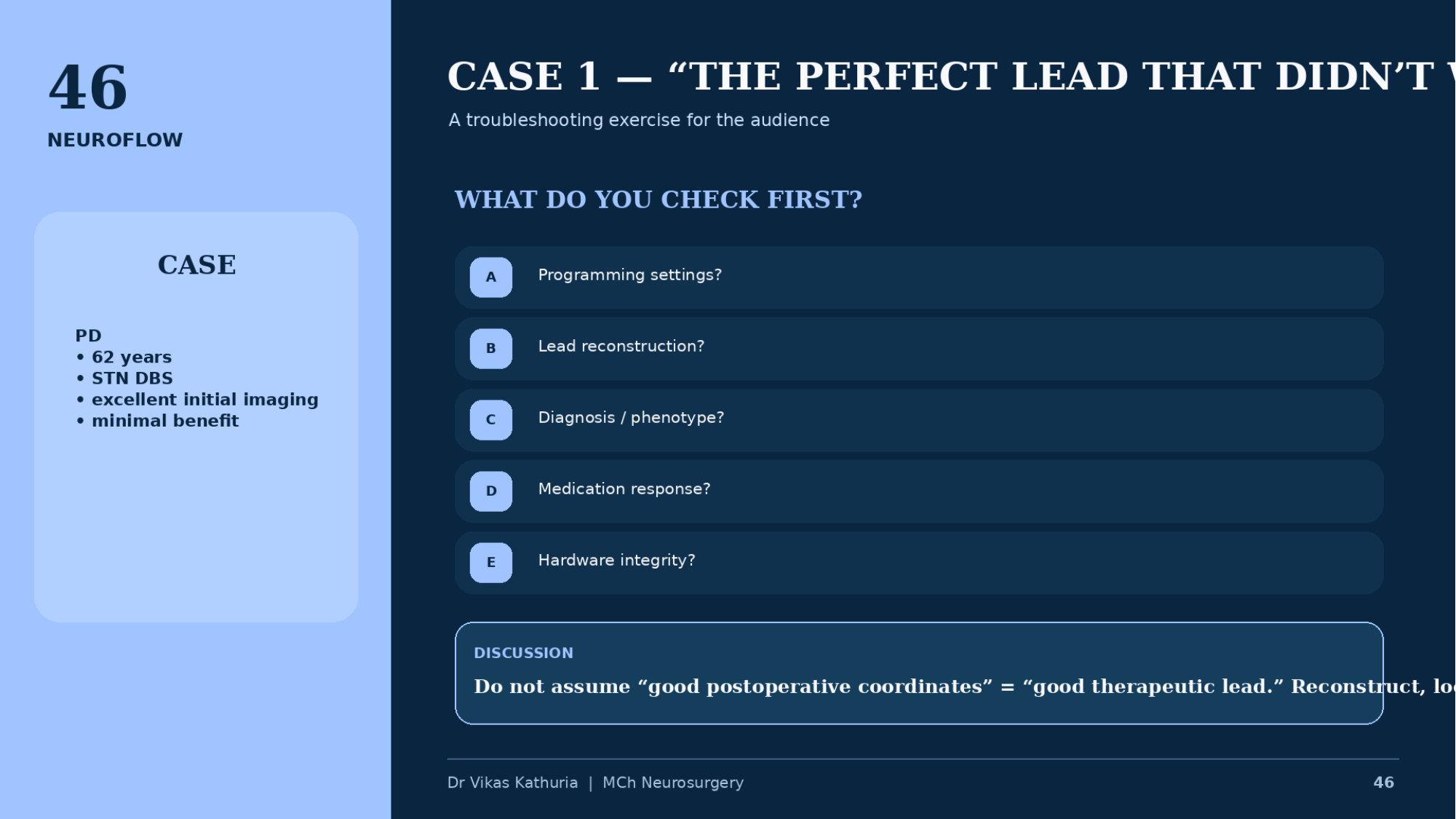
Original lecture slide 46, Case 1, the perfect lead that didn't work, with a case panel and five lettered troubleshooting options

CASE 1 — “THE PERFECT LEAD THAT DIDN'T WORK”

  • A troubleshooting exercise for the audience
  • CASE
  • PD
  • • 62 years
  • • STN DBS
  • • excellent initial imaging
  • • minimal benefit
  • WHAT DO YOU CHECK FIRST?
  • A — Programming settings?
  • B — Lead reconstruction?
  • C — Diagnosis / phenotype?
  • D — Medication response?
  • E — Hardware integrity?
  • DISCUSSION — Do not assume “good postoperative coordinates” = “good therapeutic lead.” Reconstruct, localize and troubleshoot before revision.
  • Dr Vikas Kathuria | MCh Neurosurgery
Slide 47

Slide 47

Original lecture slide

100%
Original lecture slide 47, Landmark trials, showing the evidence timeline from 2006 to 2024

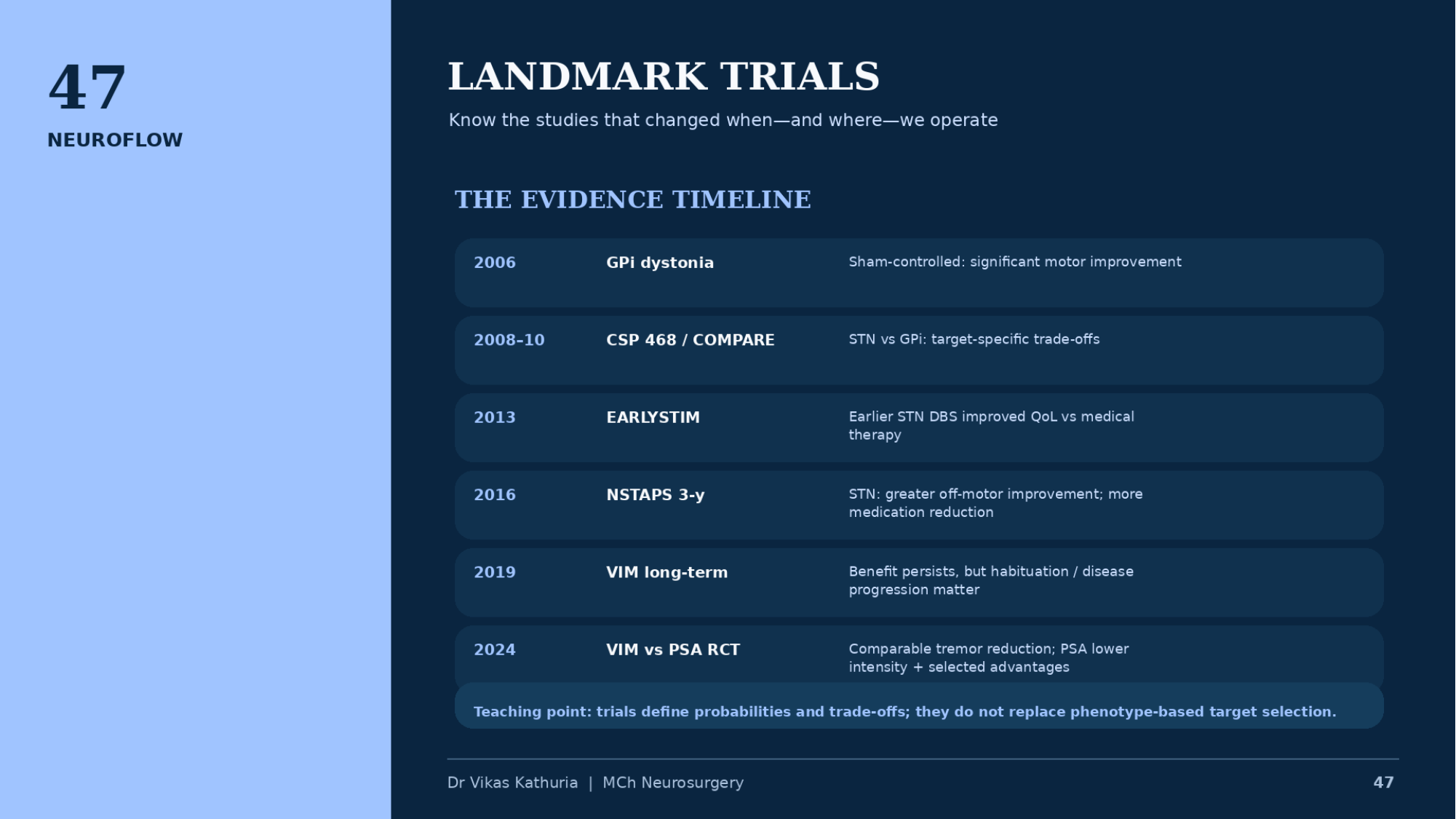
LANDMARK TRIALS

  • Know the studies that changed when—and where—we operate
  • THE EVIDENCE TIMELINE
  • 2006 — GPi dystonia — Sham-controlled: significant motor improvement
  • 2008–10 — CSP 468 / COMPARE — STN vs GPi: target-specific trade-offs
  • 2013 — EARLYSTIM — Earlier STN DBS improved QoL vs medical therapy
  • 2016 — NSTAPS 3-y — STN: greater off-motor improvement; more medication reduction
  • 2019 — VIM long-term — Benefit persists, but habituation / disease progression matter
  • 2024 — VIM vs PSA RCT — Comparable tremor reduction; PSA lower intensity + selected advantages
  • Teaching point: trials define probabilities and trade-offs; they do not replace phenotype-based target selection.
  • Dr Vikas Kathuria | MCh Neurosurgery
Slide 48

Slide 48

Original lecture slide

100%
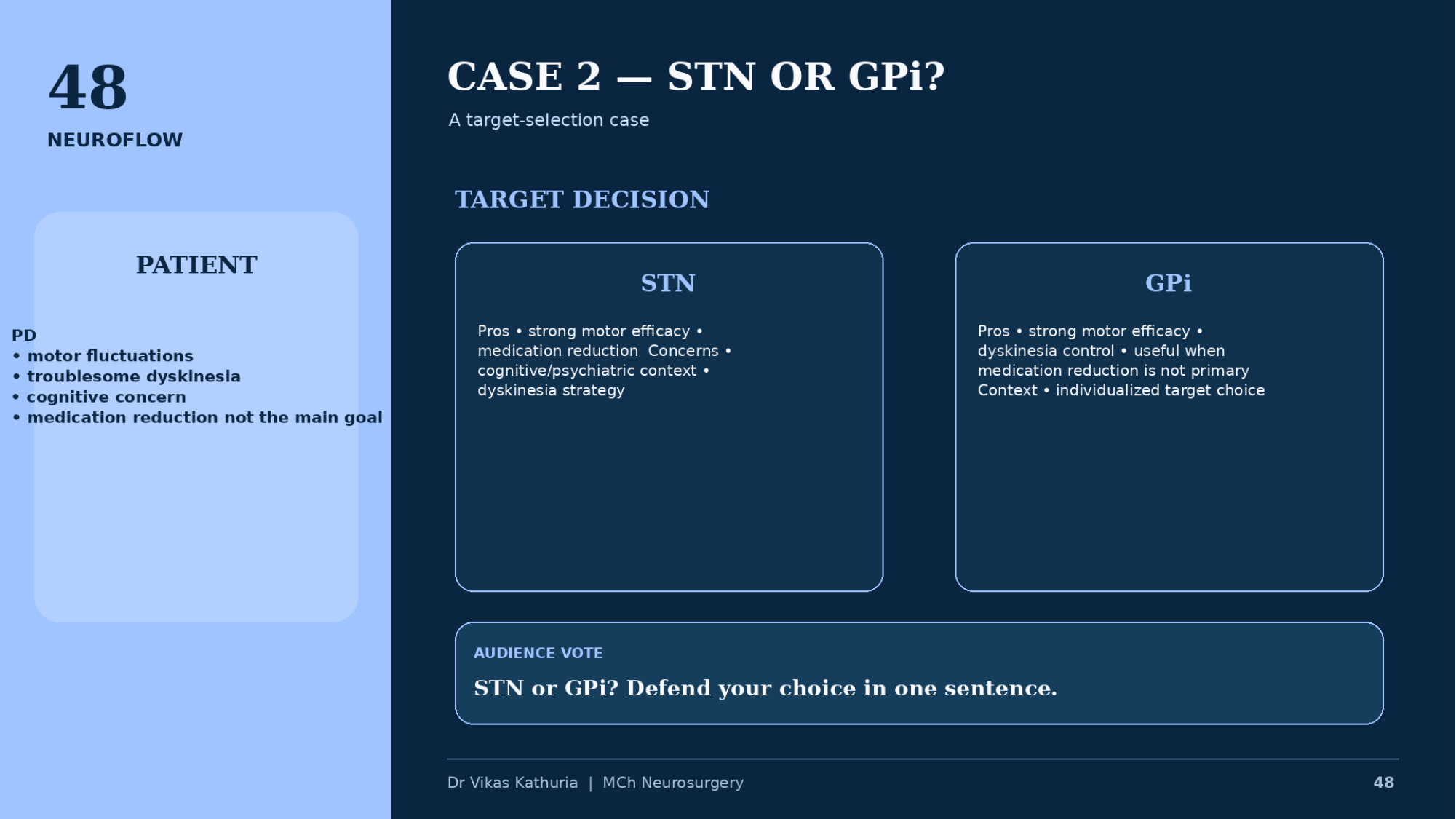
Original lecture slide 48, Case 2, STN or GPi, with a patient panel and two target columns plus an audience vote

CASE 2 — STN OR GPi?

  • A target-selection case
  • PATIENT
  • PD
  • • motor fluctuations
  • • troublesome dyskinesia
  • • cognitive concern
  • • medication reduction not the main goal
  • TARGET DECISION
  • STN — Pros • strong motor efficacy • medication reduction Concerns • cognitive/psychiatric context • dyskinesia strategy
  • GPi — Pros • strong motor efficacy • dyskinesia control • useful when medication reduction is not primary Context • individualized target choice
  • AUDIENCE VOTE — STN or GPi? Defend your choice in one sentence.
  • Dr Vikas Kathuria | MCh Neurosurgery

Slide 49

Slide 49

Original lecture slide

100%
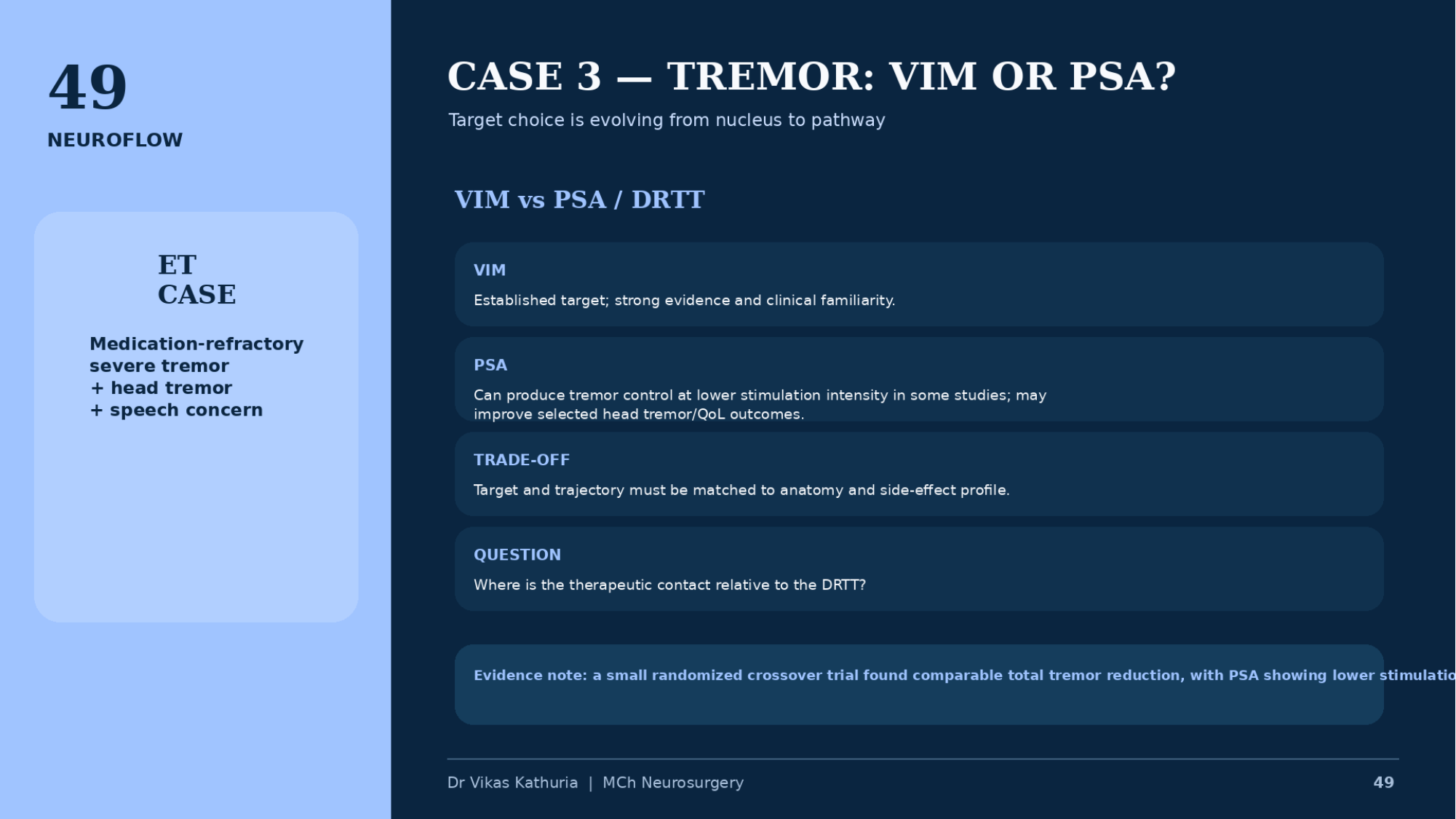
Original lecture slide 49, Case 3, tremor, VIM or PSA, with an essential tremor case panel and VIM, PSA, trade-off and question cards

CASE 3 — TREMOR: VIM OR PSA?

  • Target choice is evolving from nucleus to pathway
  • ET CASE
  • Medication-refractory severe tremor
  • + head tremor
  • + speech concern
  • VIM vs PSA / DRTT
  • VIM — Established target; strong evidence and clinical familiarity.
  • PSA — Can produce tremor control at lower stimulation intensity in some studies; may improve selected head tremor/QoL outcomes.
  • TRADE-OFF — Target and trajectory must be matched to anatomy and side-effect profile.
  • QUESTION — Where is the therapeutic contact relative to the DRTT?
  • Evidence note: a small randomized crossover trial found comparable total tremor reduction, with PSA showing lower stimulation intensity.
  • Dr Vikas Kathuria | MCh Neurosurgery

Slide 50

Slide 50

Original lecture slide

100%
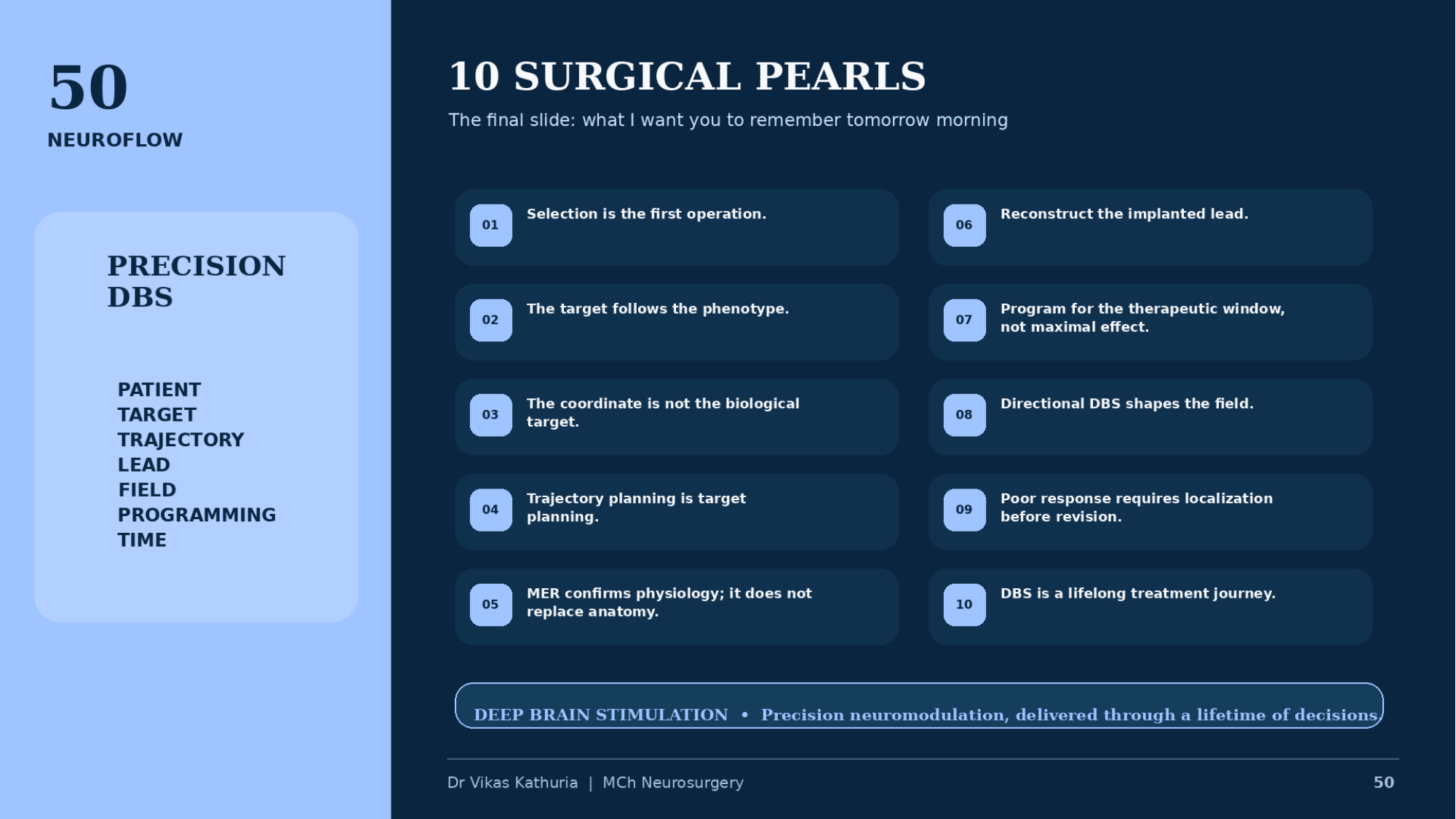
Original lecture slide 50, 10 surgical pearls, with the precision DBS framework panel and the closing statement

10 SURGICAL PEARLS

  • The final slide: what I want you to remember tomorrow morning
  • PRECISION DBS
  • PATIENT
  • TARGET
  • TRAJECTORY
  • LEAD
  • FIELD
  • PROGRAMMING
  • TIME
  • 01 Selection is the first operation.
  • 02 The target follows the phenotype.
  • 03 The coordinate is not the biological target.
  • 04 Trajectory planning is target planning.
  • 05 MER confirms physiology; it does not replace anatomy.
  • 06 Reconstruct the implanted lead.
  • 07 Program for the therapeutic window, not maximal effect.
  • 08 Directional DBS shapes the field.
  • 09 Poor response requires localization before revision.
  • 10 DBS is a lifelong treatment journey.
  • DEEP BRAIN STIMULATION • Precision neuromodulation, delivered through a lifetime of decisions
  • Dr Vikas Kathuria | MCh Neurosurgery

Keyboard: ← previous slide · → next slide · O original slide · S study mode

Central message

The value of DBS expertise is not memorizing targets. It is making the right decision for the right patient at the right time.

Expanded study material

Cases, evidence and pearls

Supplementary material written around the immutable original slides 46–50.

Interactive case

Case 1 — the perfect lead that didn't work

Vote first, discuss second. The vote is the teaching device, not an examination.

Audience vote — Case 1

What do you check first?

Programming problem or anatomy problem?

If the lead is well positioned

  • Contact selection
  • Amplitude
  • Pulse width
  • Frequency
  • Configuration
  • Directional steering
  • Medication interaction

If the lead is poorly positioned

  • Available therapeutic field
  • Adjacent structures
  • Alternative contacts
  • Realistic programming limits
  • Revision only if appropriate

Localize before you revise.

Interactive case

Case 2 — STN or GPi?

A target-selection case in which the stated goals do the work.

Audience vote — Case 2

STN or GPi? Defend your choice in one sentence.

Interactive case

Case 3 — tremor: VIM or PSA?

Nucleus and pathway are complementary concepts, not competing brands.

VIM — established

  • Long clinical experience
  • Strong evidence base
  • Familiar surgical target
  • Established programming framework
  • Considerations: speech, paresthesia, gait, habituation

PSA / DRTT — pathway-aware

  • Pathway-based targeting
  • Lower stimulation intensity in selected studies
  • Selected head tremor / QoL advantages in some data
  • Challenges: anatomical variability, trajectory precision, smaller long-term evidence base

Teaching schematic — dentato-rubro-thalamic pathway

  1. 01CEREBELLUM
  2. 02SUPERIOR CEREBELLAR PEDUNCLE
  3. 03DECUSSATION
  4. 04DRTT
  5. 05THALAMIC REGION
  6. 06MOTOR NETWORK

Place the lead, the modelled field and the pathway together and ask: where is the therapeutic contact relative to the DRTT? Tractography renders a model of probable pathways — it does not visualize axons.

The best target is not the most fashionable target. It is the target that best matches the patient, anatomy, pathway and therapeutic objective.

Master simulator

The DBS decision simulator

Ten steps around a fictional patient. Every step asks what information would change the decision.

What information changes your decision?

Is the diagnosis secure, and what would change it?

Atypical features, an unusual course or an unconvincing medication history all reopen the diagnosis before any target is discussed.

The simulator teaches reasoning, not right and wrong answers. The patient is fictional; no real clinical data are used.

Master infographic

Precision DBS — the continuous loop

The journey closes back on the patient it started with.

  1. 01PATIENT
  2. 02DIAGNOSIS
  3. 03PHENOTYPE
  4. 04INDICATION
  5. 05TARGET
  6. 06TRAJECTORY
  7. 07PHYSIOLOGY
  8. 08LEAD
  9. 09FIELD
  10. 10PROGRAMMING
  11. 11FOLLOW-UP
  12. 12OUTCOME

PRECISION DBS

Outcome returns to the patient — the loop never terminates at the operation.

Landmark evidence library

The evidence wall

Each trial is read as population, target, question, outcome, limitation and clinical implication. Trials are not interchangeable.

Population
Selected patients with primary generalized or segmental dystonia
Target
GPi
Question
Does GPi stimulation produce genuine benefit beyond sham / placebo effects?
Main finding
Significant motor improvement, including in a sham-controlled design
Key limitation
Selected dystonia populations; benefit varies by aetiology and phenotype
Clinical takeaway
GPi DBS is a recognized option in appropriately selected primary dystonia — not in all dystonia.

Trials inform the decision. The surgeon still has to make the decision.

  • TRIAL EVIDENCE
  • PATIENT PHENOTYPE
  • PATIENT GOALS
  • ANATOMY
  • COGNITION / PSYCHIATRY
  • SURGICAL EXPERTISE

= Individualized DBS decision

Synthesis

The 50-slide map

Ten modules, one continuous DBS journey.

  1. Slides 01–10

    Foundations + Targeting

  2. Slides 11–20

    Planning + Implantation + Programming

  3. Slides 21–30

    Programming + Long-term Management

  4. Slides 31–40

    Networks + Connectomics + Precision Neuromodulation

  5. Slides 41–45

    Complications

  6. Slides 46–50

    Cases + Evidence + Pearls

→ PRECISION DBS

Final integrated case

What would you do?

The same patient as Case 2, carried through ten decisions. A faculty framework, not a single answer.

01 — STN or GPi for this patient?

02 — What imaging would you review before planning?

03 — What trajectory constraints matter here?

04 — Would you use MER?

05 — How would you verify final lead position?

06 — What would you programme first?

07 — What would make you suspect a poor lead?

08 — When would you revise?

09 — What would you monitor longitudinally?

10 — What is this patient's actual treatment goal?

Optional

Fellowship exam mode

Questions drawn from the whole lecture. Optional — the site remains a teaching resource, not an exam platform.

Self-assessment

Can you now answer these 10 questions?

If any answer is uncertain, the corresponding module is the place to return to.

  1. 01 Who is the DBS patient?
  2. 02 What is the phenotype?
  3. 03 Why this target?
  4. 04 Why this trajectory?
  5. 05 What does physiology add?
  6. 06 Where is the final lead?
  7. 07 What is the stimulation field?
  8. 08 Where does the current go?
  9. 09 Why is this patient responding — or not?
  10. 10 What would you do differently at the next follow-up?

Original slide 50

Ten surgical pearls

Reproduced exactly as written on the original slide.

  1. 01

    Selection is the first operation.

  2. 02

    The target follows the phenotype.

  3. 03

    The coordinate is not the biological target.

  4. 04

    Trajectory planning is target planning.

  5. 05

    MER confirms physiology; it does not replace anatomy.

  6. 06

    Reconstruct the implanted lead.

  7. 07

    Program for the therapeutic window, not maximal effect.

  8. 08

    Directional DBS shapes the field.

  9. 09

    Poor response requires localization before revision.

  10. 10

    DBS is a lifelong treatment journey.

Cross-links

Where this page connects

Page 10 closes loops opened earlier in the lecture.

Presenter

Dr Vikas Kathuria, MCh Neurosurgery — Functional and Stereotactic Neurosurgery

Dr Vikas Kathuria

MCh Neurosurgery · Functional / Stereotactic Neurosurgery

NEUROFLOW Advanced DBS Education

From the lecture to the clinic

How to proceed with a consultation

  1. 01 Share the problem

    Bring the diagnosis, medication history, prior imaging and what is limiting daily life.

  2. 02 Assessment

    Phenotype, medication response, cognition and imaging decide whether DBS — and which target — fits.

  3. 03 Book the OPD

    Reserve a consultation slot online, or call the clinic directly.

Contact & consultation

Monday – Saturday · 09:00 – 20:00 IST

Websites

Book an OPD consultation

Skin Aura Brain & Spine Neuro Centre · Gurugram, Haryana

Open in Google Maps

DBS — from coordinates to precision neuromodulation

50 SLIDES · 10 MODULES · 1 CONTINUOUS DBS JOURNEY

PATIENT → TARGET → TRAJECTORY → LEAD → FIELD → PROGRAMMING → NETWORK → FOLLOW-UP → OUTCOME

DBS is not a device implant. It is a long-term clinical system.

The operation is implantation. The treatment is lifelong.

Precision neuromodulation, delivered through a lifetime of decisions.

Deep study material

Expanded study material

DBS is effective in appropriately selected patients with Parkinson disease, essential tremor and dystonia

ESTABLISHED

Randomized evidence supports motor benefit and quality-of-life benefit in defined populations. Selection and target choice remain clinical decisions.

STN and GPi both produce motor benefit with target-specific trade-offs

ESTABLISHED

Randomized comparisons describe differences in medication reduction, dyskinesia strategy and composite cognitive, mood and behavioural measures rather than one universally superior nucleus.

Lead localization matters in unexplained poor response

SUPPORTED

Registration of postoperative imaging to preoperative MRI with reconstruction of the implanted lead is the accepted way to establish where the lead actually is before revision is discussed.

Pathway-aware tremor targeting

SUPPORTED

PSA / DRTT-oriented targeting can achieve tremor control at lower stimulation intensity in selected studies; the evidence base remains smaller than for VIM and does not replace it.

Model-based failure analysis

EMERGING

Combined lead reconstruction, VTA modelling and connectomic analysis of DBS outcome is an active research area rather than routine care.

Automated target recommendation and individualized outcome prediction

EXPERIMENTAL

RESEARCH DIRECTION — not clinical practice, and not a substitute for the clinical decision.

Anatomy

Anatomy

Expanded study material for this section is written once the original slides for this module are supplied.

Surgical principles

Surgical principles

Expanded study material for this section is written once the original slides for this module are supplied.

Physiology

Physiology

Expanded study material for this section is written once the original slides for this module are supplied.

Imaging

Imaging

Expanded study material for this section is written once the original slides for this module are supplied.

Programming

Programming

Expanded study material for this section is written once the original slides for this module are supplied.

Image placeholders

Images required for this module

Each placeholder states the image type, what is required, why it teaches and where a legitimate source should come from. No clinical image is fabricated.

Image placeholder

PAGE 10 FULL DBS JOURNEY INFOGRAPHIC — INSERT AUTHENTIC IMAGE

Real clinical image required

Image typeSchematic / diagram
DescriptionOriginal 16:9 educational infographic of the complete 50-slide journey from patient to outcome and back to patient.
Clinical purposeSupport fellowship-level case and evidence discussion without fabricating patient imaging, published trial figures or lead-localization results.
Suggested sourceINSERT AUTHENTIC PUBLISHED / INSTITUTIONAL IMAGE HERE (licensing and consent confirmed)
Copyright statusSource, consent and reproduction rights must be confirmed before use.
CaptionTo be written with the final image
AssociationModule 10 · Slide 50

THE DBS JOURNEY

01

Patient

02

Phenotype

03

Indication

04

Target

05

Imaging

06

Trajectory

07

Physiology

08

Lead

09

Verification

10

Field / VTA

11

Programming

12

Network

13

Sensing

14

Follow-up

15

Outcome

16

Adaptation

  1. PATIENT
  2. PHENOTYPE
  3. INDICATION
  4. TARGET
  5. IMAGING
  6. TRAJECTORY
  7. PHYSIOLOGY
  8. LEAD
  9. VERIFICATION
  10. FIELD / VTA
  11. PROGRAMMING
  12. NETWORK
  13. SENSING
  14. FOLLOW-UP
  15. OUTCOME
  16. ADAPTATION
  17. BACK TO PATIENT

DBS IS A SYSTEM, NOT A PROCEDURE.

Clinical pearls

  • Selection is the first operation.
  • The target follows the phenotype.
  • The coordinate is not the biological target.
  • Trajectory planning is target planning.
  • MER confirms physiology; it does not replace anatomy.
  • Reconstruct the implanted lead.
  • Program for the therapeutic window, not maximal effect.
  • Directional DBS shapes the field.
  • Poor response requires localization before revision.
  • DBS is a lifelong treatment journey.

Common errors

  • Treating “good postoperative coordinates” as proof of a good therapeutic lead.
  • Reprogramming repeatedly instead of localizing the failure.
  • Reading EARLYSTIM as an instruction to operate early on everyone.
  • Declaring STN universally superior — or GPi universally safer.
  • Converting a small crossover trial into “PSA is better than VIM”.
  • Quoting a trial result without its population, outcome measure and limitation.
  • Choosing a target before the therapeutic goal has been agreed.
  • Presenting tractography as visualization of axons.
  • Using revision as a troubleshooting step rather than a diagnostic conclusion.
  • Ending care at the programming session instead of planning the lifelong journey.

Case discussion

Cases

Case discussion

CASE 1 — “The perfect lead that didn't work”

Patient profile

Teaching case as presented on original slide 46. No real patient data are used.

Clinical phenotype

62 years · STN DBS · excellent initial imaging · minimal benefit.

Surgical plan

Audience vote — what do you check first? A programming · B lead reconstruction · C diagnosis / phenotype · D medication response · E hardware integrity.

Outcome

THIS IS A LOCALIZATION PROBLEM. Work the sequence: diagnosis → phenotype → lead → hardware → programming → medication → disease progression.

Audience vote

WHAT DO YOU CHECK FIRST?

  • AA — Programming settings
  • BB — Lead reconstruction
  • CC — Diagnosis / phenotype
  • DD — Medication response
  • EE — Hardware integrity

Lessons

  • Do not assume good postoperative coordinates equal a good therapeutic lead.
  • Reconstruct, localize and troubleshoot before revision.
  • Revision follows a localizable, correctable problem — never a frustration.

Case discussion

CASE 2 — STN or GPi?

Patient profile

Teaching case as presented on original slide 48. No real patient data are used.

Clinical phenotype

Parkinson disease · motor fluctuations · troublesome dyskinesia · cognitive concern · medication reduction not the main goal.

Surgical plan

Audience vote — STN or GPi? Defend your choice in one sentence.

Outcome

GPi MAY be favored by the stated goals and concerns, but the final decision remains individualized. Target follows phenotype and therapeutic goal.

Target options
  • STN
  • GPi

Audience vote

STN or GPi?

  • ASTN
  • BGPi

Lessons

  • Name the therapeutic goal before naming the nucleus.
  • Cognitive concern is a consideration, not an automatic exclusion.
  • Ask what information would flip the decision — that is the examination.

Case discussion

CASE 3 — Tremor: VIM or PSA?

Patient profile

Teaching case as presented on original slide 49. No real patient data are used.

Clinical phenotype

Medication-refractory severe tremor + head tremor + speech concern.

Surgical plan

Where is the therapeutic contact relative to the DRTT?

Outcome

The best target is the one that best matches the patient, anatomy, pathway and therapeutic objective — not the most fashionable one.

Target options
  • VIM
  • PSA / DRTT

Audience vote

VIM or PSA / DRTT?

  • AVIM
  • BPSA / DRTT

Lessons

  • VIM is a nucleus; DRTT is a pathway concept. Keep them distinct.
  • Comparable tremor reduction at lower intensity is not the same as superiority.
  • Speech concern belongs in the targeting decision.

Case discussion

FINAL CASE — What would you do?

Patient profile

Integrated teaching case. No real patient data are used.

Clinical phenotype

Parkinson disease · motor fluctuations · dyskinesia · cognitive concern · medication reduction not the primary goal.

Surgical plan

Ten questions: STN or GPi? What imaging would you review? What trajectory constraints matter? Would you use MER? How would you verify final lead position? What would you program first? What would make you suspect a poor lead? When would you revise? What would you monitor longitudinally? What is the patient's actual treatment goal?

Outcome

There is no single correct answer. The faculty framework is the answer: goal → phenotype → target → trajectory → physiology → verification → field → programming → follow-up.

Lessons

  • Every question is answerable only in relation to the stated therapeutic goal.
  • Verification and follow-up are part of the surgical plan, not aftercare.
  • A defensible reasoning chain matters more than a preferred nucleus.

Take-home message

The operation is implantation. The treatment is lifelong.Trials inform the decision. The surgeon still has to make the decision.

  1. PATIENT
  2. TARGET
  3. TRAJECTORY
  4. LEAD
  5. FIELD
  6. PROGRAMMING
  7. TIME

References

Evidence supporting this module

  1. Kupsch A, Benecke R, Müller J, et al. Pallidal deep-brain stimulation in primary generalized or segmental dystonia. N Engl J Med. 2006;355(19):1978-1990.
  2. Vidailhet M, Vercueil L, Houeto JL, et al. Bilateral deep-brain stimulation of the globus pallidus in primary generalized dystonia. N Engl J Med. 2005;352(5):459-467.
  3. Follett KA, Weaver FM, Stern M, et al. Pallidal versus subthalamic deep-brain stimulation for Parkinson's disease. N Engl J Med. 2010;362(22):2077-2091.
  4. Weaver FM, Follett K, Stern M, et al. Bilateral deep brain stimulation vs best medical therapy for patients with advanced Parkinson disease: a randomized controlled trial. JAMA. 2009;301(1):63-73.
  5. Schuepbach WMM, Rau J, Knudsen K, et al. Neurostimulation for Parkinson's disease with early motor complications. N Engl J Med. 2013;368(7):610-622.
  6. Odekerken VJJ, van Laar T, Staal MJ, et al. Subthalamic nucleus versus globus pallidus bilateral deep brain stimulation for advanced Parkinson's disease (NSTAPS study): a randomised controlled trial. Lancet Neurol. 2013;12(1):37-44.
  7. Paschen S, Forstenpointner J, Becktepe J, et al. Long-term efficacy of deep brain stimulation for essential tremor: an observer-blinded study. Neurology. 2019;92(12):e1378-e1386.
  8. Barbe MT, Reker P, Hamacher S, et al. DBS of the PSA and the VIM in essential tremor: a randomized, double-blind, crossover trial. Neurology. 2018;91(6):e543-e550.
  9. Sun X, Shen R, Lin Z, et al. Optimizing deep brain stimulation in essential tremor: a randomized controlled trial for target consideration. Neurosurgery. 2024;95(1):63-75.
  10. Horn A, Kühn AA. Lead-DBS: a toolbox for deep brain stimulation electrode localizations and visualizations. Neuroimage. 2015;107:127-135.
  11. Horn A, Li N, Dembek TA, et al. Lead-DBS v2: towards a comprehensive pipeline for deep brain stimulation imaging. Neuroimage. 2019;184:293-316.
  12. Butson CR, Cooper SE, Henderson JM, McIntyre CC. Patient-specific analysis of the volume of tissue activated during deep brain stimulation. Neuroimage. 2007;34(2):661-670.
  13. Koeglsperger T, Palleis C, Hell F, Mehrkens JH, Bötzel K. Deep brain stimulation programming for movement disorders: current concepts and evidence-based strategies. Front Neurol. 2019;10:410.
  14. Okun MS. Deep-brain stimulation for Parkinson's disease. N Engl J Med. 2012;367(16):1529-1538.
  15. Bronstein JM, Tagliati M, Alterman RL, et al. Deep brain stimulation for Parkinson disease: an expert consensus and review of key issues. Arch Neurol. 2011;68(2):165-171.
  16. Hvingelby V, Khalil F, Massey F, et al. Directional deep brain stimulation electrodes in Parkinson's disease: meta-analysis and systematic review of the literature. J Neurol Neurosurg Psychiatry. 2025;96(2):188-198.

“DEEP BRAIN STIMULATION IS NOT SIMPLY A TARGET, A TRAJECTORY, A LEAD OR A PROGRAMMING SETTING. IT IS THE CONTINUOUS ALIGNMENT OF PATIENT + PHENOTYPE + ANATOMY + PHYSIOLOGY + LEAD LOCATION + ELECTRICAL FIELD + NETWORK + PROGRAMMING + TIME. THAT IS PRECISION NEUROMODULATION.”

End of the curriculumPrecision DBS — from stereotactic coordinates to patient-specific neuromodulation