Module 06

Directional DBS → Therapeutic Window → Long-Term Management

Slides 26–30 | Shaping the field, troubleshooting failure, and managing the DBS system across years

Original lecture slides 26–30 · Module 06 / 10

“Once the lead is implanted, DBS becomes a process of field shaping, clinical troubleshooting, system surveillance and longitudinal adaptation.”

The DBS longitudinal loop

  1. 01LEAD
  2. 02PROGRAMMING
  3. 03THERAPEUTIC WINDOW
  4. 04CLINICAL RESPONSE
  5. 05SIDE EFFECTS
  6. 06FOLLOW-UP
  7. 07DEVICE SURVEILLANCE
  8. 08DISEASE EVOLUTION
  9. 09REPROGRAM
  10. 10REASSESS

DBS does not end with programming. The field must be optimized, the system must be surveilled, and the therapy must evolve with the patient.

Learning objectives

By the end of this module you should be able to

  1. 01Explain how segmented contacts redistribute current without moving the lead
  2. 02State when directional stimulation is likely to help — and when it is not
  3. 03Describe directional programming concepts in device-agnostic terms
  4. 04Interpret directional DBS evidence without overstating superiority
  5. 05Define benefit threshold, side-effect threshold and therapeutic window
  6. 06Explain how the four programming levers reshape the therapeutic field
  7. 07Recognize a narrow therapeutic window as a prompt for anatomical reassessment
  8. 08Approach poor response as a localization problem across seven domains
  9. 09Match common failure patterns to likely domains and appropriate tests
  10. 10State when revision becomes a rational rather than reflexive decision
  11. 11Perform structured hardware, wound, battery and MRI surveillance
  12. 12Discuss rechargeable versus fixed-life IPGs neutrally with patients
  13. 13Structure a longitudinal DBS visit across motor, non-motor, functional, therapeutic, device and goal domains
  14. 14Distinguish continuing DBS benefit from underlying disease progression

Original lecture slides

Slides 26–30

The slides below are reproduced exactly as delivered. Everything outside the slide panel is added study material.

Slide 26

Slide 26

Original lecture slide

100%
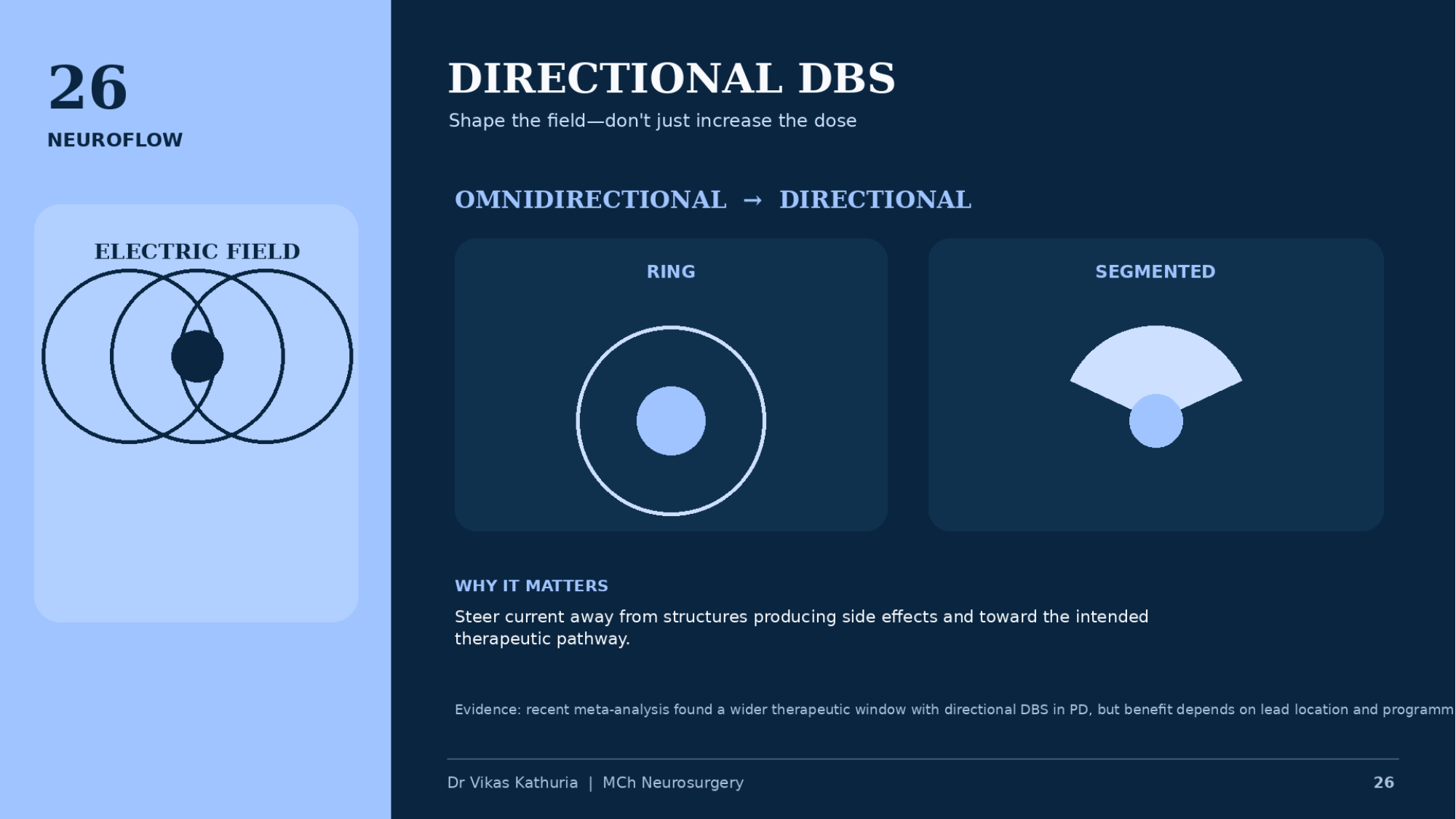
Original lecture slide 26, Directional DBS, comparing a ring contact producing a symmetrical field with a segmented contact producing a steered field

DIRECTIONAL DBS

  • Shape the field—don't just increase the dose
  • ELECTRIC FIELD
  • OMNIDIRECTIONAL → DIRECTIONAL
  • RING
  • SEGMENTED
  • WHY IT MATTERS
  • Steer current away from structures producing side effects and toward the intended therapeutic pathway.
  • Evidence: recent meta-analysis found a wider therapeutic window with directional DBS in PD, but benefit depends on lead location and programming.
  • Dr Vikas Kathuria | MCh Neurosurgery
Slide 27

Slide 27

Original lecture slide

100%
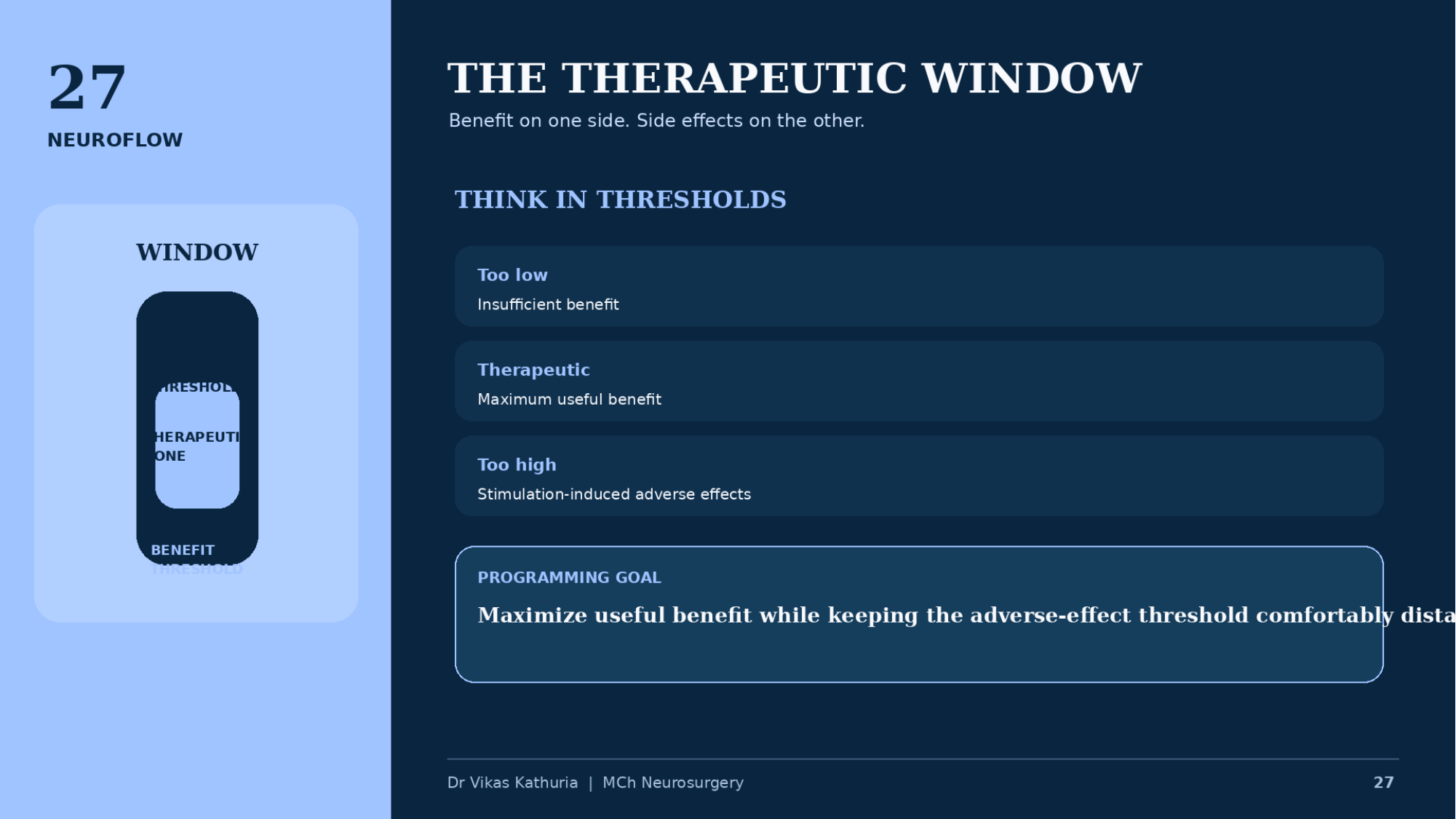
Original lecture slide 27, The Therapeutic Window, showing too low, therapeutic and too high thresholds with a window schematic

THE THERAPEUTIC WINDOW

  • Benefit on one side. Side effects on the other.
  • WINDOW
  • THRESHOLD
  • THERAPEUTIC ZONE
  • BENEFIT THRESHOLD
  • THINK IN THRESHOLDS
  • Too low — Insufficient benefit
  • Therapeutic — Maximum useful benefit
  • Too high — Stimulation-induced adverse effects
  • PROGRAMMING GOAL
  • Maximize useful benefit while keeping the adverse-effect threshold comfortably distant.
  • Dr Vikas Kathuria | MCh Neurosurgery
Slide 28

Slide 28

Original lecture slide

100%
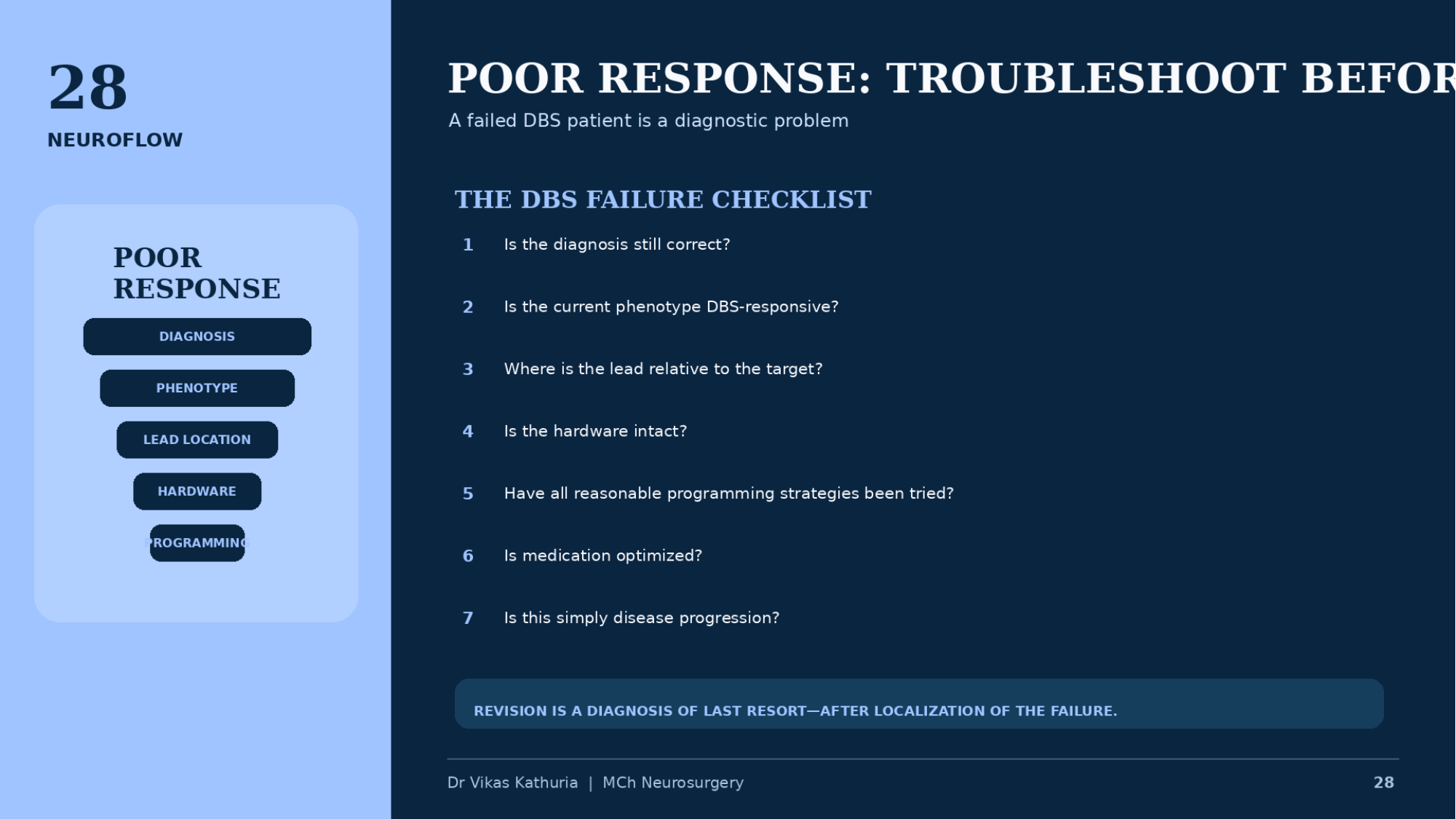
Original lecture slide 28, Poor response: troubleshoot before revision, listing the seven-item DBS failure checklist

POOR RESPONSE: TROUBLESHOOT BEFORE REVISION

  • A failed DBS patient is a diagnostic problem
  • POOR RESPONSE
  • DIAGNOSIS
  • PHENOTYPE
  • LEAD LOCATION
  • HARDWARE
  • PROGRAMMING
  • THE DBS FAILURE CHECKLIST
  • 1 Is the diagnosis still correct?
  • 2 Is the current phenotype DBS-responsive?
  • 3 Where is the lead relative to the target?
  • 4 Is the hardware intact?
  • 5 Have all reasonable programming strategies been tried?
  • 6 Is medication optimized?
  • 7 Is this simply disease progression?
  • REVISION IS A DIAGNOSIS OF LAST RESORT—AFTER LOCALIZATION OF THE FAILURE.
  • Dr Vikas Kathuria | MCh Neurosurgery

Slide 29

Slide 29

Original lecture slide

100%
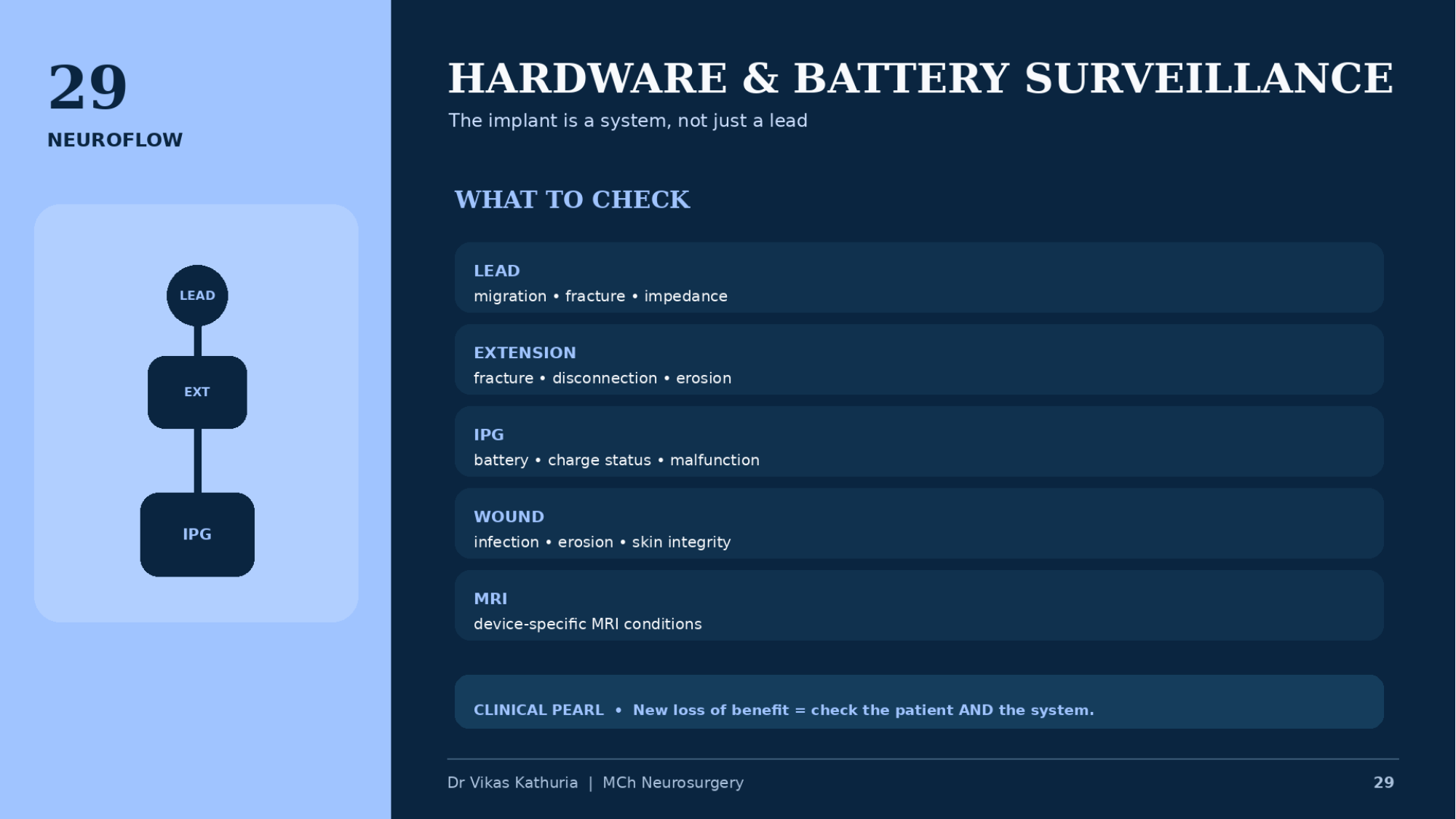
Original lecture slide 29, Hardware and battery surveillance, showing lead, extension and IPG with a what-to-check list

HARDWARE & BATTERY SURVEILLANCE

  • The implant is a system, not just a lead
  • LEAD
  • EXT
  • IPG
  • WHAT TO CHECK
  • LEAD — migration • fracture • impedance
  • EXTENSION — fracture • disconnection • erosion
  • IPG — battery • charge status • malfunction
  • WOUND — infection • erosion • skin integrity
  • MRI — device-specific MRI conditions
  • CLINICAL PEARL • New loss of benefit = check the patient AND the system.
  • Dr Vikas Kathuria | MCh Neurosurgery

Slide 30

Slide 30

Original lecture slide

100%
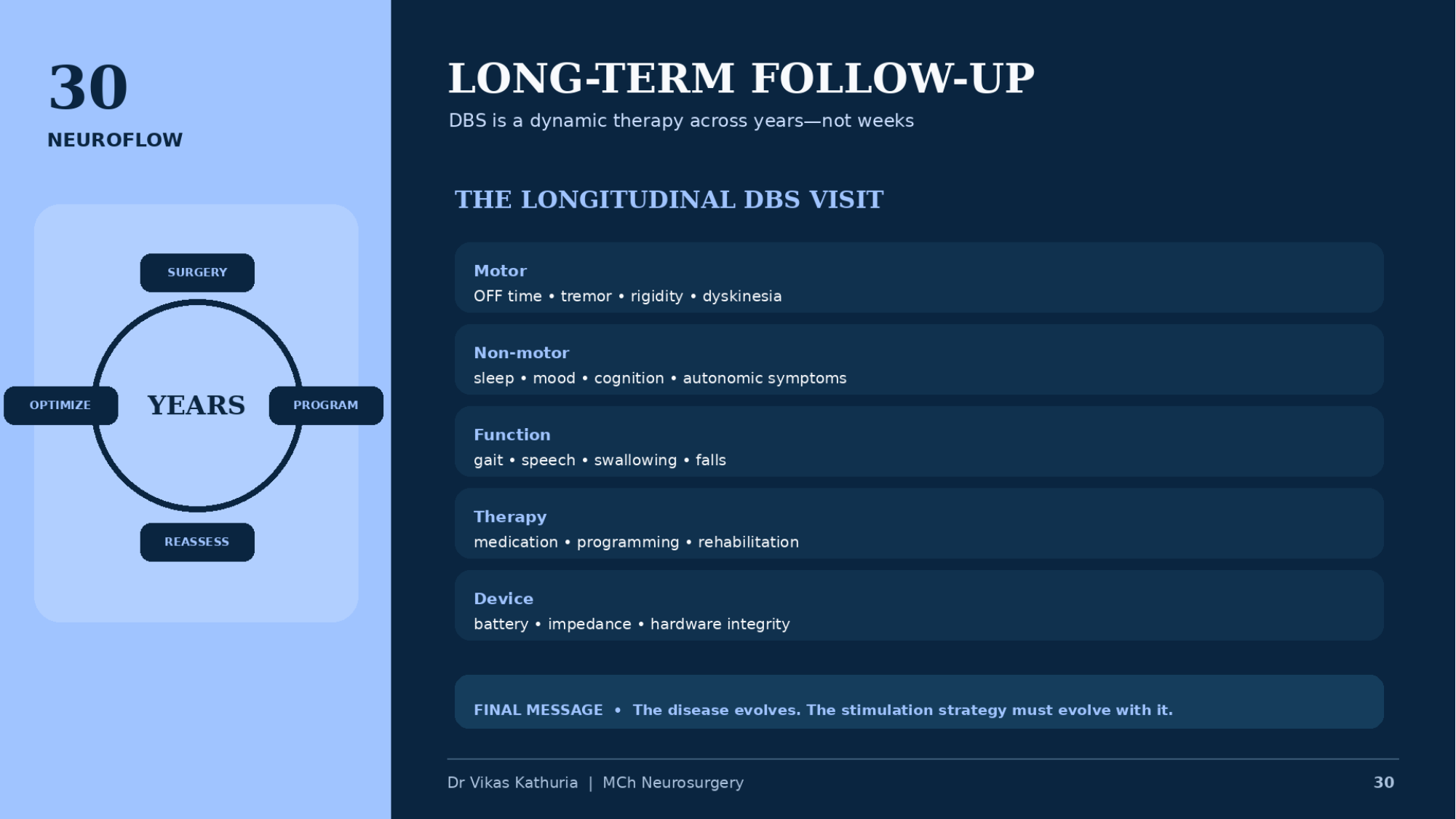
Original lecture slide 30, Long-term follow-up, showing the longitudinal DBS visit across motor, non-motor, function, therapy and device domains

LONG-TERM FOLLOW-UP

  • DBS is a dynamic therapy across years—not weeks
  • SURGERY
  • OPTIMIZE
  • YEARS
  • PROGRAM
  • REASSESS
  • THE LONGITUDINAL DBS VISIT
  • Motor — OFF time • tremor • rigidity • dyskinesia
  • Non-motor — sleep • mood • cognition • autonomic symptoms
  • Function — gait • speech • swallowing • falls
  • Therapy — medication • programming • rehabilitation
  • Device — battery • impedance • hardware integrity
  • FINAL MESSAGE • The disease evolves. The stimulation strategy must evolve with it.
  • Dr Vikas Kathuria | MCh Neurosurgery

Keyboard: ← previous slide · → next slide · O original slide · S study mode

Expanded study material

Field, window, failure, system, time

Expand each topic without leaving Page 06. All of this material is supplementary to the immutable original slides.

Interactive principle

Ring versus segmented field

Explore spatial control conceptually — this is not a device programming interface.

Sensitive structure

Schematic — not patient-specific

A ring contact distributes current relatively symmetrically. The field overlaps the neighbouring structure, so the side-effect threshold may be reached before adequate benefit.

Directional stimulation redistributes current around the lead. It cannot reach territory the lead never approaches, and it does not compensate for a fundamentally misplaced electrode.

Critical nuance

Directional ≠ automatically better

Directional stimulation is most useful when lead location is already reasonably good, a side-effect structure lies close to the therapeutic territory, current can be steered away from it, the therapeutic window is narrow and programming flexibility is needed. A directional lead cannot reliably compensate for a fundamentally misplaced electrode.

Good lead + directional programming = field optimization

Poor lead + directional programming ≠ perfect targeting

Interactive principle

Therapeutic window graph

Schematic thresholds — educational, not patient data.

Clinical effect
No benefitBenefit thresholdSide-effect thresholdTherapeutic window

Stimulation → · schematic, educational

A wide interval between thresholds gives room to titrate as the phenotype changes.

Interactive principle

Four programming levers

Each lever reshapes the field. None of them follows a universal rule.

What it changes
Alters the extent and intensity of the stimulation field.
What it may improve
Often the first lever when benefit is insufficient at a well-chosen contact.
Side effects it may influence
Wider spread towards adjacent structures; the usual cause of threshold-limited programming.
When to consider it
When a contact gives partial benefit with a comfortable side-effect threshold.

Interactive principle

Failure localization algorithm

Work down the chain. Revision is a treatment; localization is the diagnosis.

A lead in perfect position cannot treat a phenotype that does not respond to stimulation. Re-examine the diagnosis in any patient who never responded.

Signature teaching diagram

Where is the problem?

Localize first. Act second.

  1. 00POOR OUTCOME
  2. 01PATIENT?
  3. 02DIAGNOSIS?
  4. 03PHENOTYPE?
  5. 04TARGET?
  6. 05LEAD?
  7. 06CONTACT?
  8. 07FIELD?
  9. 08PROGRAMMING?
  10. 09HARDWARE?
  11. 10BATTERY?
  12. 11DISEASE PROGRESSION?

“LOCALIZE FIRST. ACT SECOND.”

Case-based learning

Reason before you revise

Reveal each faculty discussion only after committing to an answer.

Case 01

Narrow window from stimulation-induced dysarthria

STN DBS for Parkinson disease. Rigidity improves, bradykinesia improves partially, dysarthria appears at relatively low amplitude, and the lead is reasonably close to the intended target.

Could directional steering help, which structure is likely being recruited, and when would revision be more rational than programming?

Case 02

Loss of benefit after two good years

Increased bradykinesia and gait difficulty, rising medication requirements, tremor still controlled, and a normal device interrogation.

Is this hardware failure, lead migration, disease progression, programming failure or a wrong diagnosis?

Case 03

Sudden loss of benefit after years of stability

A patient with long-stable stimulation deteriorates abruptly over days.

What is checked before any stimulation parameter is changed?

Case 04

Seven years after bilateral STN DBS

Tremor well controlled, worse gait and speech, higher medication requirements, battery approaching elective replacement, cognition acceptable.

Is this DBS failure, and what should the clinic prioritize?

Deep study material

Expanded study material

Directional DBS

SUPPORTED

Segmented leads can widen the therapeutic window in selected patients, but motor superiority over conventional stimulation has not been consistently demonstrated and long-term comparative data remain limited.

Therapeutic window

ESTABLISHED

Programming towards maximum useful benefit with a comfortably distant adverse-effect threshold is a core, long-established principle of DBS management.

Systematic troubleshooting

ESTABLISHED

Structured evaluation of diagnosis, phenotype, lead location, hardware, programming, medication and disease progression before revision is standard practice; the relative weighting of each domain is workflow-dependent.

Hardware and battery surveillance

ESTABLISHED

Device interrogation, impedance assessment, wound review and planned IPG replacement are established components of DBS care.

Long-term management

ESTABLISHED

Multidimensional longitudinal follow-up with programming and medication adaptation is established; evidence beyond roughly a decade is comparatively limited.

Automated / algorithmic programming support

EMERGING

Image-guided and automated programming aids are developing rapidly; the strength of the claim determines whether the label is EMERGING or EXPERIMENTAL.

Anatomy

Anatomy

Expanded study material for this section is written once the original slides for this module are supplied.

Surgical principles

Surgical principles

Expanded study material for this section is written once the original slides for this module are supplied.

Physiology

Physiology

Expanded study material for this section is written once the original slides for this module are supplied.

Imaging

Imaging

Expanded study material for this section is written once the original slides for this module are supplied.

Programming

Programming

Expanded study material for this section is written once the original slides for this module are supplied.

Image placeholders

Images required for this module

Each placeholder states the image type, what is required, why it teaches and where a legitimate source should come from. No clinical image is fabricated.

Image placeholder

MODULE 06 DIRECTIONAL LEAD ATLAS FIGURE — INSERT AUTHENTIC IMAGE

Real clinical image required

Image typeDirectional lead diagram
DescriptionAxial atlas-style figure showing segmented contacts and steered field relative to adjacent structures.
Clinical purposeSupport fellowship-level interpretation without fabricating clinical material.
Suggested sourceINSERT AUTHENTIC CLINICAL / PUBLISHED / MANUFACTURER-APPROVED IMAGE HERE
Copyright statusSource and publication rights must be confirmed before use.
CaptionTo be written with the final image
AssociationModule 06 · Slide 26

Image placeholder

MODULE 06 LONGITUDINAL OUTCOME FIGURE — INSERT AUTHENTIC IMAGE

Real clinical image required

Image typePublished trial figure
DescriptionPublished long-term outcome figure, reproduced only with permission.
Clinical purposeSupport fellowship-level interpretation without fabricating clinical material.
Suggested sourceINSERT AUTHENTIC CLINICAL / PUBLISHED / MANUFACTURER-APPROVED IMAGE HERE
Copyright statusSource and publication rights must be confirmed before use.
CaptionTo be written with the final image
AssociationModule 06 · Slide 30

THE DBS LONGITUDINAL LOOP

01

Field shaping

02

Therapeutic window

03

Failure localization

04

System surveillance

05

Longitudinal adaptation

  1. LEAD
  2. PROGRAMMING
  3. THERAPEUTIC WINDOW
  4. CLINICAL RESPONSE
  5. SIDE EFFECTS
  6. FOLLOW-UP
  7. DEVICE SURVEILLANCE
  8. DISEASE EVOLUTION
  9. REPROGRAM
  10. REASSESS

DBS IS A DYNAMIC THERAPY.

Clinical pearls

  • Directional DBS shapes the field; it does not move the lead.
  • Directional does not automatically mean better.
  • Therapeutic window matters more than absolute amplitude.
  • Narrow windows should trigger anatomical thinking.
  • Poor response is a diagnostic problem before it is a revision problem.
  • Always distinguish programming failure from lead-location failure.
  • Sudden loss of benefit requires system surveillance.
  • Battery management is part of DBS treatment, not an administrative issue.
  • Long-term follow-up must include motor, non-motor, functional and device domains.
  • The disease evolves; the stimulation strategy must evolve with it.

Common errors

  • Treating a segmented lead as a remedy for a malpositioned electrode.
  • Escalating amplitude instead of mapping thresholds across contacts.
  • Recording benefit thresholds without recording side-effect thresholds.
  • Offering revision before the failure has been localized.
  • Changing parameters before interrogating the device in sudden loss of benefit.
  • Giving generic MRI clearance without checking the implanted configuration.
  • Presenting rechargeable IPGs as universally superior.
  • Attributing every late decline to programming, or every late decline to progression.

Take-home message

THE BEST DBS PROGRAM IS NOT THE ONE THAT NEVER CHANGES.THE BEST DBS PROGRAM IS THE ONE THAT CHANGES WHEN THE PATIENT CHANGES.

  1. FIELD
  2. WINDOW
  3. RESPONSE
  4. FAILURE LOCALIZATION
  5. SYSTEM SURVEILLANCE
  6. LONGITUDINAL ADAPTATION

References

Evidence supporting this module

  1. Hvingelby V, Khalil F, Massey F, et al. Directional deep brain stimulation electrodes in Parkinson's disease: meta-analysis and systematic review of the literature. J Neurol Neurosurg Psychiatry. 2025;96(2):188-198.
  2. Pollo C, Kaelin-Lang A, Oertel MF, et al. Directional deep brain stimulation: an intraoperative double-blind pilot study. Brain. 2014;137(Pt 7):2015-2026.
  3. Steigerwald F, Matthies C, Volkmann J. Directional deep brain stimulation. Neurotherapeutics. 2019;16(1):100-104.
  4. Dembek TA, Petry-Schmelzer JN, Reker P, et al. PSA and VIM DBS efficiency in essential tremor depends on distance to the dentatorubrothalamic tract. Neuroimage Clin. 2020;26:102235.
  5. Volkmann J, Moro E, Pahwa R. Basic algorithms for the programming of deep brain stimulation in Parkinson's disease. Mov Disord. 2006;21(Suppl 14):S284-S289.
  6. Koeglsperger T, Palleis C, Hell F, Mehrkens JH, Bötzel K. Deep brain stimulation programming for movement disorders: current concepts and evidence-based strategies. Front Neurol. 2019;10:410.
  7. Picillo M, Lozano AM, Kou N, Puppi Munhoz R, Fasano A. Programming deep brain stimulation for Parkinson's disease: the Toronto Western Hospital algorithms. Brain Stimul. 2016;9(3):425-437.
  8. Okun MS. Deep-brain stimulation for Parkinson's disease. N Engl J Med. 2012;367(16):1529-1538.
  9. Lang AE, Houeto JL, Krack P, et al. Deep brain stimulation: preoperative issues. Mov Disord. 2006;21(Suppl 14):S171-S196.
  10. Deuschl G, Schade-Brittinger C, Krack P, et al. A randomized trial of deep-brain stimulation for Parkinson's disease. N Engl J Med. 2006;355(9):896-908.
  11. Bronstein JM, Tagliati M, Alterman RL, et al. Deep brain stimulation for Parkinson disease: an expert consensus and review of key issues. Arch Neurol. 2011;68(2):165-171.

“THE GOAL IS NOT TO FIND THE PERFECT SETTING. THE GOAL IS TO MAINTAIN THE BEST THERAPEUTIC STATE AS THE PATIENT, DISEASE AND DEVICE EVOLVE.”

Next module · 07Connectomics → Tractography → Volume of Tissue Activated