Module 09

Complications → Difficult Clinical Problems

Slides 41–45 | Prevent • Detect • Localize • Treat • Learn

Original lecture slides 41–45 · Module 09 / 10

“COMPLICATION MANAGEMENT IS PART OF DBS SURGERY — NOT AN AFTERTHOUGHT.”

The DBS complication framework

  1. 01PREVENT
  2. 02RECOGNIZE
  3. 03LOCALIZE
  4. 04MANAGE
  5. 05FOLLOW
  6. 06LEARN

Every complication should trigger two questions: (1) How do I treat this patient? (2) How do I prevent the next patient from experiencing the same problem?

Learning objectives

By the end of this module you should be able to

  1. 01Classify DBS complications into intracranial, neurological, hardware, wound and stimulation-related domains
  2. 02Place each complication on the preoperative to long-term timeline
  3. 03Apply the prevention hierarchy from patient selection to long-term surveillance
  4. 04Describe hemorrhage prevention as a system rather than a single intervention
  5. 05Recognize the clinical red flags that require urgent postoperative assessment
  6. 06Interpret the relationship between microelectrode trajectories and hemorrhage without oversimplification
  7. 07Grade wound problems by depth and hardware involvement
  8. 08Weigh salvage against explantation without applying a universal algorithm
  9. 09Reconstruct the final lead before attributing poor response to programming
  10. 10Explain why good microelectrode recording does not guarantee an optimal implanted lead
  11. 11Distinguish anatomically on-target failure from functionally off-target benefit
  12. 12Run the poor-response diagnostic sequence before considering revision
  13. 13Incorporate cognitive, mood and behavioural baseline into selection and follow-up
  14. 14Discuss STN and GPi without presenting either as universally superior
  15. 15Differentiate stimulation effects from medication effects and disease progression

Original lecture slides

Slides 41–45

The slides below are reproduced exactly as delivered. Everything outside the slide panel is added study material.

Slide 41

Slide 41

Original lecture slide

100%
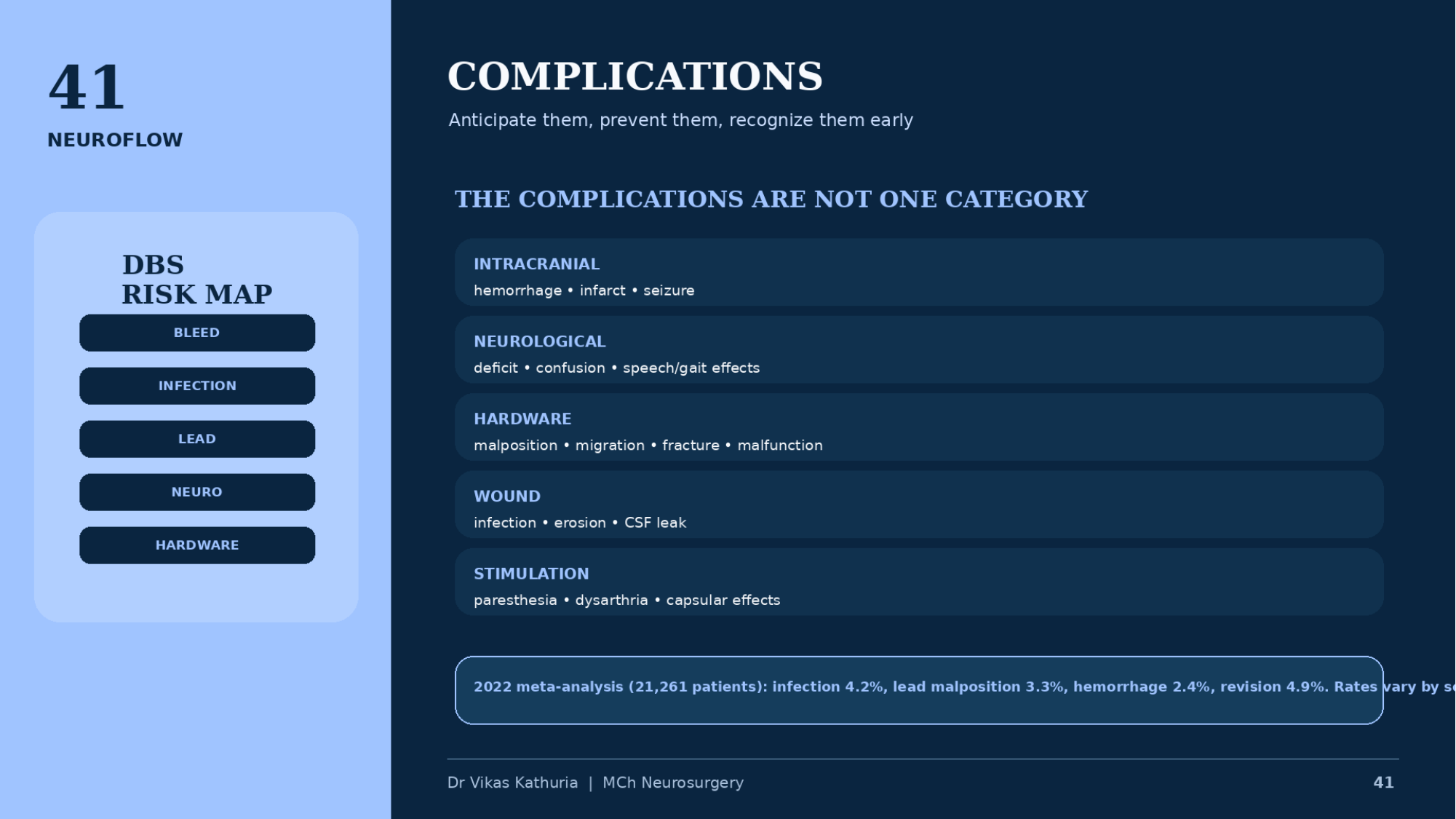
Original lecture slide 41, Complications, with a DBS risk map panel and five complication category cards

COMPLICATIONS

  • Anticipate them, prevent them, recognize them early
  • DBS RISK MAP
  • BLEED
  • INFECTION
  • LEAD
  • NEURO
  • HARDWARE
  • THE COMPLICATIONS ARE NOT ONE CATEGORY
  • INTRACRANIAL — hemorrhage • infarct • seizure
  • NEUROLOGICAL — deficit • confusion • speech/gait effects
  • HARDWARE — malposition • migration • fracture • malfunction
  • WOUND — infection • erosion • CSF leak
  • STIMULATION — paresthesia • dysarthria • capsular effects
  • 2022 meta-analysis (21,261 patients): infection 4.2%, lead malposition 3.3%, hemorrhage 2.4%, revision 4.9%. Rates vary by study.
  • Dr Vikas Kathuria | MCh Neurosurgery
Slide 42

Slide 42

Original lecture slide

100%
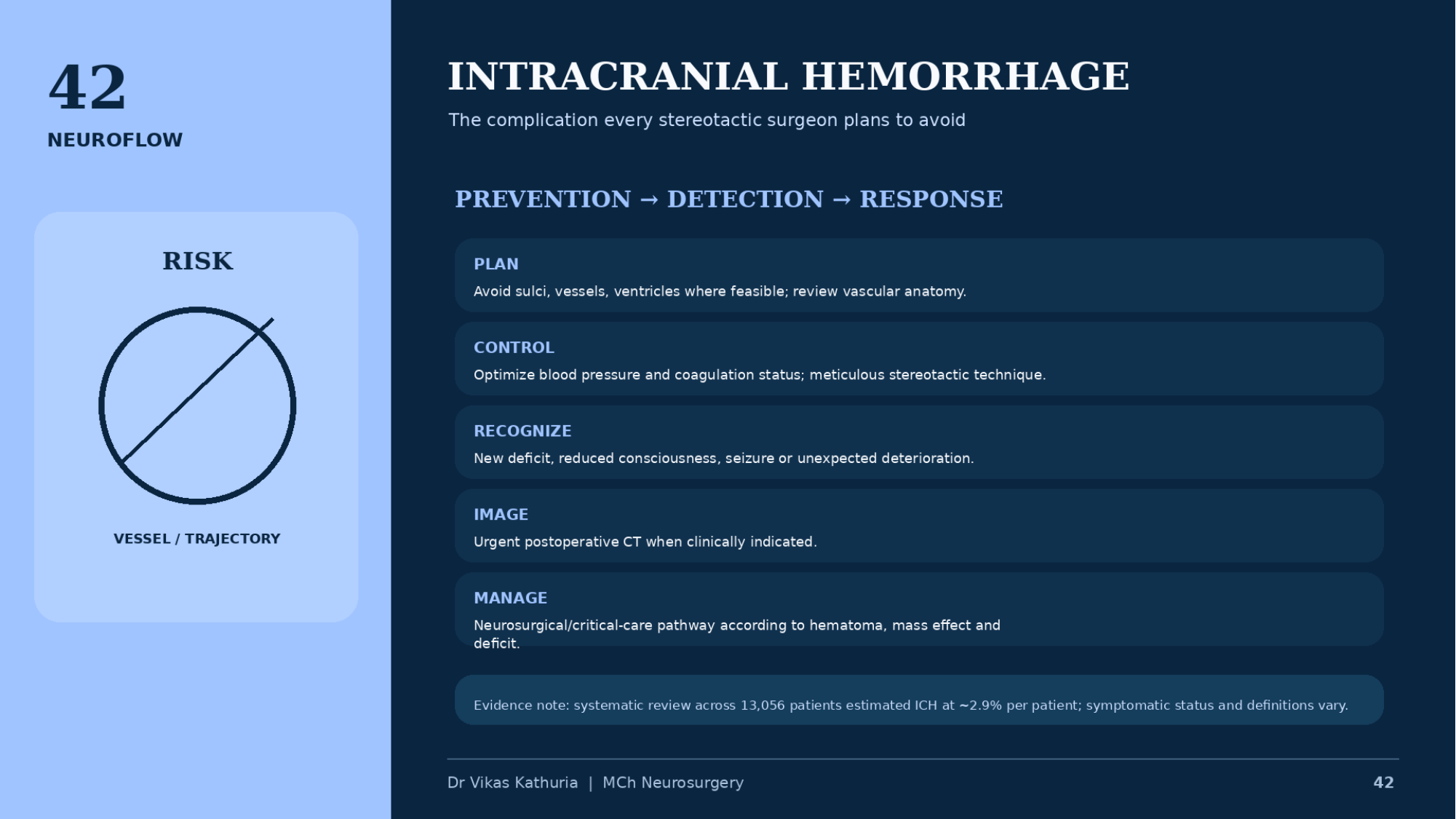
Original lecture slide 42, Intracranial hemorrhage, with a risk panel and the plan, control, recognize, image, manage sequence

INTRACRANIAL HEMORRHAGE

  • The complication every stereotactic surgeon plans to avoid
  • RISK
  • VESSEL / TRAJECTORY
  • PREVENTION → DETECTION → RESPONSE
  • PLAN — Avoid sulci, vessels, ventricles where feasible; review vascular anatomy.
  • CONTROL — Optimize blood pressure and coagulation status; meticulous stereotactic technique.
  • RECOGNIZE — New deficit, reduced consciousness, seizure or unexpected deterioration.
  • IMAGE — Urgent postoperative CT when clinically indicated.
  • MANAGE — Neurosurgical/critical-care pathway according to hematoma, mass effect and deficit.
  • Evidence note: systematic review across 13,056 patients estimated ICH at ≈2.9% per patient; symptomatic status and definitions vary.
  • Dr Vikas Kathuria | MCh Neurosurgery
Slide 43

Slide 43

Original lecture slide

100%
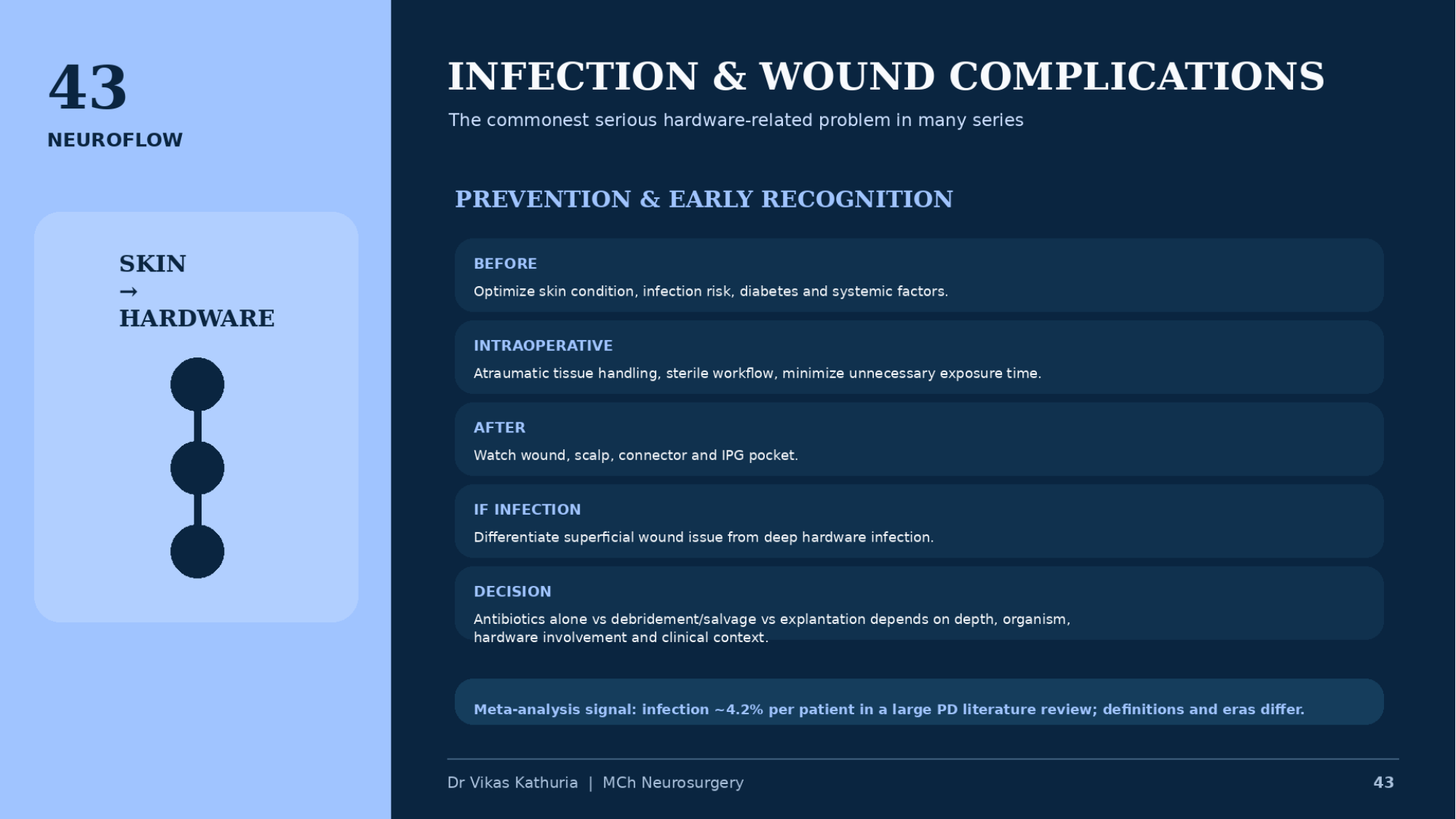
Original lecture slide 43, Infection and wound complications, with a skin to hardware panel and the before, intraoperative, after, if infection, decision sequence

INFECTION & WOUND COMPLICATIONS

  • The commonest serious hardware-related problem in many series
  • SKIN → HARDWARE
  • PREVENTION & EARLY RECOGNITION
  • BEFORE — Optimize skin condition, infection risk, diabetes and systemic factors.
  • INTRAOPERATIVE — Atraumatic tissue handling, sterile workflow, minimize unnecessary exposure time.
  • AFTER — Watch wound, scalp, connector and IPG pocket.
  • IF INFECTION — Differentiate superficial wound issue from deep hardware infection.
  • DECISION — Antibiotics alone vs debridement/salvage vs explantation depends on depth, organism, hardware involvement and clinical context.
  • Meta-analysis signal: infection ~4.2% per patient in a large PD literature review; definitions and eras differ.
  • Dr Vikas Kathuria | MCh Neurosurgery

Slide 44

Slide 44

Original lecture slide

100%
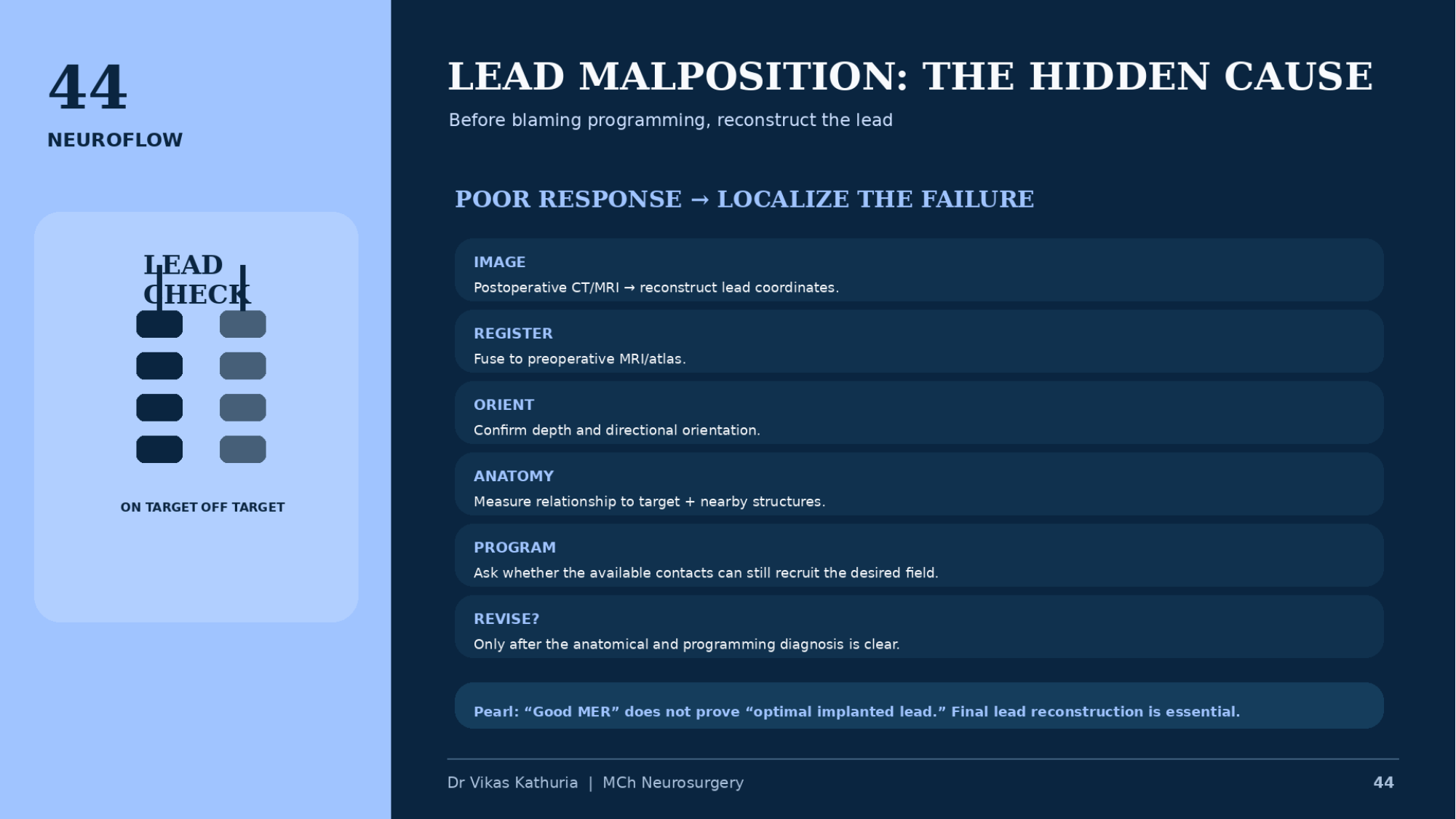
Original lecture slide 44, Lead malposition the hidden cause, with an on-target versus off-target lead check panel and the image, register, orient, anatomy, program, revise sequence

LEAD MALPOSITION: THE HIDDEN CAUSE

  • Before blaming programming, reconstruct the lead
  • LEAD CHECK
  • ON TARGET OFF TARGET
  • POOR RESPONSE → LOCALIZE THE FAILURE
  • IMAGE — Postoperative CT/MRI → reconstruct lead coordinates.
  • REGISTER — Fuse to preoperative MRI/atlas.
  • ORIENT — Confirm depth and directional orientation.
  • ANATOMY — Measure relationship to target + nearby structures.
  • PROGRAM — Ask whether the available contacts can still recruit the desired field.
  • REVISE? — Only after the anatomical and programming diagnosis is clear.
  • Pearl: “Good MER” does not prove “optimal implanted lead.” Final lead reconstruction is essential.
  • Dr Vikas Kathuria | MCh Neurosurgery

Slide 45

Slide 45

Original lecture slide

100%
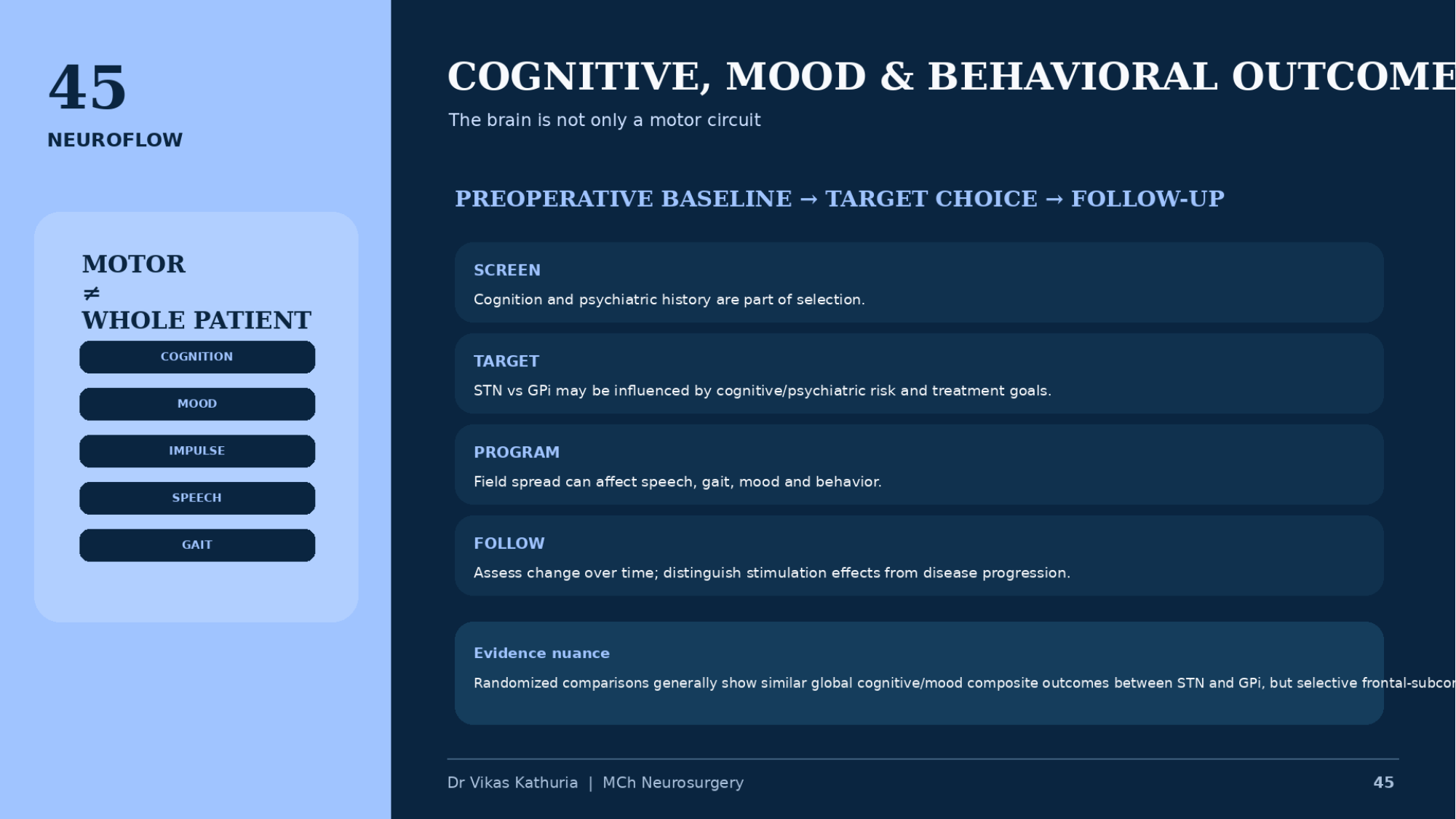
Original lecture slide 45, Cognitive mood and behavioral outcomes, with a motor does not equal whole patient panel and the screen, target, program, follow sequence

COGNITIVE, MOOD & BEHAVIORAL OUTCOMES

  • The brain is not only a motor circuit
  • MOTOR ≠ WHOLE PATIENT
  • COGNITION
  • MOOD
  • IMPULSE
  • SPEECH
  • GAIT
  • PREOPERATIVE BASELINE → TARGET CHOICE → FOLLOW-UP
  • SCREEN — Cognition and psychiatric history are part of selection.
  • TARGET — STN vs GPi may be influenced by cognitive/psychiatric risk and treatment goals.
  • PROGRAM — Field spread can affect speech, gait, mood and behavior.
  • FOLLOW — Assess change over time; distinguish stimulation effects from disease progression.
  • Evidence nuance: Randomized comparisons generally show similar global cognitive/mood composite outcomes between STN and GPi, but selective frontal-subcortical effects may differ.
  • Dr Vikas Kathuria | MCh Neurosurgery

Keyboard: ← previous slide · → next slide · O original slide · S study mode

The DBS complication framework

  1. 01PREVENT
  2. 02RECOGNIZE
  3. 03LOCALIZE
  4. 04MANAGE
  5. 05FOLLOW
  6. 06LEARN

Every complication should trigger two questions: 1. How do I treat this patient? 2. How do I prevent the next patient from experiencing the same problem?

Expanded study material

Prevent, detect, localize, treat, learn

Supplementary material written around the immutable original slides.

Interactive matrix

The DBS complication matrix

Five domains with different mechanisms, time courses and management pathways.

  • Hemorrhage
  • Infarction
  • Edema
  • Seizure

Interactive timeline

Complication timeline

When a problem appears narrows what it can be.

  • Anticoagulation / coagulation issues
  • Infection risk
  • Vascular risk
  • Cognitive / psychiatric risk

Interactive checklist

Preoperative hemorrhage prevention

A teaching aid — not a protocol, and not a medication-stop rule.

Perioperative antiplatelet / anticoagulation management must follow current institutional and specialist protocols.

Illustrative schematic

Trajectory risk

Two planning choices through the same schematic anatomy.

TARGETVENTRICLECORTEX / SULCI / CORTICAL VESSELS / BRIDGING VEINS

Trajectory B selects a gyral entry away from visible cortical vessels and bridging veins, avoids sulcal crossing and stays outside the ventricle where the anatomy allows it.

Illustrative surgical planning schematic — not patient imaging

Red flags after DBS

Urgent assessment is warranted

  • New focal neurological deficit
  • Reduced level of consciousness
  • Unexpected severe headache
  • Seizure
  • Sudden deterioration
  • Unexplained neurological change
  1. CLINICAL CHANGE
  2. URGENT ASSESSMENT
  3. IMAGING WHEN INDICATED
  4. NEUROSURGICAL / CRITICAL-CARE MANAGEMENT

Not every postoperative symptom represents hemorrhage — but unexplained deterioration is assessed rather than observed.

Critical thinking

Does MER cause hemorrhage?

The relationship is complex. Multiple trajectories can increase the number of intracranial passes. However, contemporary data have not established a simple universal “MER = hemorrhage” relationship. Focus on the number of passes, trajectory planning, vascular anatomy, surgical technique and patient risk factors, and avoid simplistic claims.

Interactive decision tree

Infection: depth and hardware involvement

The management problem changes when implanted hardware is involved.

Document appearance, depth, discharge, systemic features and timing from implantation.

  1. 01 Normal healing
  2. 02 Superficial wound problem
  3. 03 Suspected infection
  4. 04 Deep pocket / hardware involvement
  5. 05 Erosion / exposed hardware

Interactive workflow

Lead localization workflow

Reconstruct the lead before attributing poor response to programming.

Acquired to localize the implanted lead, not merely to exclude complications.

Good MER ≠ guaranteed final lead · Revision is not a programming strategy

Interactive wheel

Localize the failure

Poor outcome at the centre; each explanation asks what evidence would confirm or exclude it.

Centre — poor outcome

What evidence would confirm or exclude this explanation?

Is the underlying diagnosis correct? What evidence would confirm or exclude it — course, examination, response history, supportive investigations?

Master algorithm

DBS complication — what, when, where, why, what next

One full-width pathway from event to learning.

WHAT HAPPENED?

  • Intracranial
  • Neurological
  • Hardware
  • Wound
  • Stimulation
  • Cognitive / behavioral

WHEN?

  • Intraoperative
  • Immediate
  • Early
  • Late
  • Long-term

WHERE?

  • Brain
  • Lead
  • Extension
  • IPG
  • Wound
  • Stimulation field

WHY?

  • Surgical
  • Anatomical
  • Hardware
  • Programming
  • Medication
  • Disease
  • Patient factors

WHAT NEXT?

  • Prevent
  • Detect
  • Localize
  • Treat
  • Follow

Comparison

Prevention versus rescue

Two different disciplines around the same patient.

Prevention

  • Patient selection
  • Imaging
  • Trajectory planning
  • Coagulation / BP management
  • Sterile technique
  • Precise lead placement
  • Verification
  • Programming

Rescue

  • Early recognition
  • Urgent imaging
  • Neurological assessment
  • Infection evaluation
  • Hardware evaluation
  • Programming review
  • Multidisciplinary management
  • Revision when justified

Prevention is systematic. Rescue must be rapid. Revision must be diagnostic.

Evidence hierarchy

Where each statement currently sits

Categories move as evidence accumulates.

ESTABLISHED

  • DBS has recognized surgical, hardware and stimulation-related risks
  • Postoperative neurological deterioration requires appropriate assessment
  • Lead localization is important in unexplained poor response
  • Cognition and psychiatry belong in patient selection

SUPPORTED

  • Trajectory planning reduces avoidable anatomical risk
  • Postoperative imaging can identify lead location and complications
  • Programming and field spread influence stimulation adverse effects

EMERGING

  • Sophisticated lead / VTA / connectomic failure analysis
  • Individualized prediction of stimulation-related cognitive or behavioral effects

RESEARCH / EVOLVING

  • AI-based complication prediction
  • Automated lead-failure localization
  • Fully individualized network-based complication prediction

Five high-value faculty questions

Ask the room before revealing

Each answer stays hidden until you choose to show it.

Question 1

What is the most dangerous DBS complication to miss?

Question 2

When should you suspect hardware infection rather than a simple wound problem?

Question 3

What is the first investigation in a patient with unexplained poor DBS response?

Question 4

Does excellent MER guarantee an excellent DBS result?

Question 5

Is DBS a motor treatment only?

Major teaching statements

Seven statements to carry into the next clinic

PREVENT BEFORE YOU TREAT.
RECOGNIZE BEFORE YOU REVISE.
LOCALIZE THE FAILURE BEFORE YOU BLAME THE DEVICE.
GOOD MER DOES NOT GUARANTEE AN OPTIMAL FINAL LEAD.
POOR RESPONSE IS A DIAGNOSTIC PROBLEM.
THE BRAIN IS NOT ONLY A MOTOR CIRCUIT.
THE PATIENT'S BASELINE MATTERS AS MUCH AS THE POSTOPERATIVE RESULT.

Cross-links

Where this material connects

Each link opens the related slide elsewhere in the curriculum.

Prevent → Detect → Localize → Treat → Learn

The goal is not to have zero complications. The goal is to build a DBS system that reduces preventable complications, recognizes problems early, localizes failure accurately, and treats the patient — not just the device.

The best DBS surgeon is not the one who never encounters a complication. It is the one who anticipates risk, prevents what can be prevented, recognizes what cannot, localizes the problem, and knows when — and when not — to revise.

Deep study material

Expanded study material

DBS carries recognized surgical, hardware and stimulation-related risks

ESTABLISHED

Postoperative neurological deterioration requires appropriate assessment; lead localization matters in unexplained poor response; cognition and psychiatry belong in patient selection.

Trajectory planning and postoperative imaging

SUPPORTED

Vessel-, sulcus- and ventricle-aware trajectory planning reduces avoidable anatomical risk, and postoperative imaging can identify lead location and complications.

Programming and field spread

SUPPORTED

Contact selection, amplitude and directional steering influence stimulation-related adverse effects within the limits of lead position.

Sophisticated failure analysis

EMERGING

Combined lead reconstruction, VTA modelling and connectomic analysis of DBS failure is an active research area rather than routine care.

Individualized prediction

EMERGING

Prediction of stimulation-related cognitive or behavioural effects in an individual patient remains under investigation.

AI-based complication prediction, automated lead-failure localization and fully individualized network-based prediction

EXPERIMENTAL

RESEARCH DIRECTION — not clinical practice.

Anatomy

Anatomy

Expanded study material for this section is written once the original slides for this module are supplied.

Surgical principles

Surgical principles

Expanded study material for this section is written once the original slides for this module are supplied.

Physiology

Physiology

Expanded study material for this section is written once the original slides for this module are supplied.

Imaging

Imaging

Expanded study material for this section is written once the original slides for this module are supplied.

Programming

Programming

Expanded study material for this section is written once the original slides for this module are supplied.

Image placeholders

Images required for this module

Each placeholder states the image type, what is required, why it teaches and where a legitimate source should come from. No clinical image is fabricated.

Image placeholder

PAGE 09 COMPLICATION ALGORITHM — INSERT AUTHENTIC IMAGE

Real clinical image required

Image typeSchematic / diagram
DescriptionOriginal educational algorithm covering what, when, where, why and what next.
Clinical purposeSupport fellowship-level interpretation without fabricating patient imaging, wound photographs or lead-localization results.
Suggested sourceINSERT AUTHENTIC PUBLISHED / INSTITUTIONAL IMAGE HERE (licensing and consent confirmed)
Copyright statusSource, consent and reproduction rights must be confirmed before use.
CaptionTo be written with the final image
AssociationModule 09 · Slide 41

THE DBS COMPLICATION LOOP

01

Patient selection

02

Risk assessment

03

Trajectory

04

Surgery

05

Verification

06

Programming

07

Follow-up

08

Complication / poor response

09

Localize

10

Treat

11

Learn

  1. PATIENT SELECTION
  2. RISK ASSESSMENT
  3. TRAJECTORY
  4. SURGERY
  5. VERIFICATION
  6. PROGRAMMING
  7. FOLLOW-UP
  8. COMPLICATION / POOR RESPONSE
  9. LOCALIZE
  10. TREAT
  11. LEARN

AT THE CENTRE OF THE LOOP: PATIENT SAFETY.

Clinical pearls

  • PREVENT BEFORE YOU TREAT.
  • RECOGNIZE BEFORE YOU REVISE.
  • LOCALIZE THE FAILURE BEFORE YOU BLAME THE DEVICE.
  • GOOD MER DOES NOT GUARANTEE AN OPTIMAL FINAL LEAD.
  • POOR RESPONSE IS A DIAGNOSTIC PROBLEM.
  • THE BRAIN IS NOT ONLY A MOTOR CIRCUIT.
  • THE PATIENT'S BASELINE MATTERS AS MUCH AS THE POSTOPERATIVE RESULT.

Common errors

  • Quoting a single complication percentage as if it applied universally.
  • Treating every postoperative symptom as hemorrhage — or none of them.
  • Claiming simply that “MER causes hemorrhage”.
  • Managing a deep hardware infection as a superficial wound problem.
  • Applying a universal salvage-versus-explantation rule.
  • Changing programming repeatedly without reconstructing the lead.
  • Using revision as a troubleshooting step rather than a diagnostic conclusion.
  • Attributing every behavioural change after surgery to stimulation.
  • Presenting STN or GPi as universally superior.

Case discussion

Cases

Case discussion

CASE 1 — Postoperative day 1: new weakness and reduced consciousness

Patient profile

Teaching case. No real patient data are used.

Clinical phenotype

New focal weakness with a reduced level of consciousness on the first postoperative day.

Surgical plan

Question for the room: what do you do?

Outcome

Urgent neurological assessment + urgent imaging when indicated + neurosurgical / critical-care response.

Lessons

  • Do not delay evaluation while waiting for the picture to clarify.
  • The response pathway should already exist before the event.
  • Imaging supports the clinical assessment; it does not replace it.

Case discussion

CASE 2 — Six months after DBS: declining benefit despite multiple programming attempts

Patient profile

Teaching case. No real patient data are used.

Clinical phenotype

Progressive loss of benefit after an initially acceptable response; several programming sessions without durable improvement.

Surgical plan

Question for the room: is the lead the problem? Do not answer immediately.

Outcome

Work through diagnosis → phenotype → programming → medication → hardware → lead localization → disease progression.

Lessons

  • The sequence matters more than the individual test.
  • Hardware integrity is cheap to check and easy to forget.
  • Revision is considered only once a localizable, correctable problem exists.

Case discussion

CASE 3 — Postoperative behavioral change

Patient profile

Teaching case. No real patient data are used.

Clinical phenotype

A change in behaviour reported by the family after implantation.

Surgical plan

Question for the room: is this DBS-induced?

Outcome

Explore stimulation, medication, baseline vulnerability, disease progression, psychiatric causes, cognitive change and psychosocial factors.

Lessons

  • Attribution requires the preoperative baseline.
  • Medication changes often coincide with stimulation changes.
  • Behavioural change is a multidisciplinary problem from the first consultation.

Take-home message

Complication management is part of DBS surgery — not an afterthought.Prevention is systematic. Rescue must be rapid. Revision must be diagnostic.

  1. PREVENT
  2. DETECT
  3. LOCALIZE
  4. TREAT
  5. LEARN

References

Evidence supporting this module

  1. Rasiah NP, Maheshwary R, Kwon CS, Bloomstein JD, Girgis F. Complications of deep brain stimulation for Parkinson disease and relationship between microelectrode tracks and hemorrhage: systematic review and meta-analysis. World Neurosurg. 2022;167:e363-e377.
  2. Zrinzo L, Foltynie T, Limousin P, Hariz MI. Reducing hemorrhagic complications in functional neurosurgery: a large case series and systematic literature review. J Neurosurg. 2012;116(1):84-94.
  3. Fenoy AJ, Simpson RK Jr. Risks of common complications in deep brain stimulation surgery: management and avoidance. J Neurosurg. 2014;120(1):132-139.
  4. Wang X, Li N, Li J, et al. Optimized deep brain stimulation surgery to avoid vascular damage: a single-center retrospective analysis of path planning for various deep targets by MRI image fusion. Brain Sci. 2022;12(8):967.
  5. Bériault S, Al Subaie F, Collins DL, Sadikot AF, Pike GB. A multi-modal approach to computer-assisted deep brain stimulation trajectory planning. Int J Comput Assist Radiol Surg. 2012;7(5):687-704.
  6. Horn A, Kühn AA. Lead-DBS: a toolbox for deep brain stimulation electrode localizations and visualizations. Neuroimage. 2015;107:127-135.
  7. Horn A, Li N, Dembek TA, et al. Lead-DBS v2: towards a comprehensive pipeline for deep brain stimulation imaging. Neuroimage. 2019;184:293-316.
  8. Butson CR, Cooper SE, Henderson JM, McIntyre CC. Patient-specific analysis of the volume of tissue activated during deep brain stimulation. Neuroimage. 2007;34(2):661-670.
  9. Koeglsperger T, Palleis C, Hell F, Mehrkens JH, Bötzel K. Deep brain stimulation programming for movement disorders: current concepts and evidence-based strategies. Front Neurol. 2019;10:410.
  10. Follett KA, Weaver FM, Stern M, et al. Pallidal versus subthalamic deep-brain stimulation for Parkinson's disease. N Engl J Med. 2010;362(22):2077-2091.
  11. Odekerken VJJ, van Laar T, Staal MJ, et al. Subthalamic nucleus versus globus pallidus bilateral deep brain stimulation for advanced Parkinson's disease (NSTAPS study): a randomised controlled trial. Lancet Neurol. 2013;12(1):37-44.
  12. Weaver FM, Follett K, Stern M, et al. Bilateral deep brain stimulation vs best medical therapy for patients with advanced Parkinson disease: a randomized controlled trial. JAMA. 2009;301(1):63-73.
  13. Okun MS. Deep-brain stimulation for Parkinson's disease. N Engl J Med. 2012;367(16):1529-1538.
  14. Bronstein JM, Tagliati M, Alterman RL, et al. Deep brain stimulation for Parkinson disease: an expert consensus and review of key issues. Arch Neurol. 2011;68(2):165-171.

“THE GOAL IS NOT TO HAVE ZERO COMPLICATIONS. THE GOAL IS TO BUILD A DBS SYSTEM THAT REDUCES PREVENTABLE COMPLICATIONS, RECOGNIZES PROBLEMS EARLY, LOCALIZES FAILURE ACCURATELY, AND TREATS THE PATIENT — NOT JUST THE DEVICE.”

Next module · 10Cases → Landmark Evidence → Surgical Pearls