Module 02

Patient Selection → Stereotactic Reference → Targeting

Slides 6–10 | From coordinates to patient-specific target selection

Original lecture slides 6–10 · Module 02 / 10

“Coordinates generate the hypothesis. Anatomy refines the target. Functional territories and pathways explain the biology. Trajectory makes the plan surgical.”

From phenotype to plan

  1. 01PATIENT / PHENOTYPE
  2. 02STEREOTACTIC REFERENCE
  3. 03TARGET HYPOTHESIS
  4. 04ANATOMICAL IMAGING
  5. 05FUNCTIONAL TERRITORY
  6. 06TARGET + TRAJECTORY
  7. 07PATIENT-SPECIFIC DBS PLAN

Learning objectives

By the end of this module you should be able to

  1. 01Explain the AC–PC stereotactic reference framework
  2. 02Distinguish coordinates from biological targets
  3. 03Compare indirect, direct and hybrid DBS targeting
  4. 04Explain why STN functional territory matters
  5. 05Select MRI sequences according to the target and clinical question
  6. 06Understand the anatomical targeting logic of GPi
  7. 07Understand nucleus-plus-pathway concepts for VIM / DRT targeting
  8. 08Integrate anatomy, coordinates, pathway information and trajectory planning
  9. 09Recognize the limitations of any single targeting modality

Original lecture slides

Slides 6–10

The slides below are reproduced exactly as delivered. Everything outside the slide panel is added study material.

Slide 6

Slide 6

Original lecture slide

100%
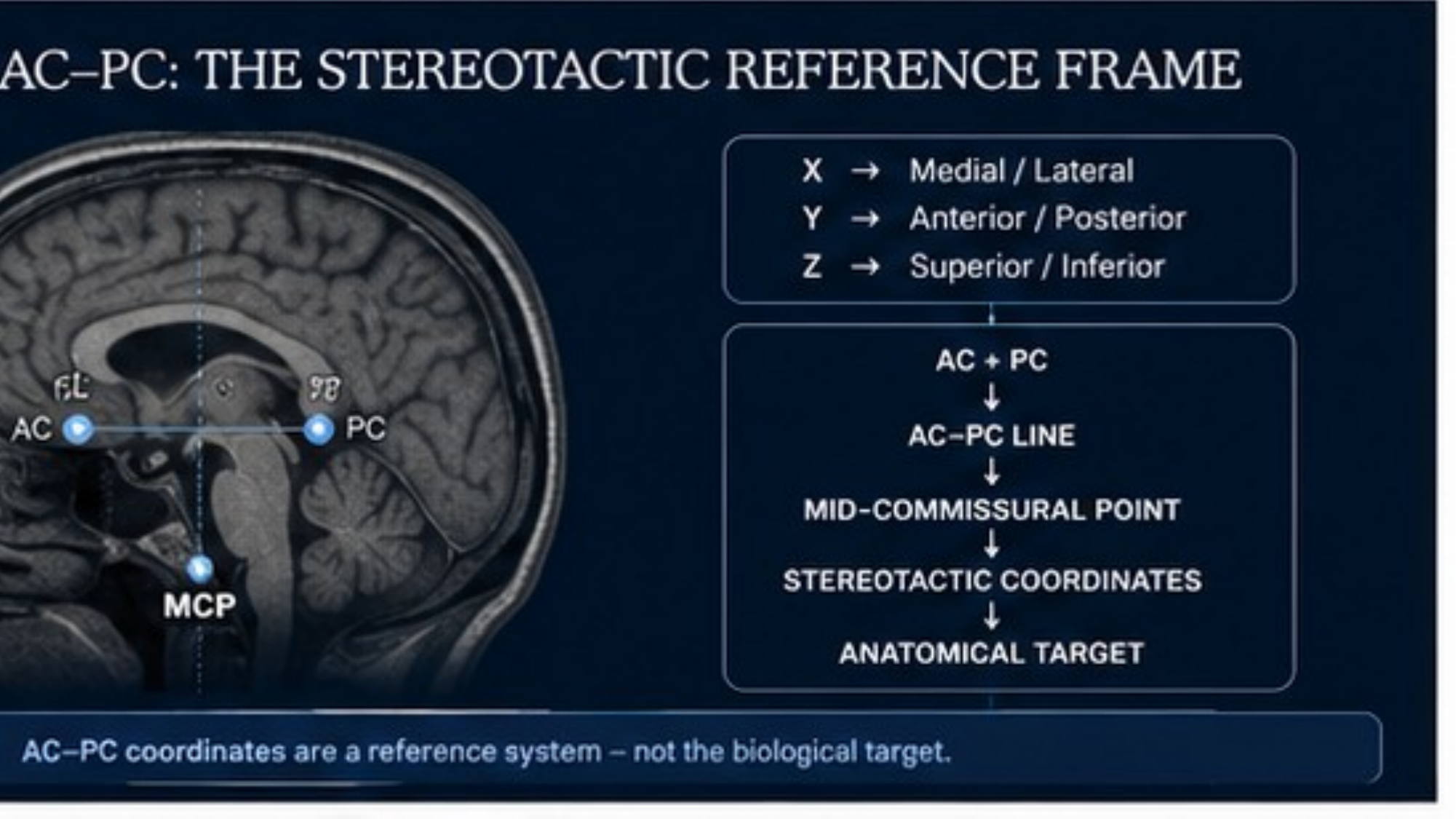
Original lecture slide 6 showing the AC–PC stereotactic reference frame

AC–PC: THE STEREOTACTIC REFERENCE FRAME

  • X → Medial / Lateral
  • Y → Anterior / Posterior
  • Z → Superior / Inferior
  • AC + PC
  • ↓
  • AC–PC LINE
  • ↓
  • MID–COMMISSURAL POINT
  • ↓
  • STEREOTACTIC COORDINATES
  • ↓
  • ANATOMICAL TARGET
  • AC–PC coordinates are a reference system – not the biological target.

Slide 7

Slide 7

Original lecture slide

100%
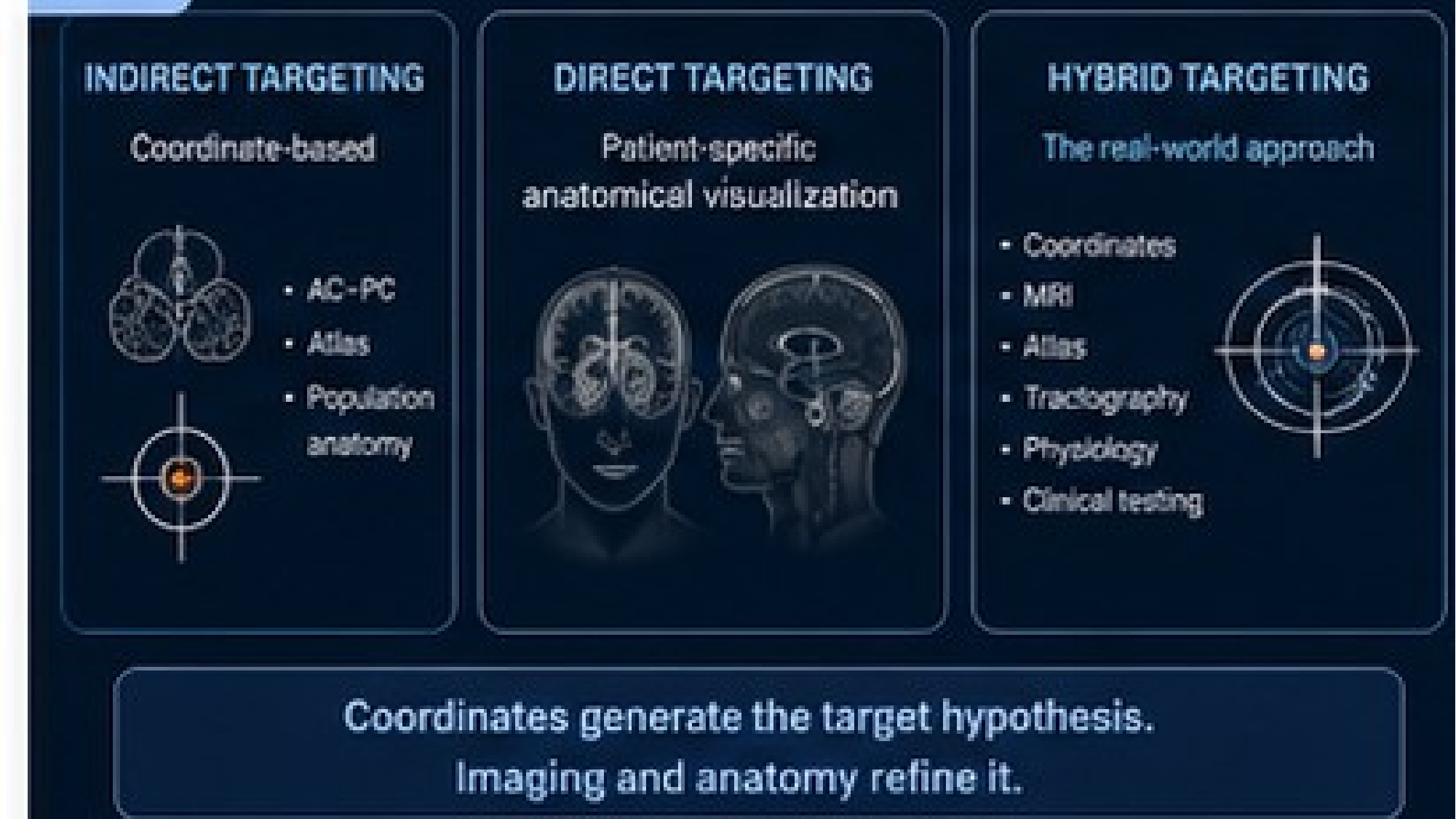
Original lecture slide 7 comparing indirect, direct and hybrid DBS targeting

INDIRECT, DIRECT & HYBRID TARGETING

  • INDIRECT TARGETING
  • Coordinate-based
  • AC–PC
  • Atlas
  • Population anatomy
  • DIRECT TARGETING
  • Patient-specific anatomical visualization
  • HYBRID TARGETING
  • The real-world approach
  • Coordinates
  • MRI
  • Atlas
  • Tractography
  • Physiology
  • Clinical testing
  • Coordinates generate the target hypothesis.
  • Imaging and anatomy refine it.

Slide 8

Slide 8

Original lecture slide

100%
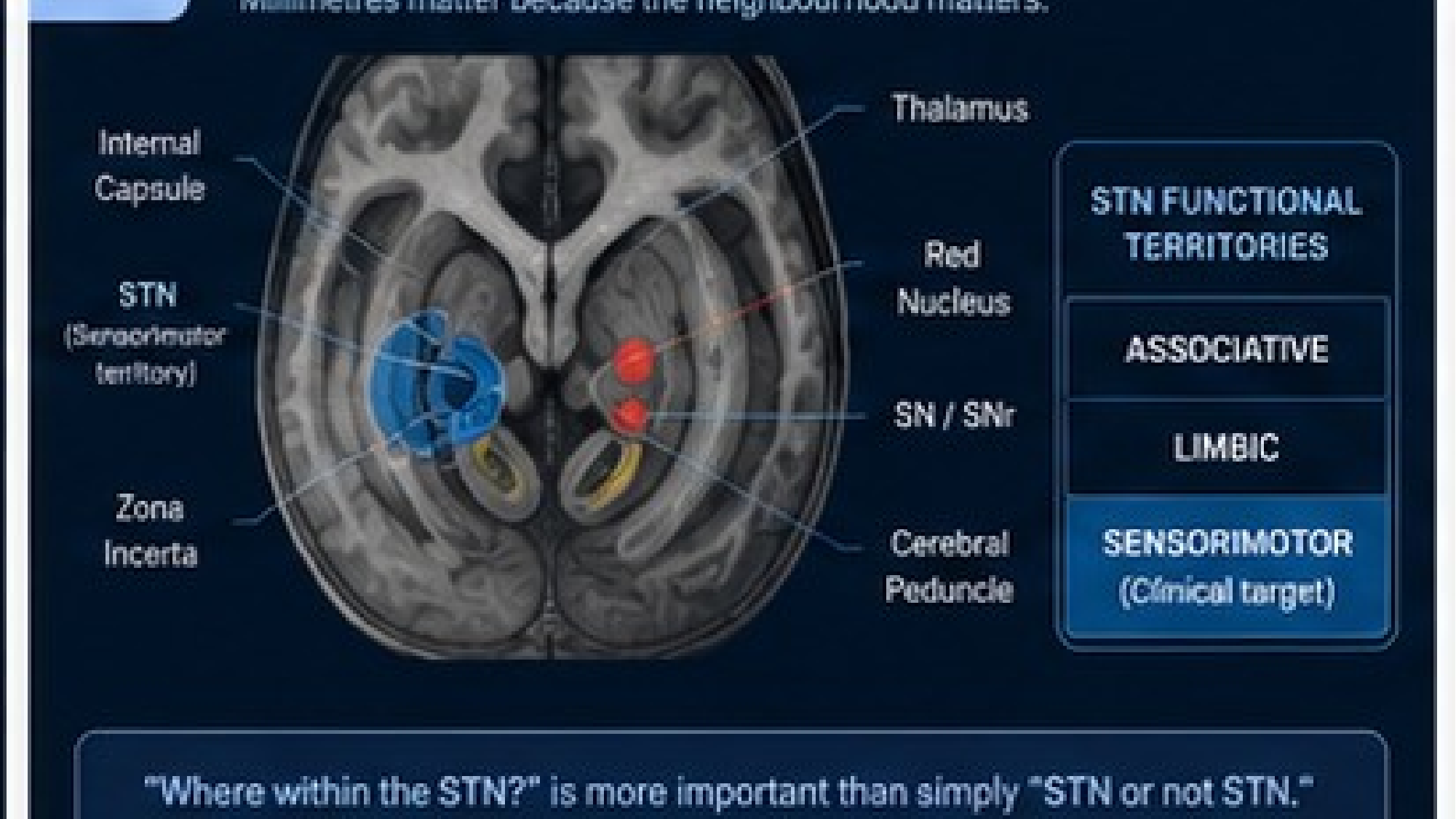
Original lecture slide 8 showing STN functional territories and neighbouring structures

MILLIMETRES MATTER BECAUSE THE NEIGHBOURHOOD MATTERS.

  • Internal Capsule
  • STN (Sensorimotor territory)
  • Zona Incerta
  • Thalamus
  • Red Nucleus
  • SN / SNr
  • Cerebral Peduncle
  • STN FUNCTIONAL TERRITORIES
  • ASSOCIATIVE
  • LIMBIC
  • SENSORIMOTOR (Clinical target)
  • “Where within the STN?” is more important than simply “STN or not STN.”

Slide 9

Slide 9

Original lecture slide

100%
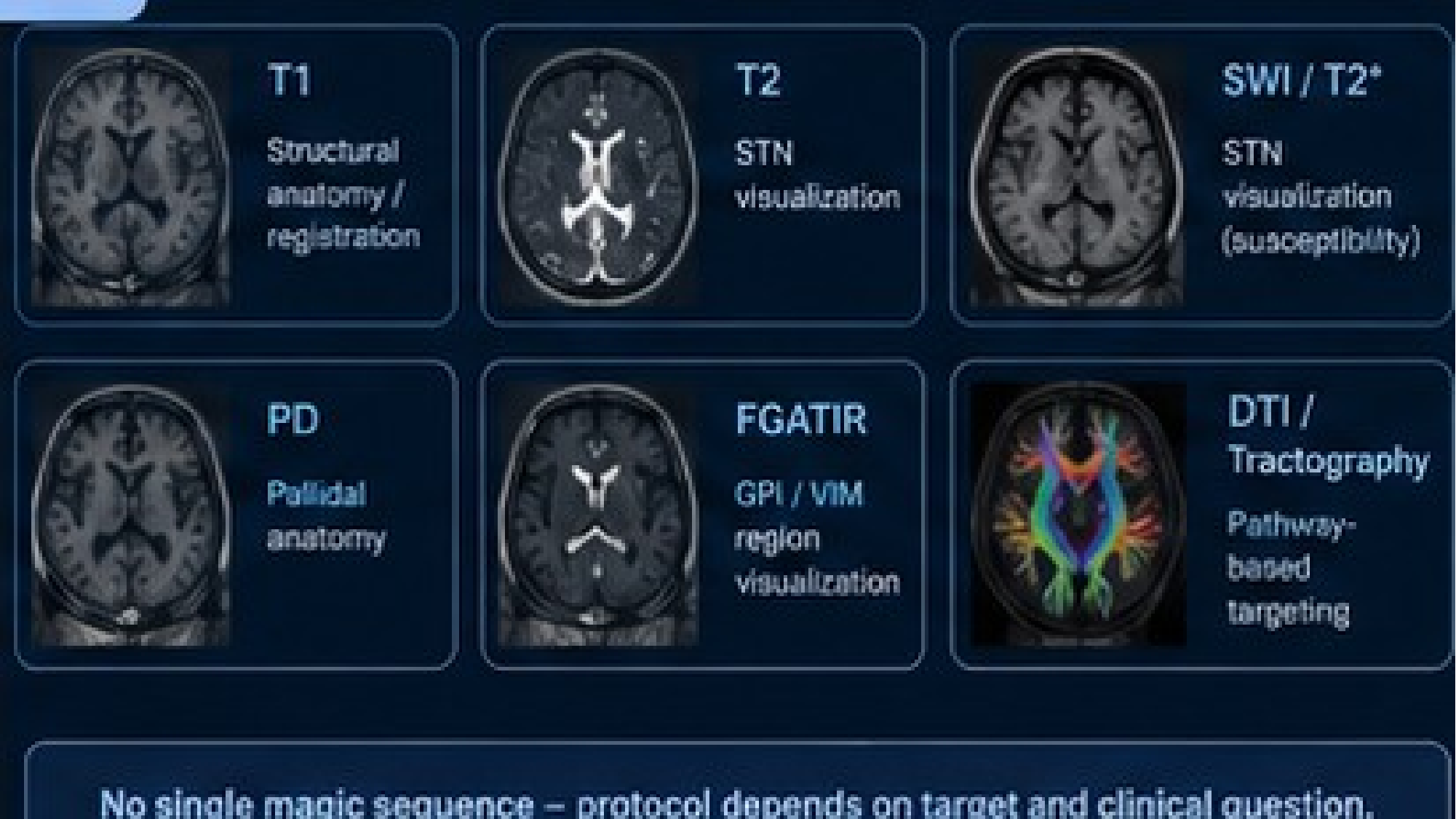
Original lecture slide 9 comparing MRI sequences used in DBS targeting

MRI SEQUENCES FOR DBS TARGETING

  • T1
  • Structural anatomy / registration
  • T2
  • STN visualization
  • SWI / T2*
  • STN visualization (susceptibility)
  • PD
  • Pallidal anatomy
  • FGATIR
  • GPi / VIM region visualization
  • DTI / Tractography
  • Pathway-based targeting
  • No single magic sequence – protocol depends on target and clinical question.

Slide 10

Slide 10

Original lecture slide

100%
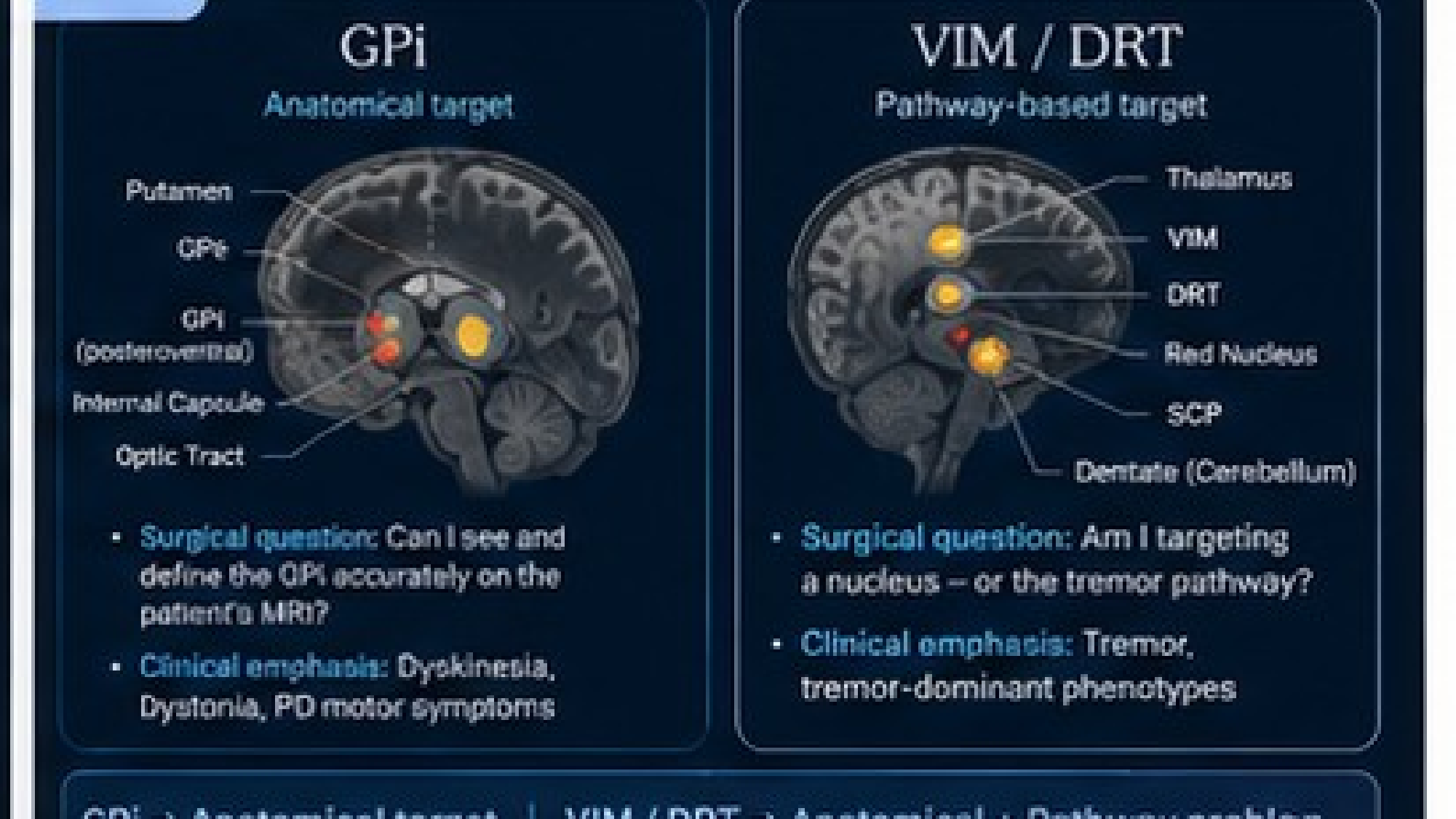
Original lecture slide 10 comparing anatomical GPi and pathway-based VIM/DRT targets

GPi & VIM / DRT

  • GPi
  • Anatomical target
  • Putamen
  • GPe
  • GPi (posteroventral)
  • Internal Capsule
  • Optic Tract
  • Surgical question: Can I see and define the GPi accurately on the patient's MRI?
  • Clinical emphasis: Dyskinesia, Dystonia, PD motor symptoms
  • VIM / DRT
  • Pathway-based target
  • Thalamus
  • VIM
  • DRT
  • Red Nucleus
  • SCP
  • Dentate (Cerebellum)
  • Surgical question: Am I targeting a nucleus – or the tremor pathway?
  • Clinical emphasis: Tremor, tremor-dominant phenotypes
  • GPi = Anatomical target | VIM / DRT = Anatomical + Pathway problem

Expanded study material

Targeting concepts

Expand each fellowship-level topic without leaving Page 02. These panels are supplementary to the immutable original slides.

Case-based learning

Targeting decisions

Commit to an answer before revealing the discussion.

Case 01 · STN targeting

Discordant coordinate and MRI targets

A patient with Parkinson's disease is being evaluated for STN DBS. MRI demonstrates the STN reasonably well, but the coordinate-derived target is slightly different from the visually estimated target.

What should determine your final plan?

Case 02 · Tremor targeting

Thalamic anatomy and the DRT pathway

A patient with essential tremor is being considered for DBS. The surgeon can identify the thalamic anatomy and is also evaluating the dentato-rubro-thalamic pathway.

Why might pathway information change the targeting discussion?

Deep study material

Expanded study material

Coordinates, anatomy and physiology

ESTABLISHED

AC–PC coordinates provide a reproducible reference. Patient-specific imaging tests the resulting hypothesis against anatomy, while physiological confirmation may refine selected workflows where it is used; it is not a universal requirement for every DBS procedure.

No single targeting modality is sufficient in every case

SUPPORTED

Direct visualization, atlas information, vascular constraints, tractography and physiological or clinical testing each have target-dependent strengths and limitations.

Anatomy

Anatomy

Expanded study material for this section is written once the original slides for this module are supplied.

Surgical principles

Surgical principles

Expanded study material for this section is written once the original slides for this module are supplied.

Physiology

Physiology

Expanded study material for this section is written once the original slides for this module are supplied.

Imaging

Imaging

Expanded study material for this section is written once the original slides for this module are supplied.

Programming

Programming

Expanded study material for this section is written once the original slides for this module are supplied.

TARGETING LOGIC

01

Reference frame

02

Coordinates

03

Target hypothesis

04

Patient-specific MRI

05

Functional territory

06

Pathway / connectivity

07

Trajectory

08

Physiology when appropriate

09

Final lead position

10

Stimulation field

11

Clinical effect

  1. REFERENCE
  2. COORDINATES
  3. HYPOTHESIS
  4. MRI
  5. TERRITORY
  6. PATHWAY
  7. TRAJECTORY
  8. LEAD
  9. FIELD
  10. EFFECT

THE TARGET IS A BIOLOGICAL CONCEPT, NOT JUST A COORDINATE.

Clinical pearls

  • Coordinates are a reference system, not the biological target.
  • Direct visualization does not eliminate the need for anatomical reasoning.
  • Where within the target may matter more than simply reaching the target.
  • MRI protocol should follow the target and the clinical question.
  • GPi and VIM / DRT represent different targeting philosophies.
  • Pathway-based targeting is powerful but should not be treated as infallible.

Take-home message

THE FINAL TARGETIS PATIENT-SPECIFIC.

  1. COORDINATES
  2. ANATOMY
  3. FUNCTIONAL TERRITORY
  4. PATHWAY
  5. TRAJECTORY
  6. PLAN

References

Evidence supporting this module

  1. Güttler C, Achtzehn J, Blomstedt P, et al. Toward a standard preoperative MRI protocol for functional neurosurgery. Imaging Neurosci (Camb). 2025;3.
  2. D'Alessandris QG, Pambianco F, Martinelli R, et al. Usefulness of 3T MR in surgical planning for deep brain stimulation surgery: a systematic literature review. Neurosurg Rev. 2025;48(1):415.
  3. Andrade-Souza YM, Schwalb JM, Hamani C, et al. Comparison of three methods of targeting the subthalamic nucleus for chronic stimulation in Parkinson's disease. Neurosurgery. 2005;56(2 Suppl):360-368.
  4. Lahtinen MJ, Haapaniemi TH, Kauppinen MT, Salokorpi N, Heikkinen ER, Katisko JP. A comparison of indirect and direct targeted STN DBS in the treatment of Parkinson's disease—surgical method and clinical outcome over 15-year timespan. Acta Neurochir (Wien). 2020;162(5):1067-1076.
  5. Haynes WI, Haber SN. The organization of prefrontal-subthalamic inputs in primates provides an anatomical substrate for both functional specificity and integration. J Neurosci. 2013;33(11):4804-4814.
  6. Lambert C, Zrinzo L, Nagy Z, et al. Confirmation of functional zones within the human subthalamic nucleus: patterns of connectivity and sub-parcellation using diffusion weighted imaging. Neuroimage. 2012;60(1):83-94.
  7. Starr PA, Turner RS, Rau G, et al. Microelectrode-guided implantation of deep brain stimulators into the globus pallidus internus for dystonia: techniques, electrode locations, and outcomes. J Neurosurg. 2006;104(4):488-501.
  8. Parras O, Domínguez P, Tomás-Biosca A, Guridi J. The role of tractography in the localization of the Vim nucleus of the thalamus and the dentato-rubro-thalamic tract for the treatment of tremor. Neurologia (Engl Ed). 2022;37(8):691-699.
  9. Dembek TA, Petry-Schmelzer JN, Reker P, et al. PSA and VIM DBS efficiency in essential tremor depends on distance to the dentatorubrothalamic tract. Neuroimage Clin. 2020;26:102235.
  10. Lehman VT, Lee KH, Klassen BT, et al. MRI and tractography techniques to localize the ventral intermediate nucleus and dentatorubrothalamic tract for deep brain stimulation and MR-guided focused ultrasound: a narrative review and update. Neurosurg Focus. 2020;49(1):E8.
  11. Calabrese E. Diffusion tractography in deep brain stimulation surgery: a review. Front Neuroanat. 2016;10:45.

“Coordinates generate the hypothesis. Anatomy refines the target. Functional territories and pathways explain the biology. Trajectory makes the plan surgical. The final target is patient-specific.”

Next module · 03Stereotactic Planning → Physiological Confirmation