Slide 21
PROGRAMMING: THE SECOND OPERATION
- Turning a well-placed lead into clinical benefit
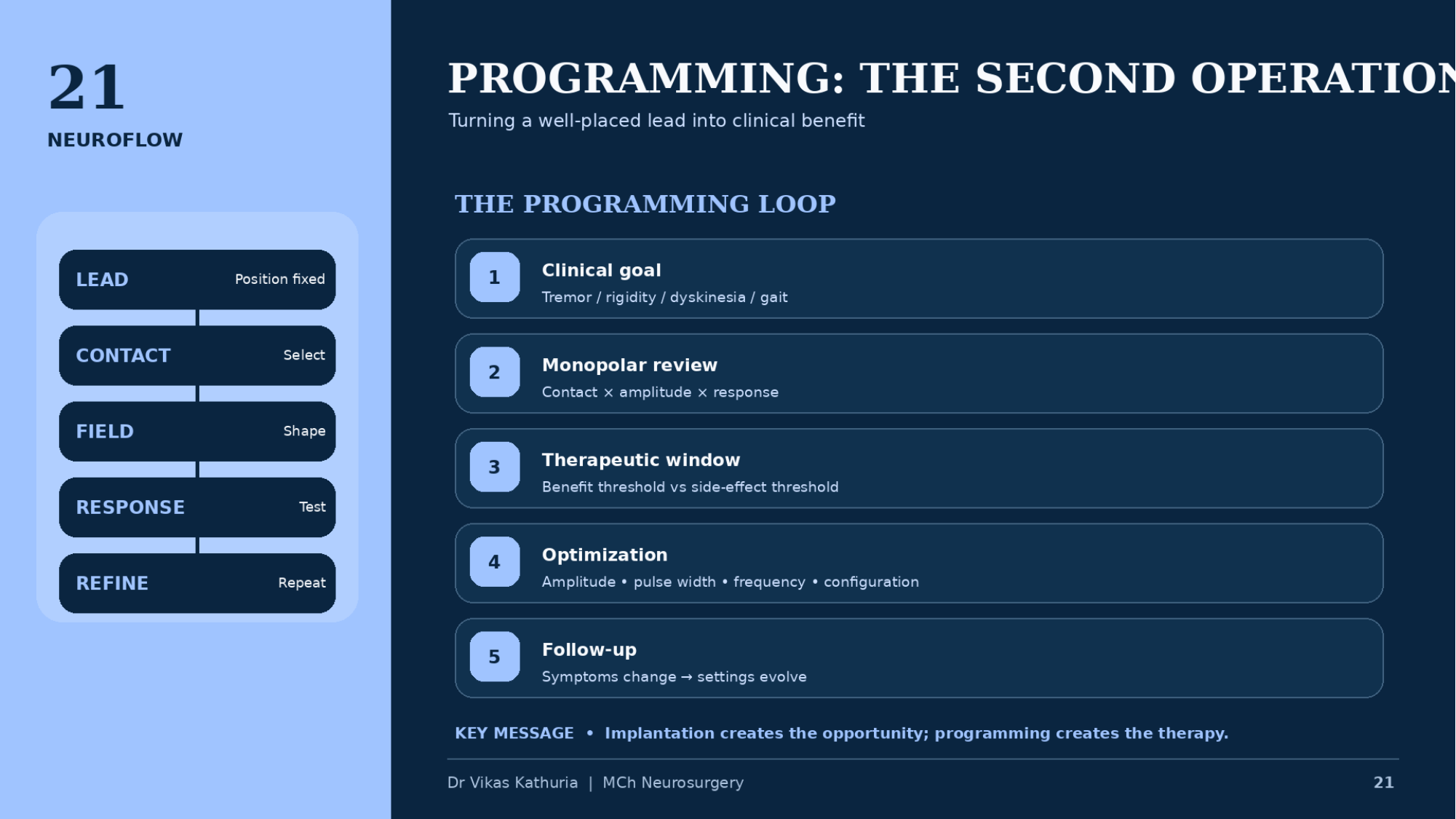
- LEAD — Position fixed
- CONTACT — Select
- FIELD — Shape
- RESPONSE — Test
- REFINE — Repeat
- THE PROGRAMMING LOOP
- 1 Clinical goal — Tremor / rigidity / dyskinesia / gait
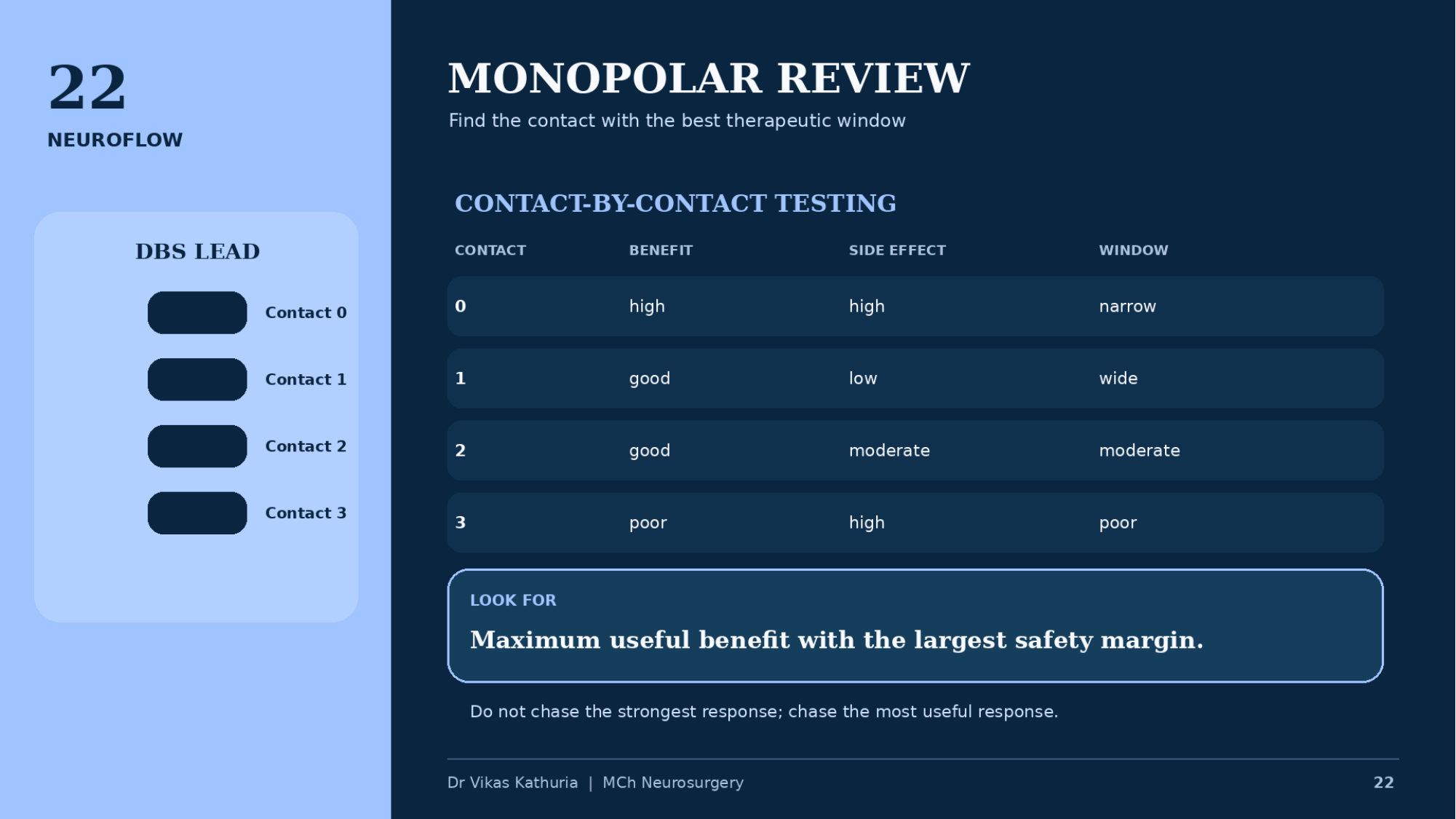
- 2 Monopolar review — Contact × amplitude × response
- 3 Therapeutic window — Benefit threshold vs side-effect threshold
- 4 Optimization — Amplitude • pulse width • frequency • configuration
- 5 Follow-up — Symptoms change → settings evolve
- KEY MESSAGE • Implantation creates the opportunity; programming creates the therapy.
- Dr Vikas Kathuria | MCh Neurosurgery
Why this slide matters
Once the lead is fixed, every remaining degree of freedom is electrical. Programming is where a technically good operation becomes — or fails to become — a treatment.
Core concepts
The lead position is now a constant
ESTABLISHEDContact, field, response and refinement are the only variables left. That is why lead position had to be right, and why it must be known.
Programming is a loop, not an event
ESTABLISHEDSymptoms change, medication changes and the disease progresses, so settings evolve across years of follow-up.
Start from a clinical goal
ESTABLISHEDA setting can only be judged against a stated goal.
- Tremor
- Rigidity
- Bradykinesia
- Dyskinesia
- Gait
- Function and quality of life
Surgical / clinical pearl
- Implantation creates the opportunity; programming creates the therapy.
- If nobody wrote down the goal, nobody can say whether the session helped.
- Change one variable at a time or the result cannot be interpreted.
Image placeholder
21A PROGRAMMING SESSION — INSERT AUTHENTIC IMAGE
Real clinical image required
Audience question
AUDIENCE QUESTIONESTABLISHEDWhat is the first thing you do at a first programming session?
Diagram
The programming loop
Original slide framework, reproduced as supplied.
Speaker notes — 12 teaching points (hidden by default)
- Open by asking how many in the room programme their own patients — the split shapes the discussion.
- Established: a fixed lead means all remaining control is electrical.
- Practical implication: book enough time; a rushed first session produces settings nobody can interpret later.
- Prevention strategy: record the goal, the baseline examination and the medication state before touching the device.
- Diagnostic pitfall: attributing a poor first session to the lead before the programming space has been explored.
- Management consideration: agree who owns follow-up programming before the patient leaves.
- Evidence limitation: programming protocols vary between centres; the method matters more than the local recipe.
- Common misconception: that programming is technical support rather than clinical practice.
- Question for fellows: what would you document so a colleague could continue this in five years?
- Difficult decision point: a patient with unrealistic expectations at the first session.
- Multidisciplinary trigger: involve the specialist nurse or therapist early in the loop.
- Close on the original key message.
References
- Volkmann J, Moro E, Pahwa R. Basic algorithms for the programming of deep brain stimulation in Parkinson's disease. Mov Disord. 2006;21(Suppl 14):S284-S289.
- Koeglsperger T, Palleis C, Hell F, Mehrkens JH, Bötzel K. Deep brain stimulation programming for movement disorders: current concepts and evidence-based strategies. Front Neurol. 2019;10:410.
- Picillo M, Lozano AM, Kou N, Puppi Munhoz R, Fasano A. Programming deep brain stimulation for Parkinson's disease: the Toronto Western Hospital algorithms. Brain Stimul. 2016;9(3):425-437.