Module 08

Sensing → Adaptive DBS → Future Precision Neuromodulation

Slides 36–40 | From open-loop stimulation to biomarker-driven, state-dependent and potentially adaptive DBS

Original lecture slides 36–40 · Module 08 / 10

“The next step in DBS is not simply more stimulation. It is better information about when, where and why to stimulate.”

Open loop → closed loop

  1. 01SENSING
  2. 02BIOMARKER
  3. 03STATE DETECTION
  4. 04ADAPTIVE CONTROL
  5. 05REAL-TIME / STATE-DEPENDENT STIMULATION

Closed-loop DBS requires a reliable biomarker, reliable sensing, state detection, a stimulation control algorithm, safety constraints and clinical validation. Traditional DBS remains: clinical assessment → programming → fixed settings → follow-up → manual optimization.

Learning objectives

By the end of this module you should be able to

  1. 01Contrast the traditional DBS pathway with the emerging sensing-driven paradigm
  2. 02Describe what a sensing-capable implanted system can measure
  3. 03Qualify beta-band activity as a studied biomarker rather than a disease signature
  4. 04Trace the signal pipeline from neural activity to clinical interpretation
  5. 05Distinguish sensing only, sensing plus analysis, and closed-loop control
  6. 06State the properties of a useful DBS biomarker
  7. 07Define adaptive DBS and diagram its feedback loop
  8. 08Compare open-loop and closed-loop stimulation
  9. 09List the potential advantages of adaptive DBS without overstating them
  10. 10Enumerate the principal challenges facing closed-loop systems
  11. 11Integrate five information streams into a single clinical decision
  12. 12Position AI as decision support rather than decision replacement
  13. 13Place each DBS technology in an honest evidence category
  14. 14Explain why increasing technology does not automatically improve outcome
  15. 15Define precision clinically using the five levels of precision

Original lecture slides

Slides 36–40

The slides below are reproduced exactly as delivered. Everything outside the slide panel is added study material.

Slide 36

Slide 36

Original lecture slide

100%
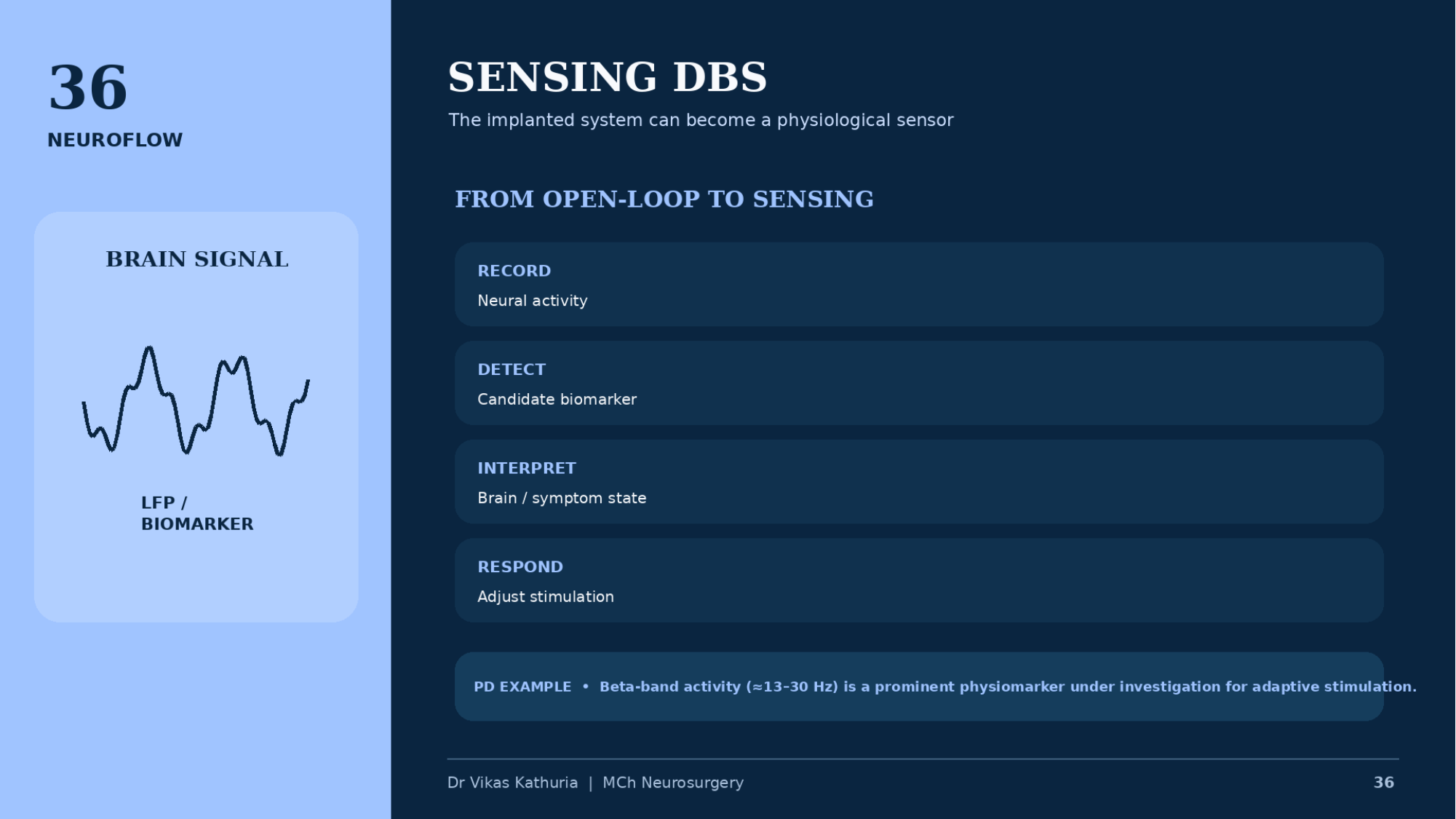
Original lecture slide 36, Sensing DBS, showing a brain signal trace labelled LFP/biomarker beside the record, detect, interpret and respond sequence

SENSING DBS

  • The implanted system can become a physiological sensor
  • BRAIN SIGNAL
  • LFP / BIOMARKER
  • FROM OPEN-LOOP TO SENSING
  • RECORD — Neural activity
  • DETECT — Candidate biomarker
  • INTERPRET — Brain / symptom state
  • RESPOND — Adjust stimulation
  • PD EXAMPLE • Beta-band activity (≈13-30 Hz) is a prominent physiomarker under investigation for adaptive stimulation.
  • Dr Vikas Kathuria | MCh Neurosurgery
Slide 37

Slide 37

Original lecture slide

100%
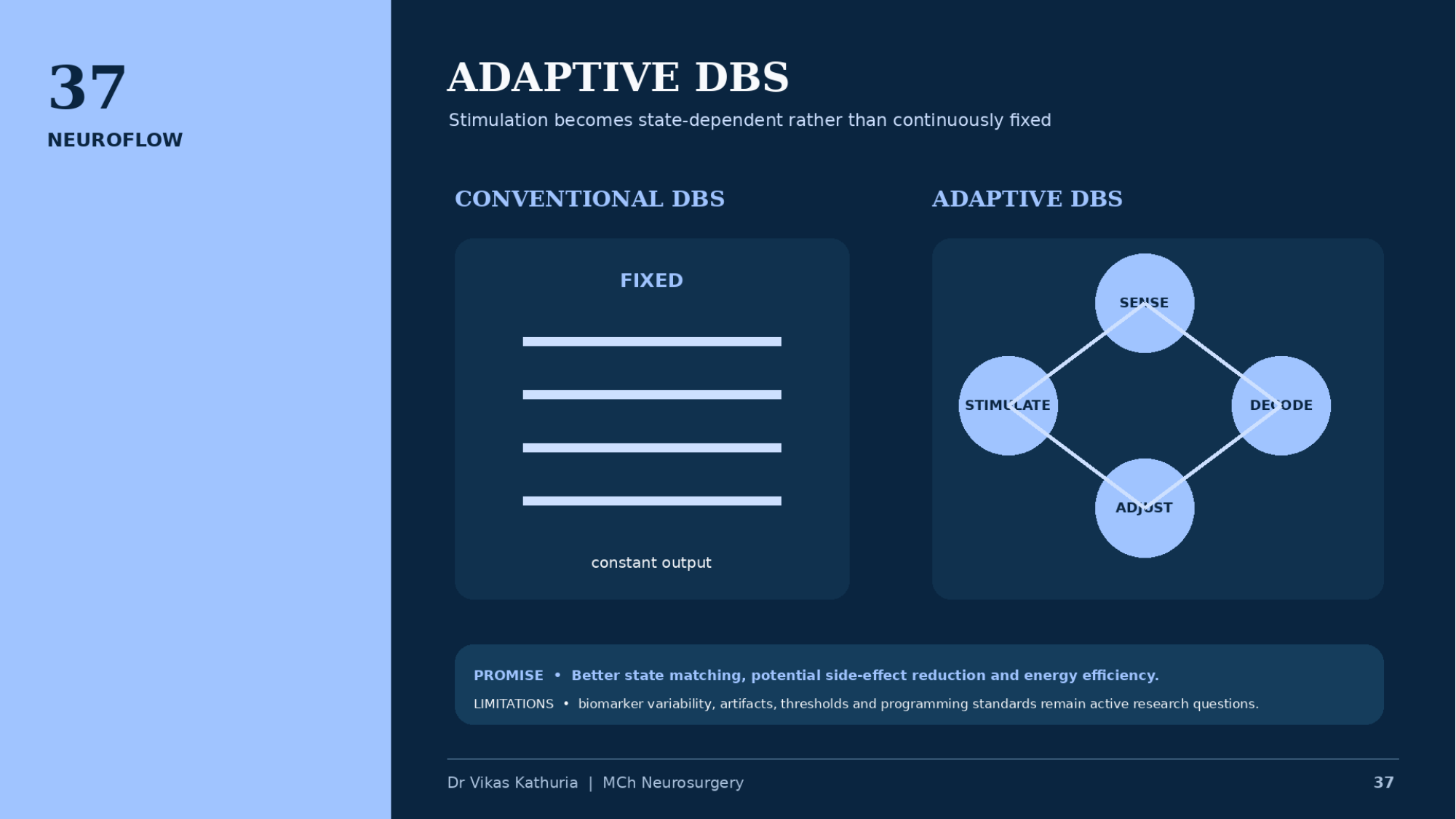
Original lecture slide 37, Adaptive DBS, comparing fixed conventional output with a sense, decode, adjust, stimulate loop

ADAPTIVE DBS

  • Stimulation becomes state-dependent rather than continuously fixed
  • CONVENTIONAL DBS
  • FIXED
  • constant output
  • ADAPTIVE DBS
  • SENSE
  • DECODE
  • ADJUST
  • STIMULATE
  • PROMISE • Better state matching, potential side-effect reduction and energy efficiency.
  • LIMITATIONS • biomarker variability, artifacts, thresholds and programming standards remain active research questions.
  • Dr Vikas Kathuria | MCh Neurosurgery
Slide 38

Slide 38

Original lecture slide

100%
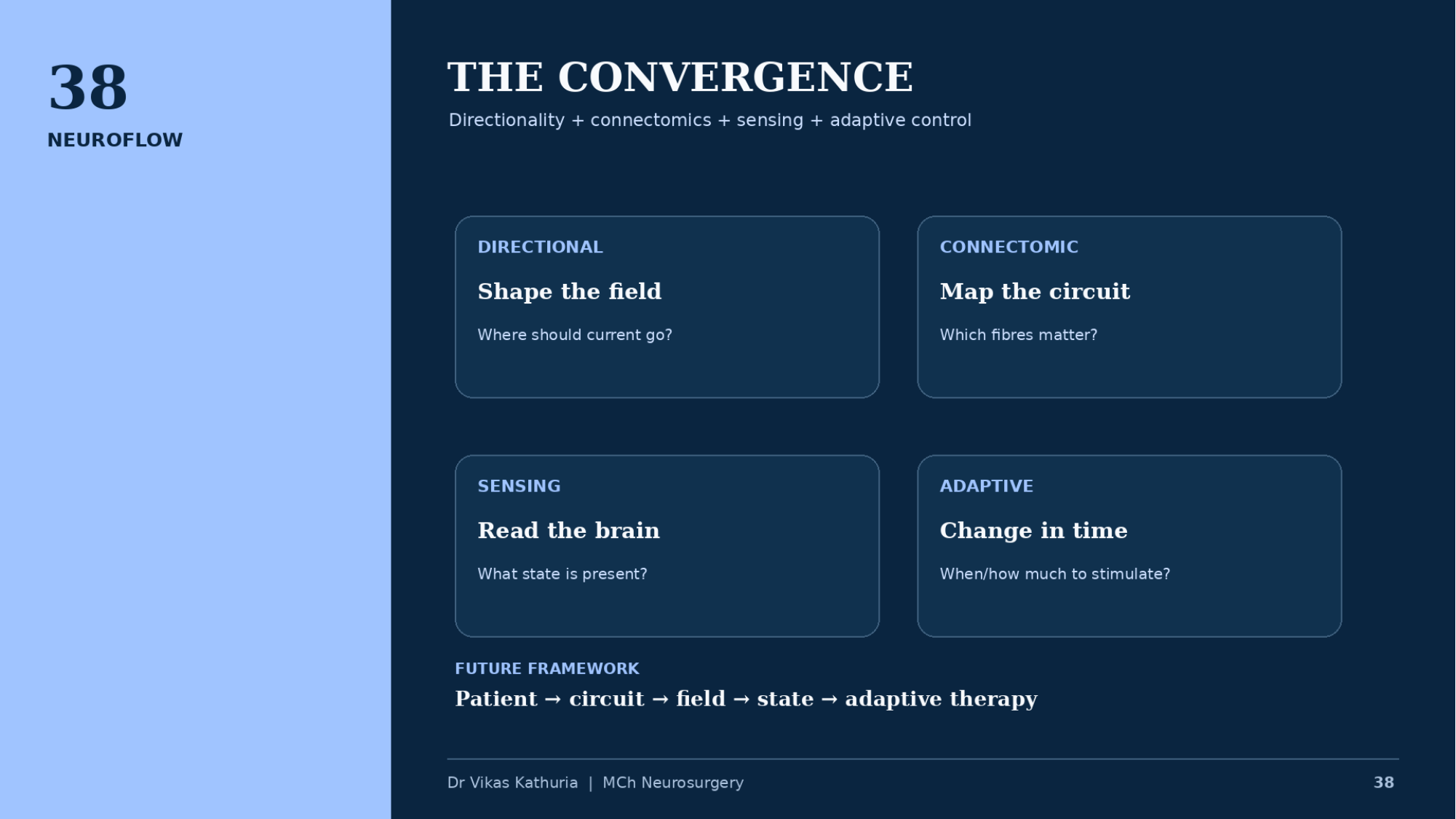
Original lecture slide 38, The convergence, with four cards for directional, connectomic, sensing and adaptive approaches and a future framework line

THE CONVERGENCE

  • Directionality + connectomics + sensing + adaptive control
  • DIRECTIONAL — Shape the field — Where should current go?
  • CONNECTOMIC — Map the circuit — Which fibres matter?
  • SENSING — Read the brain — What state is present?
  • ADAPTIVE — Change in time — When/how much to stimulate?
  • FUTURE FRAMEWORK
  • Patient → circuit → field → state → adaptive therapy
  • Dr Vikas Kathuria | MCh Neurosurgery

Slide 39

Slide 39

Original lecture slide

100%
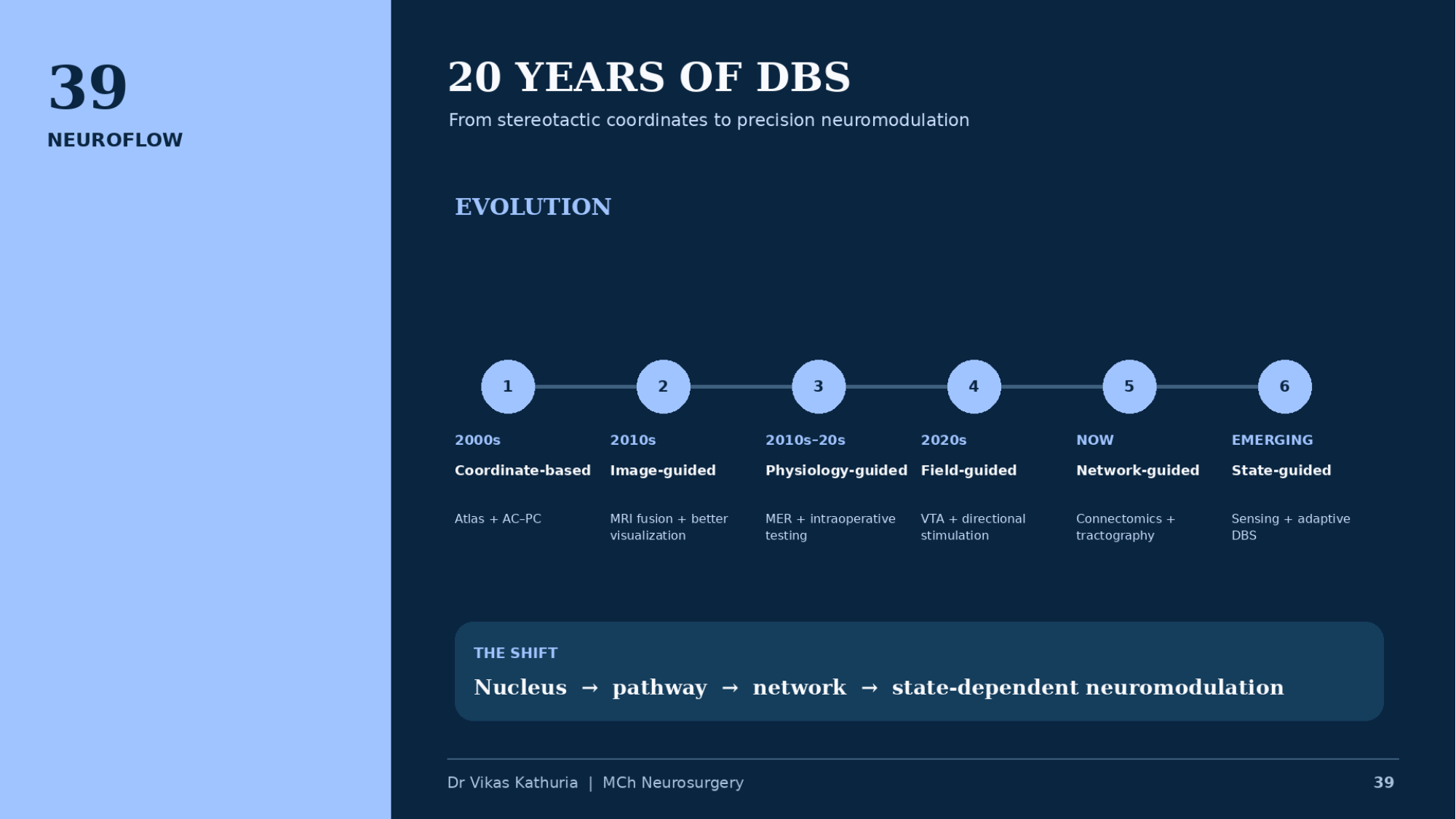
Original lecture slide 39, 20 years of DBS, showing a six-stage evolution timeline from coordinate-based to state-guided DBS

20 YEARS OF DBS

  • From stereotactic coordinates to precision neuromodulation
  • EVOLUTION
  • 1 · 2000s · Coordinate-based · Atlas + AC-PC
  • 2 · 2010s · Image-guided · MRI fusion + better visualization
  • 3 · 2010s–20s · Physiology-guided · MER + intraoperative testing
  • 4 · 2020s · Field-guided · VTA + directional stimulation
  • 5 · NOW · Network-guided · Connectomics + tractography
  • 6 · EMERGING · State-guided · Sensing + adaptive DBS
  • THE SHIFT
  • Nucleus → pathway → network → state-dependent neuromodulation
  • Dr Vikas Kathuria | MCh Neurosurgery

Slide 40

Slide 40

Original lecture slide

100%
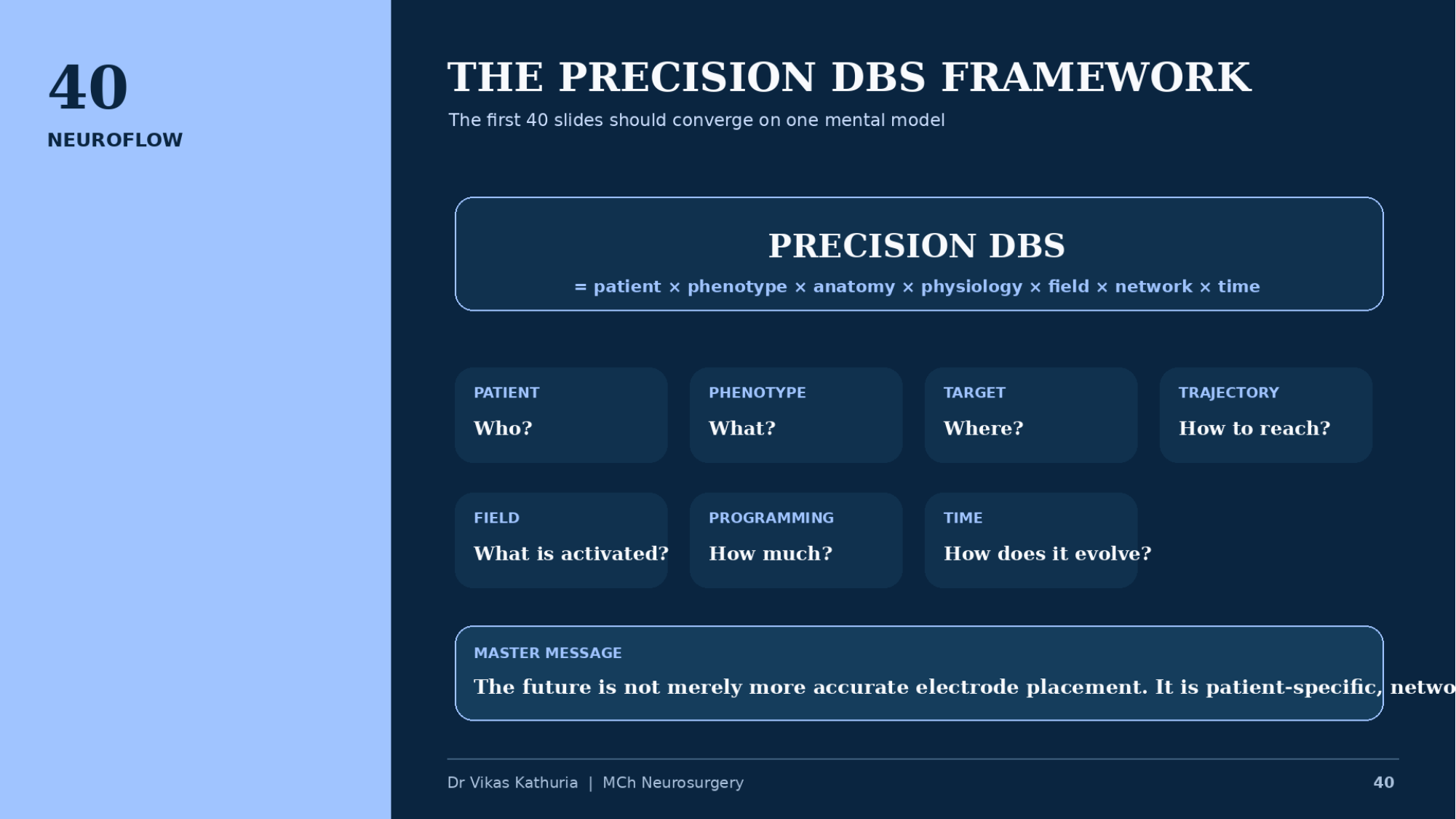
Original lecture slide 40, The precision DBS framework, defining precision DBS as patient by phenotype by anatomy by physiology by field by network by time

THE PRECISION DBS FRAMEWORK

  • The first 40 slides should converge on one mental model
  • PRECISION DBS
  • = patient × phenotype × anatomy × physiology × field × network × time
  • PATIENT — Who?
  • PHENOTYPE — What?
  • TARGET — Where?
  • TRAJECTORY — How to reach?
  • FIELD — What is activated?
  • PROGRAMMING — How much?
  • TIME — How does it evolve?
  • MASTER MESSAGE
  • The future is not merely more accurate electrode placement. It is patient-specific, network-aware, state-dependent neuromodulation.
  • Dr Vikas Kathuria | MCh Neurosurgery

Keyboard: ← previous slide · → next slide · O original slide · S study mode

Expanded study material

Sensing, control, convergence and precision

Supplementary material written around the immutable original slides.

Interactive principle

Sensing pipeline

Seven stages from neural activity to clinical interpretation.

The physiological source. What reaches the electrode is already shaped by distance, orientation and tissue properties.

Biomarker ↔ symptom / state — correlation must be validated

Essential distinction

Sensing ≠ adaptive DBS

Level 1 — sensing only

Measure neural signals.

Level 2 — sensing + analysis

Identify physiological states.

Level 3 — closed-loop control

Use sensed information to modify stimulation.

Interactive principle

Biomarker explorer

What a feature must satisfy before it is allowed to drive therapy.

The feature reflects a mechanism plausibly related to the symptom being treated.

Beta-band activity (approximately 13–30 Hz) has been studied as a biomarker associated with motor state in Parkinson disease. It is not a disease signature, and its relationship to symptoms varies with brain state, medication, movement, electrode location, phenotype, stimulation parameters and sensing methodology.

Interactive principle

Open loop versus closed loop

The same patient, two control architectures.

  1. 01Programmer
  2. 02Fixed settings
  3. 03Patient
  4. 04Clinical response
  5. 05Next clinic visit

“Fixed settings persist until the next clinical decision.”

Conceptual closed-loop model — safety + clinical validation + programming + physiology surround the loop

Expandable limitations

Ten challenges for adaptive DBS

A closed loop is only as good as its sensor, model and control rule.

Does the feature track the clinical state in this patient, at this target, under stimulation?

Evidence hierarchy

Where each technology currently sits

Categories are not permanent; each moves as evidence accumulates.

ESTABLISHED

  • Conventional DBS
  • Anatomical targeting
  • Clinical programming

SUPPORTED

  • Neural sensing
  • Image-based lead localization
  • VTA modelling
  • Selected pathway analysis

EMERGING

  • Connectomic targeting
  • Biomarker-guided programming
  • Adaptive DBS
  • AI-assisted optimization

EXPERIMENTAL / FUTURE

  • Fully autonomous DBS optimization
  • Broad disease-state prediction
  • Generalized patient-specific connectomic targeting

Critical thinking

More data ≠ better decision

  1. 01DATA
  2. 02INFORMATION
  3. 03INTERPRETATION
  4. 04DECISION
  5. 05PATIENT OUTCOME

The value of technology is determined by whether it improves the decision and ultimately the patient outcome.

Decision hierarchy

When is a technology justified?

Technology is justified when it changes a clinically important decision.

  1. 01Clinical question
  2. 02What information is needed?
  3. 03What technology provides it?
  4. 04How reliable is that information?
  5. 05Does it change the decision?
  6. 06Does it improve patient outcome?

Precision without overengineering

Precision does not mean

  • Maximum imaging
  • Maximum data
  • Maximum technology
  • Maximum stimulation
  • Maximum algorithmic complexity

Precision means

The right information for the right decision in the right patient.

Cross-links

Where this material connects

Each link opens the related slide elsewhere in the curriculum.

Final faculty question

What is the ultimate target of DBS?

Reveal the answer one line at a time.

    From coordinates → to circuits → to states → to adaptive therapy

    The future of DBS is not just placing a lead more precisely. It is understanding what to modulate, when to modulate it, and how to adapt the therapy to the patient.

    Deep study material

    Expanded study material

    Conventional DBS, anatomical targeting and clinical programming

    ESTABLISHED

    These remain the established foundation of practice.

    Neural sensing

    SUPPORTED

    Substantial research support, increasingly incorporated into investigational and commercial platforms. The clinical value of a particular biomarker depends on indication, target, signal quality, patient and control strategy.

    Image-based lead localization, VTA modelling and selected pathway analysis

    SUPPORTED

    Supported as research and programming tools.

    Adaptive DBS

    EMERGING

    Important proof-of-concept and clinical feasibility have been demonstrated, particularly in Parkinson disease research. Biomarkers vary, optimal control strategies remain under investigation, long-term comparative evidence is limited and programming standards are evolving.

    Connectomic targeting, biomarker-guided programming and AI-assisted optimization

    EMERGING

    Active areas of development that are not yet routine standard of care.

    Fully autonomous DBS optimization, broad disease-state prediction, generalized patient-specific connectomic targeting

    EXPERIMENTAL

    Research directions rather than clinical practice. Categories are not permanent: each technology moves as evidence accumulates.

    Anatomy

    Anatomy

    Expanded study material for this section is written once the original slides for this module are supplied.

    Surgical principles

    Surgical principles

    Expanded study material for this section is written once the original slides for this module are supplied.

    Physiology

    Physiology

    Expanded study material for this section is written once the original slides for this module are supplied.

    Imaging

    Imaging

    Expanded study material for this section is written once the original slides for this module are supplied.

    Programming

    Programming

    Expanded study material for this section is written once the original slides for this module are supplied.

    Image placeholders

    Images required for this module

    Each placeholder states the image type, what is required, why it teaches and where a legitimate source should come from. No clinical image is fabricated.

    Image placeholder

    MODULE 08 SENSING WORKFLOW — INSERT AUTHENTIC IMAGE

    Real clinical image required

    Image typeSensing / LFP spectrogram
    DescriptionAuthentic sensing workflow illustration or recording, with permission.
    Clinical purposeSupport fellowship-level interpretation without fabricating recordings, patient data or trial results.
    Suggested sourceINSERT AUTHENTIC PUBLISHED / INSTITUTIONAL IMAGE HERE (licensing confirmed)
    Copyright statusSource and reproduction rights must be confirmed before use.
    CaptionTo be written with the final image
    AssociationModule 08 · Slide 36

    Image placeholder

    MODULE 08 PRECISION DBS WORKFLOW — INSERT AUTHENTIC IMAGE

    Real clinical image required

    Image typeSchematic / diagram
    DescriptionOriginal educational schematic of the complete precision loop.
    Clinical purposeSupport fellowship-level interpretation without fabricating recordings, patient data or trial results.
    Suggested sourceINSERT AUTHENTIC PUBLISHED / INSTITUTIONAL IMAGE HERE (licensing confirmed)
    Copyright statusSource and reproduction rights must be confirmed before use.
    CaptionTo be written with the final image
    AssociationModule 08 · Slide 40

    THE EVOLUTION OF DBS

    01

    Anatomy — “Where?”

    02

    Physiology — “What is happening?”

    03

    Imaging — “Where is the lead?”

    04

    VTA — “Where does the field extend?”

    05

    Connectomics — “Which pathway / network?”

    06

    Sensing — “What state is the brain in?”

    07

    Adaptive DBS — “When should stimulation change?”

    08

    Precision DBS — “What is right for this patient now?”

    1. ANATOMY
    2. PHYSIOLOGY
    3. IMAGING
    4. VTA
    5. CONNECTOMICS
    6. SENSING
    7. ADAPTIVE DBS
    8. PRECISION NEUROMODULATION

    PRECISION NEUROMODULATION IS THE INTEGRATION OF ANATOMY, PHYSIOLOGY, ELECTRICAL FIELD, NETWORK, NEURAL STATE AND CLINICAL PHENOTYPE — NOT THE USE OF TECHNOLOGY FOR ITS OWN SAKE.

    Clinical pearls

    • Sensing is not adaptive DBS; only closed-loop control changes stimulation automatically.
    • No single biomarker is universally valid across indication, target and patient.
    • Beta activity is a studied correlate of motor state, not a disease signature.
    • A closed loop is only as good as its sensor, model and control rule.
    • Adaptive DBS is feasible and promising, not universally superior.
    • Computational tools are decision support, not decision replacement.
    • Eras of DBS layered onto each other; the fundamentals remain.
    • Technology is justified when it changes a clinically important decision.
    • More data does not equal a better decision.
    • Precision is the right information for the right decision in the right patient.

    Common errors

    • Describing a sensing-capable device as adaptive DBS.
    • Reading beta power as a direct measure of symptom severity.
    • Presenting adaptive DBS as standard of care for all patients.
    • Trusting the most sophisticated modality when streams disagree.
    • Portraying AI as autonomous surgical or programming decision-making.
    • Assuming intermittent stimulation automatically saves energy.
    • Ordering more investigation without asking which decision it changes.

    Take-home message

    FROM COORDINATES → TO CIRCUITS → TO STATES → TO ADAPTIVE THERAPY.THE FUTURE OF DBS IS NOT JUST PLACING A LEAD MORE PRECISELY. IT IS UNDERSTANDING WHAT TO MODULATE, WHEN TO MODULATE IT, AND HOW TO ADAPT THE THERAPY TO THE PATIENT.

    1. DATA
    2. INFORMATION
    3. INTERPRETATION
    4. DECISION
    5. PATIENT OUTCOME

    References

    Evidence supporting this module

    1. Little S, Pogosyan A, Neal S, et al. Adaptive deep brain stimulation in advanced Parkinson disease. Ann Neurol. 2013;74(3):449-457.
    2. Oehrn CR, Cernera S, Hammer LH, et al. Chronic adaptive deep brain stimulation versus conventional stimulation in Parkinson's disease: a blinded randomized feasibility trial. Nat Med. 2024;30(11):3345-3356.
    3. Connectomic deep brain stimulation for neurological and psychiatric disorders. Nat Rev Neurol. 2025. PMID 40903613.
    4. Horn A, Reich M, Vorwerk J, et al. Connectivity predicts deep brain stimulation outcome in Parkinson disease. Ann Neurol. 2017;82(1):67-78.
    5. Horn A, Li N, Dembek TA, et al. Lead-DBS v2: towards a comprehensive pipeline for deep brain stimulation imaging. Neuroimage. 2019;184:293-316.
    6. Butson CR, Cooper SE, Henderson JM, McIntyre CC. Patient-specific analysis of the volume of tissue activated during deep brain stimulation. Neuroimage. 2007;34(2):661-670.
    7. Koeglsperger T, Palleis C, Hell F, Mehrkens JH, Bötzel K. Deep brain stimulation programming for movement disorders: current concepts and evidence-based strategies. Front Neurol. 2019;10:410.
    8. Okun MS. Deep-brain stimulation for Parkinson's disease. N Engl J Med. 2012;367(16):1529-1538.
    9. Bronstein JM, Tagliati M, Alterman RL, et al. Deep brain stimulation for Parkinson disease: an expert consensus and review of key issues. Arch Neurol. 2011;68(2):165-171.
    10. Deuschl G, Schade-Brittinger C, Krack P, et al. A randomized trial of deep-brain stimulation for Parkinson's disease. N Engl J Med. 2006;355(9):896-908.

    “PRECISION NEUROMODULATION IS THE INTEGRATION OF ANATOMY + PHYSIOLOGY + ELECTRICAL FIELD + NETWORK + NEURAL STATE + CLINICAL PHENOTYPE — NOT THE USE OF TECHNOLOGY FOR ITS OWN SAKE.”

    Next module · 09Complications → Difficult Clinical Problems